

Planning Across Two Inheritance Systems: Key Differences Between Japan and the U.S.
Many international families living in Japan own assets in both Japan and the United States.
As explained in our previous article, Japanese assets and U.S. assets may ultimately be governed by different legal systems and require different legal procedures.
For that reason, understanding how each country administers an estate is just as important as understanding which country's inheritance law applies.
This article compares the inheritance procedures in Japan and the United States, explaining why understanding both systems is an essential part of cross-border estate planning.
New to this series? We recommend reading
Cross-Border Inheritance: Why One Country's Law Isn't the Whole Story
first. It explains how Japan determines the applicable inheritance law, how renvoi (反致) works, and why Japanese and U.S. assets may ultimately follow different legal procedures.
Note
This article assumes that the deceased left valid and appropriately coordinated wills.
For many international families, this may involve separate wills for Japan and the United States.
Without appropriate estate planning, inheritance procedures can become significantly more complicated. We'll examine those situations in the next article.
Quick Summary
Japan and the United States follow fundamentally different inheritance systems.
Probate is common in the United States but does not exist in Japan.
Many Americans plan their estates to reduce or avoid probate where appropriate.
For many international families, separate but carefully coordinated wills for each country are highly recommended.
Table of Contents
1. U.S. vs. Japan — Two Different Ways of Thinking
2. How Probate Works in the United States
3. Wills Play Different Roles
4. Administering a Cross-Border Estate
5. Q&A
6. Wrap Up
1.U.S. vs. Japan — Two Different Ways of Thinking
Although both Japan and the United States recognize wills, they administer an estate in fundamentally different ways.
The table below summarizes some of the key differences between the two inheritance systems.
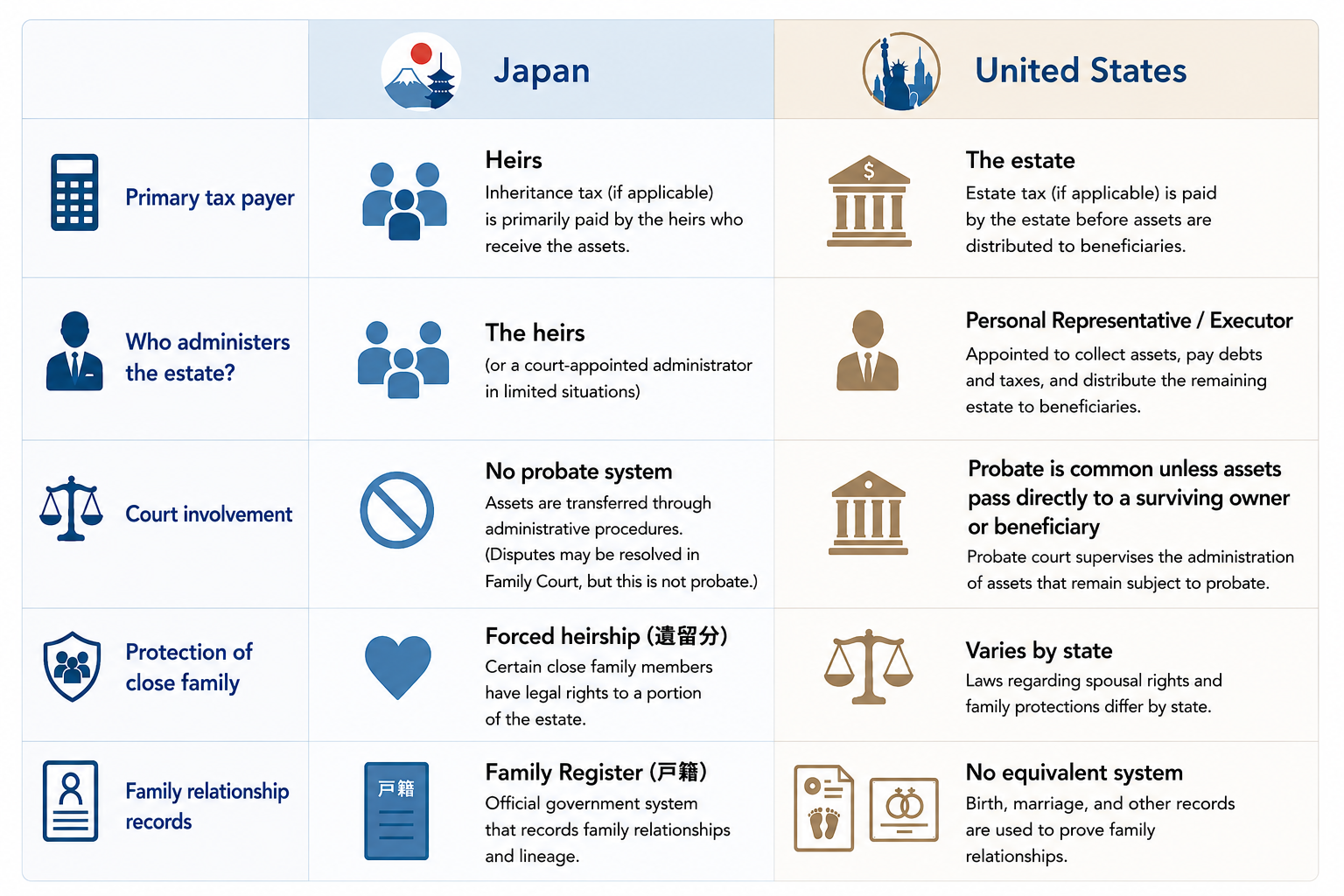
Notes
1. Japan: No General Probate System
Japan does not have a general probate system comparable to that of the United States.
However, if a Holographic Will (自筆証書遺言) is kept at home rather than deposited with the Legal Affairs Bureau (法務局), it generally must undergo Family Court validation (検認) before many financial institutions or the Legal Affairs Bureau will accept it. This court procedure is not probate and does not determine whether the will itself is legally valid.
2. U.S. Probate Is Limited to U.S. Assets
A U.S. Personal Representative (Executor) administers U.S.-situs assets under the applicable U.S. state law.
They cannot directly transfer Japanese real estate, release Japanese bank accounts, or complete inheritance procedures for assets located in Japan. Those assets generally require Japanese legal procedures, as explained in the previous article.
While you cannot change the legal framework, understanding how Japan and the United States administer an estate will help you make more informed estate planning decisions.
2. How Probate Works in the United States
Probate is the legal process through which a court supervises the administration of a deceased person's estate.
Depending on the circumstances, the court may confirm the validity of the will, appoint a Personal Representative(commonly called an Executor when named in a will), protect the rights of creditors, and oversee the distribution of the estate.
Once appointed, the Personal Representative has legal authority to administer the estate.
Because probate is governed by state law, the required procedures vary from state to state. In some cases, if the deceased owned real estate in a different state from the primary probate proceeding, a separate Ancillary Probate may also be required for that property.
For many Japanese readers, this process is unfamiliar because Japan does not have a comparable probate system.
Instead, inheritance procedures are generally carried out by the heirs through administrative procedures using documents such as the Family Register (戸籍), wills (where applicable), and other required records.
As a result, international families are often surprised to learn that owning assets in the United States may require probate proceedings, even if the deceased and all heirs live in Japan.
Not Every U.S. Estate Goes Through Probate
It is important to note that not every U.S. estate requires probate.
Many Americans structure their estates so that assets pass directly to the surviving owner or named beneficiary.
Common examples include jointly owned property, bank and brokerage accounts with Payable-on-Death (POD) or Transfer-on-Death (TOD) designations, retirement accounts, life insurance policies, and assets held in a Revocable Living Trust.
When assets are structured this way and there are no disputes, some—or even all—of the estate may pass without formal probate proceedings.
Cross-Border Planning Reminder
Many U.S. estate planning techniques work well under U.S. law. However, they may produce different Japanese inheritance or gift tax consequences. Before implementing any cross-border estate planning strategy, consult qualified legal and tax professionals familiar with both U.S. and Japanese law.

3. Wills Play Different Roles
Although both Japan and the United States recognize wills, they play different roles in each country's inheritance system.
Japan
In Japan, a will primarily determines who inherits which assets.
A valid will generally overrides the statutory order of inheritance. However, certain close family members may still have the right to claim their reserved portion (遺留分) if they choose to exercise that right.
A Japanese will may also appoint a Will Executor (遺言執行者). However, that role is generally much narrower than that of a U.S. Personal Representative.
United States
In the United States, a will does more than express the deceased's wishes regarding the distribution of assets.
It also typically nominates a Personal Representative (Executor) to administer the estate through probate. The court generally confirms that appointment before the Executor begins acting on behalf of the estate.
Although a valid will is generally respected, it may still be contested in court.
Cross-Border Estate Planning
For many international families with assets in both Japan and the United States, preparing separate, carefully coordinated wills is vital.
A dedicated Japanese will allows Japanese assets to be administered directly through Japanese legal procedures. For example, a Japanese judicial scrivener (司法書士) generally cannot use a U.S. will or U.S. trust document by itself to register ownership of Japanese real estate at the Legal Affairs Bureau (法務局).
Likewise, a U.S. will or Revocable Living Trust can address U.S. assets under U.S. law without delaying their administration while Japanese procedures are completed.
When separate wills are prepared, they must be carefully coordinated so that each document complements, rather than conflicts with, the other —for example, if they contain inconsistent provisions or broad revocation clauses—one document may unintentionally affect the validity or operation of the other.
Related article
How to Navigate Inheritance, Wills, and Tax in Japan (2026 Edition)
4. Administering a Cross-Border Estate
Good planning can significantly simplify a cross-border estate. However, it cannot eliminate every administrative task.
Consider the couple from the introduction.
After retiring in Japan, they:
reviewed their estate plan;
prepared separate, carefully coordinated wills for Japan and the United States; and
identified professionals in both countries whom their family could contact if necessary.
Later, one spouse passes away.
The planning is complete. Now begins the practical task of administering a cross-border estate.
Family Relationship Documents Still Matter
Even when valid wills are in place, family relationship documents remain important.
Japanese institutions commonly rely on the Family Register (戸籍), while U.S. institutions generally require documents such as birth certificates, marriage certificates, death certificates, court records, or sworn affidavits.
Depending on the circumstances, these documents may be required to administer the estate, confirm the identity or relationship of beneficiaries, or complete inheritance tax procedures.
International families often face additional complexity when there are previous marriages, children living overseas, or family members living in multiple countries.
Keeping these records organized—and knowing where to obtain missing documents—can save your family considerable time and effort.
Distance and Coordination
Administering an estate across two countries presents practical challenges that go beyond legal procedures.
Questions quickly arise, such as:
Can probate be handled from Japan?
Will travel to the United States be necessary?
Can a local attorney represent the estate?
Will original documents need to be mailed internationally?
Who will communicate with financial institutions in English?
Many procedures can now be handled remotely.
Yet, time zone differences alone may require meetings with U.S. attorneys, financial institutions, or other professionals early in the morning or late at night in Japan.
Language, Cost, and Emotional Burden
Language itself can become another challenge. Family members may need to communicate with banks, attorneys, accountants, and government agencies in two different languages, where legal and financial terminology can be difficult to navigate.
Cross-border estate administration also requires more time and expense than a domestic inheritance. Professional fees, court costs, translations, certified copies, notarization, international courier services, and sometimes overseas travel all add to the overall cost.
Most importantly, these responsibilities arise while the family is still coping with the loss of a loved one.
If the surviving spouse is elderly, in poor health, living with dementia, or unable to communicate in the required language, other family members may need to step in and coordinate the entire process.
Every additional country where assets are held can increase the administrative burden on the surviving family.
When practical, reducing the number of jurisdictions in which assets are held is worth serious consideration.
Finally, legal procedures and tax filing deadlines do not always align across countries. Understanding those differences is just as important as understanding the inheritance process itself. We'll explore those timing issues in the future article.

5. Q&A
Q1. Can my Japanese spouse serve as the Executor of my U.S. estate?
A1. Legally, yes in most states, but practically, it can be extremely difficult.
A non-U.S. resident executor may be required to provide financial security (a court bond), may have difficulty opening U.S. estate bank accounts, and may face additional administrative requirements.
Coordinating with a U.S.-based co-executor or estate attorney is often necessary to assist a Japanese spouse.
Q2. If I have a U.S. Revocable Living Trust, do I still need a Japanese will?
A2. Yes. I highly recommend it.
While a U.S. trust can hold U.S. real estate and investment accounts to avoid probate in America, Japanese real estate and Japanese bank accounts cannot easily be transferred into a foreign trust.
Executing a separate Japanese will for your Japan-based assets ensures a smooth transfer without running into foreign trust recognition issues.
Q3 What if a sibling or other family member cannot be located?
A3. Even with a valid will, locating family members can be challenging in an international inheritance.
For example, siblings may have lost contact over the years, family members may live in different countries, or there may be children from previous relationships whose existence or whereabouts need to be confirmed.
In our next article, we'll look at what happens when someone dies without a valid will, where identifying all legal heirs and obtaining their agreement can become significantly more complicated.
6. Wrap Up
You do not need to become an expert in Japanese or U.S. inheritance law.
The more you prepare in advance, the more manageable the inheritance process becomes.
Regardless of the size of your estate, good planning can help reduce uncertainty and avoid unnecessary disputes.
Questions or comments?
If you have a question or would like to share your own experience with cross-border inheritance planning, I'd love to hear from you.
Aki | Japanese | Former Head of HR in Global Finance
With over two decades of experience navigating labor law, residency, and wealth protection in both Tokyo and Chicago, she now provides the "insider’s roadmap" for foreigners planning a stable, high-value long-term life and retirement in Japan.
