

The Cost of a Cross-Border Life: Managing Complexity and Spending Wisely in Japan
This year, my husband and I paid JPY143,000 for professional assistance with a spouse visa renewal, including the JPY5,500 government renewal fee.
Living in Japan as U.S. persons—with ongoing U.S. tax obligations—can create costs that don't appear in a typical household budget.
Some are obvious, such as tax and immigration. Others are part of maintaining a life across two countries: keeping a U.S. phone number, maintaining access to U.S. banking, or paying for professional help.
You can hire professionals to handle everything, but those fees add up quickly. Doing everything yourself, however, can create unnecessary risks.
This article shares some of the lessons we have learned about managing a cross-border life—and its costs—between Japan and the United States.
Quick Summary
You may be paying professionals for tasks you can learn to handle yourself.
Free government support and basic Japanese skills can reduce your dependence on paid help.
A simple personal data baseline can save professional time—and help you make better decisions.
Table of Contents
1. The 5 Drivers of Cross-Border Overhead
2. Learn Enough to Spend—and Decide—Wisely
3. Organize First, Pay Less Later
4. Takeaway: Complexity Breeds Professional Fees
5. Q&A
6. Wrap-Up

1. The 5 Drivers of Cross-Border Overhead
For Americans living in Japan, those costs can come from several directions.
1. Immigration and Administrative Status
Depending on your situation, you may need to budget for:
visa applications and renewals
changes of status
advice on choosing the most appropriate residence status
supporting documents and translations
A quick heads-up:
Immigration application fees in Japan are scheduled to increase significantly from October 1, 2026. For example, the fee for a permanent residence application will increase from JPY10,000 to JPY200,000
The official announcement is available from Japan's Immigration Services Agency.
2. Tax and Financial Administration
This is where cross-border complexity becomes most visible.
Depending on your circumstances, you may need to manage:
Japanese tax returns (there is no joint filing)
U.S. tax returns
foreign financial account reporting
overseas asset reporting
foreign exchange gains and losses
FATCA-related issues
Major life events can add another layer of complexity, including estate planning, wills, inheritance-related tax issues, guardianship, trusts, major asset transfers, and real estate purchases.
One complicated situation can involve multiple documents, multiple professionals, and multiple legal or tax systems.
3. Investment Restrictions and Opportunity Cost
Some cross-border costs never appear as a bill.
They are opportunity costs.
Americans living in Japan need to be particularly careful about certain investment products because of U.S. tax rules, including PFIC considerations.
This can affect decisions involving:
Japanese mutual funds
NISA
iDeCo
other Japanese investment products
retirement and long-term investment planning
A financial product that appears simple and tax-efficient for a Japanese resident may create additional U.S. tax or reporting complications for a U.S. person.
That is why cross-border investment planning should begin before making the investment—not after discovering a reporting problem.

4. Healthcare, Aging, and Senior Care
Healthcare creates another type of cross-border overhead that may become more important over time.
When you are young and healthy, you may be able to manage most medical appointments independently. Basic Japanese, translation tools, or support from family may be enough.
But that ability may change as you age. I think of this as a form of operational fragility.
Possible additional costs can include:
medical interpretation
assistance communicating with family overseas
help navigating Japan's long-term care system
professional support during a serious medical event
Preparation can help reduce unnecessary dependence on emergency support.
Two practical steps are to build relationships with local doctors before a crisis occurs and to understand the basics of Japan's long-term care system before you need it.
5. Maintaining Your U.S. Infrastructure
Living in Japan does not necessarily mean that you can simply close everything in the United States.
Many Americans continue to maintain parts of their U.S. infrastructure, including:
Maintaining U.S. communication, mailing, banking, and financial accounts
Ongoing U.S. tax, financial, and professional administration
Managing U.S. property or other assets
Travel to maintain family and personal connections
Cross-border life is not only about tax codes and visa rules—maintaining access to familiar personal items, U.S. services, and family connections adds a quiet, ongoing layer of expense over 10 or 20 years.
2. Learn Enough to Spend—and Decide—Wisely
Not every cross-border task requires a professional.
DIY is not all or nothing.
Learning from experience
In our own case of visa renewal, after going through the renewal process twice and reviewing the required forms, I now feel comfortable handling a future renewal myself. The upcoming increase in the online renewal fee from JPY5,500 to JPY65,000 is also a strong financial motivation to do so.
Of course, every immigration case is different.
A straightforward renewal with a good record of immigration and tax compliance may be very different from a case involving significant changes or complications.
The important point is that once you understand the process, you can make a better decision about whether professional assistance is still necessary.
I have seen the same approach with tax administration.
One of my friends handles her husband's Japanese tax return online and has also completed the Overseas Asset Report herself. She previously paid around JPY20,000 for professional help with the report.
Again, this does not mean everyone should do the same.
It simply shows that some recurring procedures may become manageable once you understand how they work.
Use Free Official and Local Support
Before paying someone to explain the basics, check the official source.
Government agencies and local offices may provide:
official guidance
online information
consultation services
For example:
National Tax Agency (NTA): Consultation Services
Example of Local Government Consultation Services
Official support cannot replace specialist cross-border tax advice. But for straightforward questions about forms, procedures, or filing requirements, it can be an excellent starting point.
Learn the basics. Use official support. Then decide whether you need a professional.
Improve Your Japanese—Even a Little
Even basic Japanese can make everyday life easier.
Being able to write your name and address, understand basic instructions, and explain your situation can help when dealing with banks, government offices, and other services.
The same applies to healthcare. Knowing key medical and care-related terms can give you more independence.
Build Your Own Basic Knowledge
Understanding the basic rules and the bigger picture can make a significant difference.
Books, YouTube, official websites, and resources such as NavigatorJapan can help you understand the basics before making important decisions.
This knowledge can also help you:
spot unnecessary costs and potential problems earlier
understand basic terms and concepts without starting from zero
use professional consultation time more efficiently
make sure your own priorities and preferences are part of the decision
The goal is to become an informed client.
And that may save both time and money.
I hope NavigatorJapan can be one useful part of that process.
3. Organize First, Pay Less Later
This may be the least exciting part of cross-border planning—but it can also be one of the most valuable.
Professionals charge for expertise, but they also charge for the time required to understand your situation.
If you bring decades of unorganized records to a cross-border professional, you may be paying an expensive specialist to do basic information gathering before they can provide actual advice.
Imagine trying to reconstruct 40 years of USD savings. Before anyone can analyze the tax implications, basic questions may need to be answered:
Which accounts are relevant?
When was the money acquired?
Where did it come from?
Which transactions matter?
What records are available?
But this does not necessarily mean you should reconstruct decades of records on your own before seeking advice.
Depending on the situation, you may not need every historical document.
Before spending significant time reconstructing old records, it may be worth consulting a qualified professional to understand what information is actually needed.
Cross-Border Data Baseline: Key Records to Retain
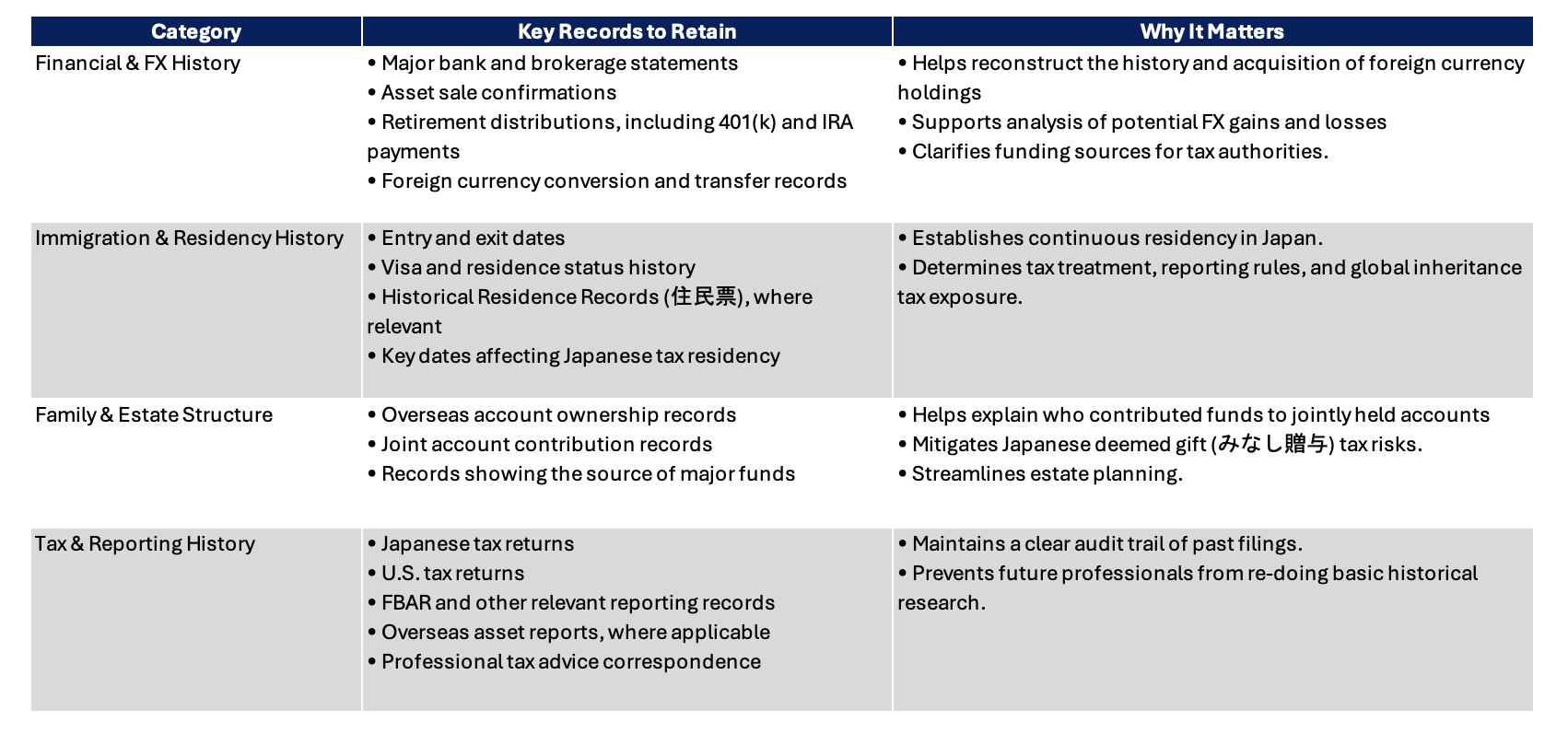
Tip: Use this as an index or baseline. Store original documents securely and record where they can be found.
Your own database does not need to contain every document. It should tell you what exists, where it is, and why it matters.
For people living across borders, maintaining a clear data baseline is part of risk management—and can save time and professional costs when help is needed.
4. Takeaway: Complexity Breeds Professional Fees
One of the key lessons of a cross-border life is this:
Complexity breeds professional fees.
The more accounts, assets, jurisdictions, documents, real estate, and transactions you have, the more time someone may need to understand your situation. You should actively manage complexity.
For example:
Organize and simplify your accounts and services where practical
Avoid financial products you do not understand
Understand your overseas assets before retirement
Think about healthcare and care support before a crisis occurs
The goal is to avoid unnecessary complexity.

5. Q&A
Q. How far back should I reconstruct my "Data Baseline" records?
A: It depends. There is no official number of years that applies to every situation.
Ideally, keep records that help explain the history and source of major assets and foreign currency holdings, including when and how they were acquired.
In reality, reconstructing decades of financial history is not always possible—or necessary. Before spending significant time gathering old records, consider what information is actually relevant to your situation.
For a more detailed discussion, see my related article below.
The same principle applies to your broader Data Baseline: keep the records you have, organize them clearly, and preserve enough information to explain your major assets, transfers, and foreign currency holdings.
Related article:
You Saved in USD for Decades. What Happens When You Convert It to JPY in Japan?
6. Wrap-Up
Living a cross-border life comes with additional costs. Some are unavoidable, but others can be reduced through better preparation, basic knowledge, organization, and strategic use of professional help.
And if you can save some money along the way, you can spend it on yourself and your family instead!
Aki | Japanese | Former Head of HR in Global Finance
I believe building a long-term life in Japan requires seeing the bigger picture.
By understanding how visa, healthcare, taxes, retirement, senior care, inheritance, and family decisions fit together, you can make informed decisions and take calculated risks.
References
Immigration Services Agency of Japan — Revision of Fees for Immigration Procedures
