

Do Not Resuscitate (DNR) in Japan: When Your U.S. Wishes Cross Borders
My parents-in-law in Illinois kept their DNR/POLST form on the refrigerator, where it was easy for both emergency personnel and family members to find and understand their wishes.
That surprised me.
In Japan, however, DNR/POLST is less familiar to many people, and the system does not necessarily work in the same way—particularly during an emergency.
For foreign residents, understanding those differences can be an important part of life planning.
Quick Summary
Japan has no nationwide standardized DNR/DNAR system. National guidance exists, but implementation varies by setting.
A U.S. advance directive, DNR, or POLST does not automatically apply in Japan. Keep it accessible and discuss it with your Japanese healthcare provider.
Make your wishes known in Japan. Discuss them with your doctor, document them locally, and make sure your family knows what you want—especially if they live overseas.
Table of Contents
1. DNR/DNAR in the U.S. and Japan: Similar Purpose, Different Systems
2. Why a DNR/DNAR Order May Not Work as Expected in Japan
3. The Reality in Japan: Where Things Can Fall Through the Cracks
4. What Can You Do Before a Crisis?
5. Q&A
6. Wrap Up
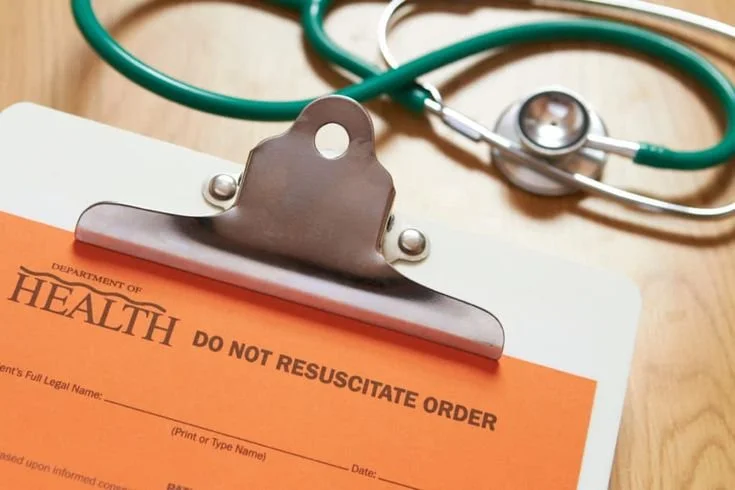
1. DNR in the U.S. and Japan: Similar Purpose, Different Systems
DNR/DNAR and Advance-Care Planning: United States and Japan
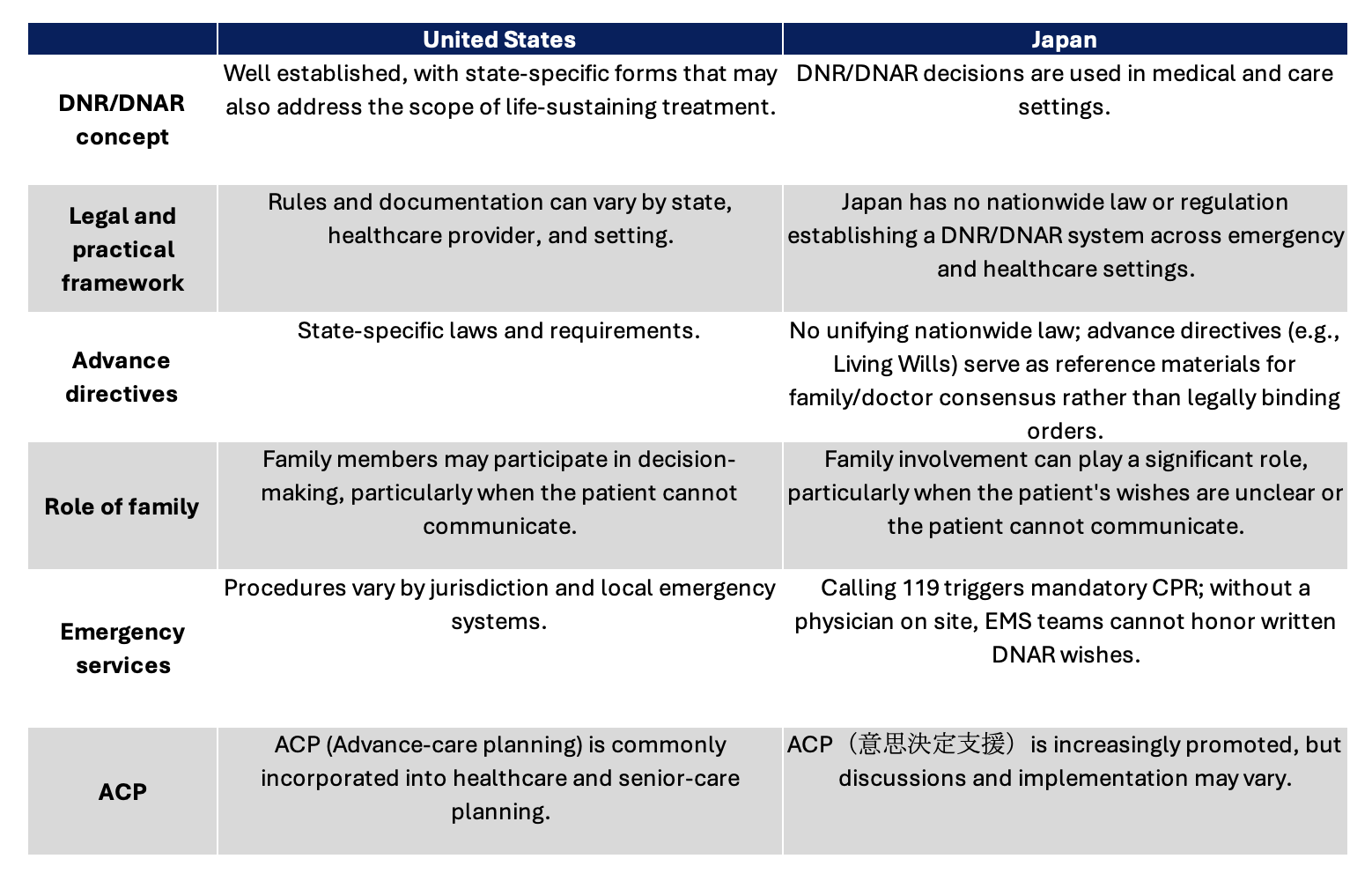
Those practical differences become particularly important during an emergency.
2. Why a DNR/DNAR Order May Not Work as Expected in Japan
Key Point: Without a clear legal framework for DNR/DNAR decisions, healthcare professionals may face legal uncertainty when deciding whether to withhold CPR—adding another layer of difficulty during an emergency.
A 2025 Study Shows the Challenge
A 2025 study at Keio University Hospital looked at 142 patients aged 65 or older who were brought to the emergency department after out-of-hospital cardiac arrest.
Among them:
| Finding | Number |
|---|---|
| Patients studied | 142 |
| Patients with a DNAR order | 23 (16%) |
| DNAR patients who nevertheless received CPR | 6 of 23 (26%) |
| DNAR decisions made by the patient | 7 of 23 (30%) |
| DNAR decisions made by family members | 16 of 23 (70%) |
| Written DNAR orders | 1 of 23 |
The striking finding is that 26% of patients received CPR despite a DNAR order.
This was not an isolated finding. An earlier 2021 study at Kitasato University found that CPR was performed in 43 of 45 cases (95.6%) despite a confirmed DNAR order.
Together, these studies illustrate an important practical point: having a DNR/DNAR order and having that order followed during an emergency are not necessarily the same thing.
Why Can This Happen?
There are several reasons.
1. Legal uncertainty
This can leave healthcare professionals uncertain about the legal consequences of withholding CPR.
2. Wishes may not be documented
A DNR/DNAR decision may be discussed verbally without being formally documented. Even when documentation exists, it may not be immediately available to the medical team responding to an emergency.
3. DNR/DNAR may be understood differently
Japanese medical literature has raised concerns that it may be interpreted more broadly, affecting decisions about other life-sustaining treatments such as intubation or mechanical ventilation.
4. The Patient May Not Decide
When the patient's own wishes have not been clearly expressed, family members may be left to interpret what the patient would have wanted.
5. 119 Starts Resuscitation
If someone calls 119 (medical emergency) after cardiac arrest, emergency responders generally begin life-saving measures.
3. The Reality in Japan: Where Things Can Fall Through the Cracks
Key Point: Japan has national guidance on end-of-life decision-making and is moving toward Advance Care Planning (ACP), but it does not have a nationwide standardized POLST system like some U.S. states.
The emphasis is on dialogue—discussing the person's wishes and values and reflecting them in the medical record or other documentation.
1. Regular Care Creates Opportunities
For people who regularly visit a hospital or clinic, receive home medical care or visiting nursing services, or live in a long-term care facility, there are opportunities to discuss treatment preferences.
These ongoing relationships can help clarify wishes, involve family, and document decisions.
But what happens outside these settings?
Consider someone who is relatively healthy, has never had an end-of-life discussion with their doctor, and suddenly develops a serious heart problem.
For foreign residents, there may be an additional challenge: family members may be living overseas and unable to arrive quickly.
2. What if You Already Have a U.S. Document?
Some Americans living in Japan may already have a U.S. advance directive, DNR/DNAR, or POLST.
Its legal effect in Japan is not automatic.
However, it can still provide important information about the person's wishes and help the Japanese medical team when determining treatment.
For this reason, if you have a U.S. document, bring it with you, keep it accessible, and discuss it with your Japanese healthcare provider before an emergency occurs.
3. DNR/DNAR and “Do Not Treat” Are Not the Same Decision
A DNR/DNAR order concerns whether CPR should be attempted if cardiac arrest occurs.
It does not automatically answer other questions about treatment, such as intubation, mechanical ventilation, hospitalization, or other life-sustaining measures.
The 2025 Keio study illustrates just how specific these decisions can become. In one case, the patient did not want intubation or mechanical ventilation but still wanted other resuscitation measures, including chest compressions and epinephrine.
In an emergency, drawing the line between which treatments a patient wants and does not want can be difficult.
This is one reason POLST-type orders are used in the U.S. They can document not only whether CPR should be attempted, but also broader treatment preferences, such as the level of medical treatment, hospitalization, and mechanical ventilation.
4. Practice Can Vary by Setting
Japan has national guidance encouraging ACP and patient-centered decision-making.
But how DNR/DNAR is discussed, documented, and implemented can still vary by healthcare institution and care setting.
4. What You Can Do Before a Crisis
Key Takeaway: In Japan, healthcare providers will not automatically request end-of-life directives upon admission as they do in the U.S.
To ensure your wishes are honored, you must proactively document your choices, place them into your local medical record, and secure complete family alignment before a crisis occurs.
1. Document Your Wishes with Your Local Medical Team
Unlike U.S. hospitals—which are legally mandated to ask about advance directives—Japanese facilities rarely prompt patients for a POLST or living will upon intake.
Establish a Primary Physician: Or partner with a local clinic doctor or a home medical care team.
Embed Preferences in Your Electronic Medical Record: Request that your specific DNR/DNAR directives record directly within your official Japanese medical chart.
Clarify Local Emergency Protocols: Ask your doctor directly: "If an emergency happens at home on a weekend, what is our established local procedure to inform emergency responders without triggering unwanted CPR?"
2. Talk to Your Family Before a Crisis
Your family should know what you want, why you want it, and where your documents are.
You do not need to anticipate every possible medical scenario. Focus on the decisions that matter most to you:
Quality of life: What level of physical, mobility, or cognitive independence would be acceptable to you?
Treatment limits: Are there treatments you would not want, such as prolonged mechanical ventilation or artificial nutrition?
Who should speak for you: If you cannot communicate, who should explain your wishes to the medical team?
Take charge by documenting your choices locally, aligning your family, and embedding your preferences directly into Japan's healthcare system.

4. Q & A
Q1.What if my family disagrees about my wishes?
A1: This is one reason why communication before a crisis is so important.
Research involving families making proxy DNR/DNAR decisions has shown that family members can experience regret and distress when making decisions without fully understanding the patient's wishes. Do not assume that your spouse, children, or other family members automatically know what you would want.
Q2. Is a DNR/DNAR the same as refusing all medical treatment?
A2: No.
DNR/DNAR refers specifically to not attempting cardiopulmonary resuscitation when cardiac or respiratory arrest occurs. It does not automatically mean that other medical treatment, medication, care, or comfort measures should be stopped. Because these decisions can be complex, discuss the details with your healthcare provider.
5. Wrap-Up
DNR and DNAR directives are familiar concepts to most Americans, but in Japan, they operate under entirely different legal and medical realities.
In Japan, conversations about end-of-life care may not happen until they become necessary. By then, the patient may no longer be able to speak for themselves, leaving family members to make difficult decisions without knowing exactly what the patient wanted.
If you live in Japan, do not wait for the crisis. Talk with your doctor, document your wishes, and make sure your family and the people involved in your care know what you want.
You May Also Find Useful
When Your Spouse Becomes Your Care Plan: Navigating One of Retirement's Biggest Transitions
Your Children Live Overseas: Planning Senior Care in Japan Before a Crisis Occurs
Premium Care Roadmap: Navigating Quality and Optionality in Japanese Senior Living
Aki | Japanese | Former Head of HR in Global Finance
I believe building a long-term life in Japan requires seeing the bigger picture. By understanding how visa, healthcare, taxes, retirement, senior care, inheritance, and family decisions fit together, you can make informed decisions and take calculated risks.
References
Japan’s End-of-Life Decision-Making Guidelines — MHLW
DNAR Orders in Older Adults After Out-of-Hospital Cardiac Arrest in Japan — 2025 Keio Study
DNAR Directives and Emergency Medical Services in Japan — 2021 Sagamihara Study
Patient Participation in DNAR and End-of-Life Discussions — 2021 Study
Japan Geriatrics Society: Position Statement on End-of-Life Care for Older Adults — 2025
