

U.S.–Japan Inheritance Tax: 3 Critical Risks in Cross-Border Estate Planning
A couple of years ago, I learned about a Japanese wife who passed away unexpectedly in Japan. Her American husband was suddenly left to navigate the administrative and tax complexities of a cross-border estate without the benefit of a will.
The experience reminded me of the importance of preparing wills and organizing our family's estate plan.
Over the past three articles, we've explored how Japan and the United States handle cross-border inheritance from a legal and procedural perspective.
Cross-Border Inheritance: Why One Country's Law Isn't the Whole Story
Planning Across Two Inheritance Systems: Key Differences Between Japan and the U.S.
When There Is No Will: Who Makes the Decisions?
In this fourth article, we shift focus to tax and liquidity risk management.
We’ll break down three major structural risks every US–Japan family should understand before a crisis occurs:
Risk 1: Taxing the Deceased vs. Taxing the Heir
Risk 2: Japan May Tax Worldwide Assets
Risk 3: The 10-Month Cash Crunch: Timing and Liquidity
Disclaimer
This article covers common tax and administrative issues for families with assets or members in both Japan and the United States. Cross-border estate rules are highly fact-specific and may depend on residency, visa status, nationality, asset ownership, lifetime gifts, and treaty provisions.
This content is for risk-awareness purposes only and is not legal or tax advice. Consult a qualified professional regarding your specific situation.

Table of Contents
1. Risk 1: Taxing the Deceased vs. Taxing the Heir
2. Risk 2: Japan May Tax Worldwide Assets
3. Risk 3: The 10-Month Cash Crunch: Timing and Liquidity
4. Cross-Border Planning Checklist
5. Q&A
6. Wrap Up
1. Risk 1: Taxing the Deceased vs. Taxing the Heir
The United States and Japan take fundamentally different approaches to inheritance taxation.
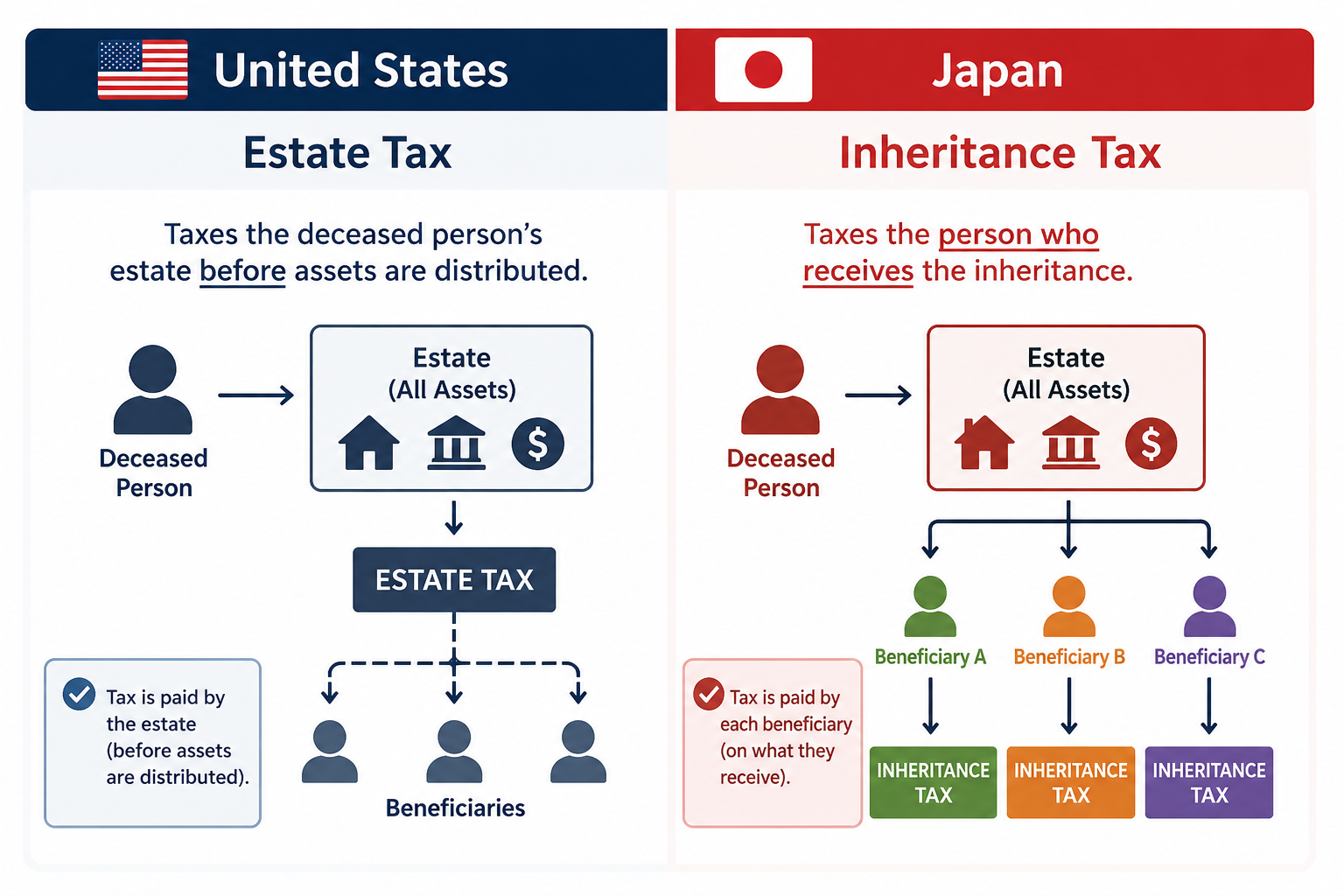
This distinction may sound technical, but it can produce different results for the same family.
U.S. Side: The Estate Is Taxed
For 2026, the federal estate and gift tax exemption is USD15 million per person. Estates below this amount are not subject to the federal estate tax.
This means that many families with ordinary-sized estates may not actually pay U.S. federal estate tax.
NOTE: U.S. Estate Tax Can Include Worldwide Assets
For a U.S. citizen, federal estate tax generally applies to the value of the worldwide assets, including assets located outside the United States. However, inclusion in the taxable estate does not necessarily mean federal estate tax will be owed. The applicable exemption and other rules determine whether tax is ultimately due.
NOTE: State Estate Taxes
Some U.S. states impose their own estate taxes, with thresholds that can be lower than the federal exemption. State estate tax may therefore apply even when no federal estate tax is due.
NOTE: Probate and Estate Tax Are Different
Assets that pass outside probate—such as jointly owned property, beneficiary-designated accounts, or assets held in a revocable trust—may still be included in the U.S. taxable estate.
The Surviving Spouse's Citizenship Matters
When assets pass to a U.S.-citizen surviving spouse, the Unlimited Marital Deduction generally allows qualifying assets to pass without current federal estate tax.
The Non-Citizen Spouse Misconception
A Green Card holder is not automatically treated the same as a U.S. citizen for the Unlimited Marital Deduction.
Japanese Side: The Heir Is Taxed
Japan takes a different approach. Japanese inheritance tax is imposed on the person receiving the inheritance, subject to the applicable Japanese rules.
First, Japan applies a basic deduction to the estate as a whole:
JPY 30 million + JPY 6 million × number of statutory heirs
The amount remaining after this deduction forms the basis for calculating inheritance tax.
NOTE: Japanese inheritance tax is not calculated simply by applying a tax rate to the amount each person actually inherits.
NTA — Inheritance Tax Rates (No. 4155)
Japan also provides important relief for surviving spouses.
Under the Spousal Tax Reduction (配偶者の税額軽減), a surviving spouse generally does not owe inheritance tax on the amount actually inherited up to the greater of:
JPY 160 million, or
the spouse's statutory inheritance share.
These are two different mechanisms: the basic deduction reduces the taxable estate, while the spousal tax reduction reduces the spouse's tax liability.
For international families, the interaction between these rules—and the timing of the estate division—can become particularly important.
We will look more closely at who is subject to Japanese inheritance tax and when Japan can tax worldwide assets in Risk 2.
The USD 0 U.S. Tax Fallacy
This creates an important cross-border risk.
A family may look at the U.S. side and conclude:
"The U.S. estate is below the exemption, so there is no U.S. estate tax. We're fine."
Not necessarily.
The absence of U.S. estate tax does not mean that the inheritance is free from Japanese tax.
For example, an American citizen living in Japan may leave assets in both countries. The U.S. estate may have no federal estate tax because it falls below the applicable exemption. Yet a surviving spouse or other heir may still have a Japanese inheritance tax liability.
If the U.S. estate tax is USD0, there may be little or no U.S. tax available to offset Japanese inheritance tax. A USD 0 U.S. tax bill does not necessarily mean a USD 0 tax bill overall.
2. Risk 2: Japan May Tax Worldwide Assets
Many people assume that Japan only taxes assets located in Japan.
That is not always the case.
Whether Japan taxes only Japanese assets or a person's worldwide assets depends on several factors, including the nationality, residency, and tax status of both the deceased and the heir.
How Japan Determines Taxable Assets
It first determines who is subject to Japanese inheritance tax and the scope of that person's tax liability.
Among the questions that may matter are:
1. Deceased’s Residence: Where lived at the time of death?
2. Heir’s Residence: Where lived when the inheritance took place?
3. Nationality: Does the heir hold Japanese or foreign citizenship?
4. 10-Year Residency History: Did either party hold an address in Japan within the last 10 years?
5. Temporary Foreign Resident Status: Does the heir qualify under the 10-out-of-15-year rule for Table 1 visas?
6. Deceased's Tax Status: Is the deceased classified as a Foreign Deceased or Non-Resident Deceased?
Together, these factors dictate whether Japanese tax applies to your worldwide assets or is strictly limited to Japanese-situs assets.
NTA Guide to the Scope of Japanese Inheritance Tax
(Simplified English version based on the National Tax Agency's guidance P7. )
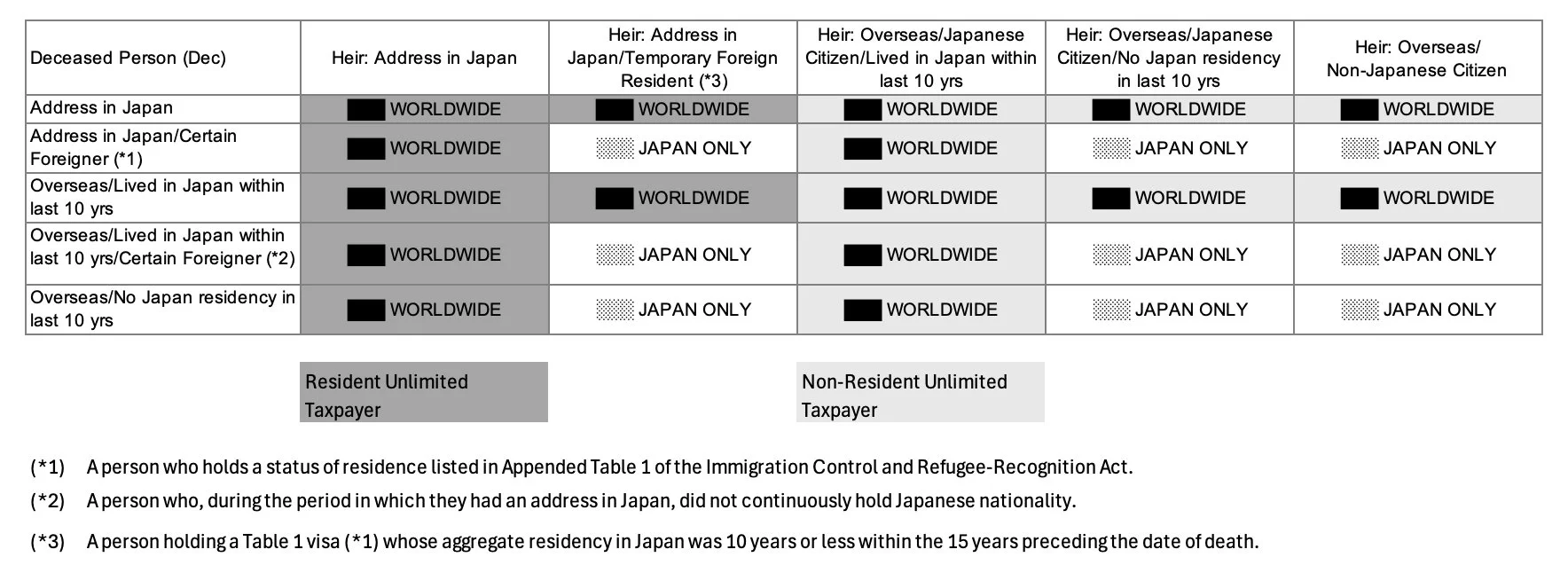
Key Footnotes & Definitions
1. Heir: Address in Japan / Temporary Foreign Resident: A foreign national holding a Table 1 visa (e.g., Work, Instructor, Humanities visa) who has resided in Japan for 10 years or less out of the last 15 years.
(Note: This category generally does not include people holding Table 2 statuses, such as Permanent Resident or Spouse of Japanese National.)
2. Heir: Overseas / Japanese Citizen / Lived in Japan within last 10 years: Applies if the heir held a Japan address at any point in the 10 years prior to the inheritance.
3. Deceased: Address in Japan / Certain Foreigner (外国人被相続人): A foreign national who held a status of residence and had an address in Japan at the time of death.
4. Deceased: Overseas / No Japan residency in last 10 years (非居住被相続人): A deceased individual with no Japanese address and no Japanese citizenship during the 10 years prior to death.
Takeaway: If Japan's Worldwide Tax rules apply, overseas real estate, investments, retirement accounts, and other foreign assets may be subject to Japanese inheritance tax, with progressive rates reaching up to 55%.
Treaty provisions and foreign tax credits may help mitigate double taxation in some circumstances, but they do not eliminate the need to understand your Japanese tax exposure.
Cross-Border Example: American Couple Working in Japan
Scenario:
An American couple has lived in Japan for 5 years on work visas (Table 1 visas). Their adult child is a U.S. citizen residing in the United States. The husband unexpectedly passes away holding assets in both Japan and the U.S.
Tax Outcome
Japanese Inheritance Tax
Under this specific fact pattern:
The surviving spouse is a Temporary Foreign Resident under the Japanese inheritance tax rules.
The adult child is a U.S. citizen living overseas with no Japanese residence.
Both fall into the Japan Only category shown in the NTA chart.
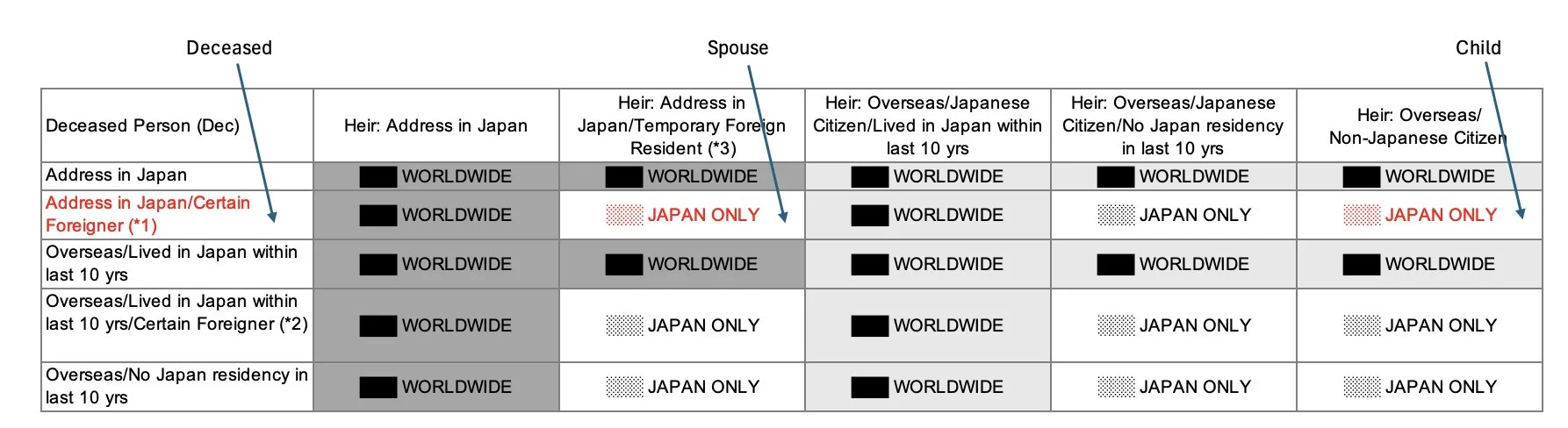
Therefore, Japanese inheritance tax generally applies to the Japanese-situs assets, but not the deceased's U.S.-located assets such as U.S. real estate, 401(k)s, IRAs, or U.S. bank and brokerage accounts.
U.S. Estate Tax
Separately, the deceased's worldwide estate may be subject to U.S. federal estate tax rules, including the applicable estate tax exemption.
Takeaway: Under this specific visa and residency profile, U.S. assets remain outside Japan's inheritance-tax scope.
3. Risk 3: The 10-Month Cash Crunch: Timing and Liquidity
Knowing what is taxable is only part of the planning.
An equally important question is:
When will the tax be due—and will the money be available to pay it?
For cross-border families, the mismatch between Japan's strict tax deadline and the time required to access U.S. assets can create a liquidity problem.
Japan's 10-Month Filing and Payment Deadline
Japanese inheritance tax is generally required to be filed and paid within 10 months from the day after the date on which the heir became aware of the death—normally, the day after the date of death.
The deadline does not automatically extend simply because the estate has not yet been divided among the heirs.
Payment in cash is the standard rule. Payment in kind (物納) is available only under specific conditions, including cases where payment in installments would still be difficult, and the property used for payment must generally be qualifying property located in Japan.
So, practically, families should plan around having cash available by the deadline.
That does not necessarily mean the cash must already be sitting in a bank account on the day of death.
If the inheritance process moves quickly, inherited cash may become available. A Japanese property may also be sold and the proceeds used to pay the tax.
The problem arises when the assets needed to create that cash are still tied up.
The 10-Month vs. Longer U.S. Timeline
Consider an American retiree living in Japan who dies with:
Japanese bank accounts,
a Tokyo condominium,
a U.S. brokerage account, and
U.S. real estate.
If the surviving heir is subject to Japanese inheritance tax on worldwide assets, the Japanese tax calculation may include the U.S. assets.
But those assets may not yet be accessible.
U.S. estate administration or probate may take many months or longer, particularly when real estate, multiple institutions, creditor claims, or court procedures are involved.
Meanwhile, the Japanese inheritance tax deadline continues to run.
The Timing Conflict
This creates the central risk:
The family may owe Japanese inheritance tax on assets that they cannot yet access.
The assets exist.
The tax liability exists.
But the cash does not.
Another Cross-Border Surprise: U.S. Social Security
There is another issue that U.S.–Japan families should be aware of.
A surviving spouse may become entitled to U.S. Social Security survivor benefits after the death of a spouse.
In February 2026, the Tokyo District Court ruled in two cases that certain U.S. Social Security survivor-benefit rights could be treated as deemed inherited property (みなし相続財産) for Japanese inheritance-tax purposes.
The rulings were not based simply on citizenship, and the cases are currently under appeal.
This is a stark reminder that international families should not assume an asset treated as a pension in the United States will receive the same tax treatment in Japan.
In these cases, the court accepted a valuation of the future benefit right based on its present value. This means a future stream of Social Security benefits can create a Japanese inheritance-tax liability at the 10-month deadline—even though the surviving spouse will receive the benefits over many years.
That creates a potentially significant upfront cash-flow burden: the family may need JPY cash to pay the inheritance tax before the underlying benefit has been received.
4.Cross-Border Planning Checklist
Before retirement—or before a major inheritance occurs—consider these questions:
☐ Which country's inheritance tax rules may apply to your family?
☐ Have you identified your assets in both Japan and the United States?
Include bank accounts, investments, retirement accounts, and real estate.
☐ Will you have enough liquid cash to pay Japanese inheritance tax if U.S. assets are still tied up in probate or other procedures?
☐ Have you reviewed your wills, beneficiary designations, and overall estate plan across both countries?
☐ Have you considered the tax filing deadlines in both countries?
☐ Have you discussed your situation with qualified legal and tax professionals familiar with cross-border U.S.–Japan issues?
Good estate planning is not simply about reducing tax—it is about reducing uncertainty for the people you leave behind.

5.Q&A
Q1. How does Japan determine whether I have an "address" in Japan?
A1. Having a resident registration (住民票) does not by itself determine whether you have an address in Japan for tax purposes. Japan generally looks at the center of your life, including factors such as where you spend your time, where your family lives, and where your work or other main activities are based.
Q2. Can gifts made before death affect the tax calculation?
A2. They can. Certain lifetime gifts may be brought into the tax calculation depending on the applicable tax rules. For international families, keeping records of significant gifts and transfers can be important when an estate is eventually settled.
Q3. Does "up to 55%" mean Japan takes 55% of the entire inheritance?
A3. No. The 55% figure is the top marginal inheritance-tax rate, not a flat tax on the entire estate. The actual tax depends on the taxable amount, statutory heirs, deductions, exemptions, and other applicable rules.
6.Wrap Up
International families must navigate different legal systems, different tax systems, and different administrative timelines—often at the same time.
The earlier you understand these differences, the more planning options you are likely to have.
Throughout this inheritance series, we've explored:
Cross-Border Inheritance: Why One Country's Law Isn't the Whole Story
Planning Across Two Inheritance Systems: Key Differences Between Japan and the U.S.
Thoughtful planning today can help your family make informed decisions tomorrow.
Aki | Japanese | Former Head of HR in Global Finance
I believe building a long-term life in Japan requires seeing the bigger picture.
By understanding how visa, healthcare, taxes, retirement, senior care, inheritance, and family decisions fit together, you can make informed decisions and take calculated risks.
