

Digital Navigator: A Cross-Border Checklist for Your Digital Legacy (2026 Edition)
By Aki | Navigator Japan
Your spouse may legally inherit your assets but still be unable to access them.
If your digital access fails, your heirs face a “Digital Death” where U.S. brokerage accounts become unreachable and Japanese administrative procedures grind to a halt.
In 2026, a locked smartphone, expired SIM card, or missing 2FA device can freeze an entire cross-border estate. This guide explains how to prevent that failure before it happens.
Quick Summary
Access vs. Ownership: Legal rights are useless without the digital "keys" (passwords/2FA) required to unlock the assets.
3-Month Debt Trigger: Japanese heirs have only 90 days to discover leveraged debts before becoming personally liable.
Connectivity Bridge: Active US/JP SIM cards are mandatory for receiving the 2FA codes that maintain estate access.
USD 0 Basis Tax Trap: Missing digital records allow the IRS to assume zero cost-basis, maximizing the tax hit for heirs.
Fiduciary-First Tech: Native tools (like Apple Legacy) grant legal access without the risks of sharing master passwords.
Table of Contents
Invisible Crisis: Access vs. Ownership
What Actually Happens When Access Fails
Cross-Border Digital Asset Inventory: Mapping Your Global Footprint
Cross-Border Tax Trap: Compliance, Discovery, and Debt
Strategic Safeguards: Fiduciary-First Tech Stack
Navigator’s Action Plan Checklist
Q&A
Wrap Up

1. Invisible Crisis: Access vs. Ownership
In 2026, the barrier to inheriting an estate is a conceptual wall between Digital Access and Digital Assets. This is an emerging challenge that your parents’ generation never had to face.
Digital Access is the "key"—your passwords, 2FA codes, and biometrics.
Digital Assets are the "value"—your crypto, monetized content, and online financial holdings.
For an expat, this crisis is compounded by two conflicting legal systems that view these two concepts very differently.
U.S. Perspective: Property Rights (UFADAA)
Under the Uniform Fiduciary Access to Digital Assets Act (UFADAA), the U.S. legal system treats your digital footprint as property. This empowers your executor to manage emails, crypto, and social media much like real estate.
However, this power is not a given. Tech platforms often prioritize their own tiered privacy settings. Unless you explicitly grant permission through the platform’s "Legacy Tools" or a specific clause in your Will, the company's privacy policy can legally block your heir’s right to the asset.
Japan Perspective: Protection Gap (APPI & Contracts)
Japan lacks a dedicated digital asset law. Instead, access is governed by the Act on the Protection of Personal Information (APPI) and individual service contracts.
The critical nuance is that APPI only protects the data of "living individuals." Upon death, legal privacy protections effectively expire. However, this does not grant heirs access; instead, Japanese providers default strictly to their Terms of Service (ToS). Most view heirs as "third parties" with no inherent right to the deceased’s data. Without a password or pre-arranged access, heirs face a total blackout. In Japan, proactive preparation is the only legal bridge to bypass these rigid corporate walls.
Navigator’s Note: Your heirs might hold the legal right to your wealth, yet lack the standing to bypass the security. This "Digital Death" results in assets remaining in a permanent state of limbo—accruing taxes and fees while being effectively frozen.
2. What Actually Happens When Access Fails
Day 1
Your spouse cannot unlock your iPhone.
Face ID fails, leaving banking apps, password managers, and authentication tokens permanently inaccessible.
Day 3
Without an active Connectivity Bridge (like a maintained Mint or Tello line), heirs cannot receive the SMS verification codes required to access U.S. brokerage accounts or IRS portals.
Day 7
Your heirs discover a Coinbase account.
The password exists, but the two-factor authentication (2FA) device is missing.
Day 30
An external hard drive containing a crypto wallet backup is discovered.
The recovery seed phrase cannot be found.
Month 3
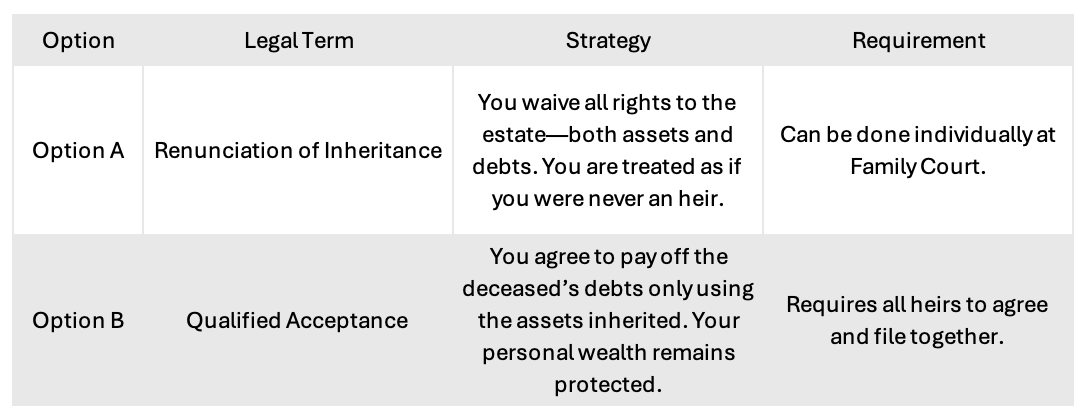
Under Japanese law, you must file for Renunciation of Inheritance within 3 months of knowledge. Missing this window means heirs personally inherit all leveraged debts.
Month 4
Japan’s final tax filing for the deceased (quasi-final tax return) must generally be completed within 4 months of death, requiring heirs to identify and verify income.
Month 10
Inheritance tax must be filed within 10 months. Undiscovered digital assets at this stage trigger legal complications and severe under-reporting penalties.
Most cross-border estate failures do not begin with missing assets. They begin with missing access.
See: Will Your Accounts Freeze? Navigating Cognitive Decline & Banking in Japan [2026 Guide]
3.Cross-Border Digital Asset Inventory: Mapping Your Global Footprint
Before you can secure your legacy, you must map the Digital Surface Area across both jurisdictions. In the 2026 landscape, this includes high-stakes financial tools and daily subscriptions that can drain an estate if left unchecked.
Comprehensive Asset & Subscription Map
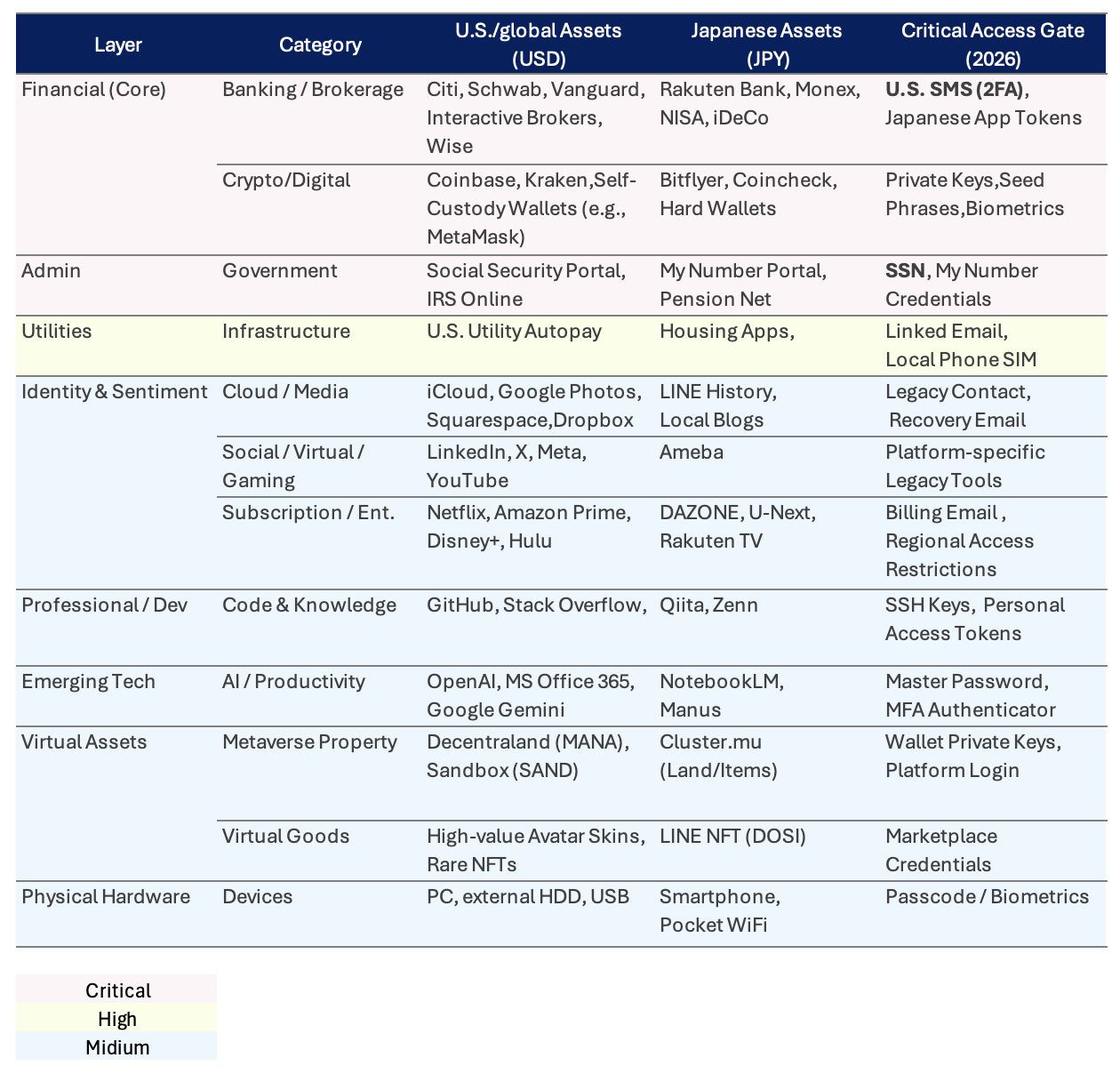
Mapping your assets is the necessary first step, but a list alone won't protect your estate. Now, let's analyze the high-stakes compliance and tax reality where an unmapped digital footprint can turn a legacy into a liability.
4. Cross-Border Tax Trap: Compliance, Discovery, and Debt
By 2026, digital assets have become a significant focus of tax compliance and audit activity.
For U.S./Japan expatriates, the challenge is two-fold: the IRS increasingly requires standardized reporting of digital assets and offshore accounts, while Japan’s National Tax Agency (NTA) applies residency-based rules that can expand reporting and inheritance tax exposure to worldwide assets.
U.S. Perspective: Standardized Reporting & Federal Estate Tax
The IRS treats digital assets (crypto, NFTs, virtual real estate) as property, not currency. By 2026, reporting for transactions on many centralized platforms has become increasingly automated.
Form 1099-DA: Brokers may issue this form for digital asset dispositions. Heirs may rely on these records to help establish the stepped-up basis to fair market value at the date of death, potentially reducing or eliminating capital gains tax on pre-death appreciation.
FBAR & Form 8938: If digital assets are held through certain foreign (non-U.S.) exchanges (e.g., bitFlyer or Coincheck), related accounts may need to be reported on an FBAR (if aggregate foreign financial accounts exceed USD10,000) and on Form 8938 (if FATCA filing thresholds are met). Penalties for noncompliance can begin at USD10,000, depending on the filing failure involved.
Basis Battle: Heirs must establish the original acquisition cost and valuation history of digital assets to calculate gains or losses accurately. Without a reliable digital inventory and transaction history, heirs may be unable to substantiate the cost basis, potentially resulting in higher taxable gains and increased tax exposure.
Japan Perspective: 5-Year vs. 10-Year Trap
You may not be a “Permanent Resident” on your visa, but the NTA defines your reporting obligations based on your time in-country.
Overseas Asset Report (OAR) Threshold (JPY50M): If you are a "Resident" (excluding "Non-Permanent Residents"), you must file the Overseas Asset Report (OAR) if your foreign assets exceed JPY50M.
Residency Definition: Under Japanese tax law, once you have lived in Japan for more than 5 years (within a 10-year period), you lose your "Non-Permanent Resident" status for OAR purposes. At this point, your global digital footprint—including offshore crypto and U.S. brokerage accounts—becomes fully reportable.
Discovery Delay: Finding digital assets after the Inheritance Division Agreement (遺産分割協議) is signed forces a full legal restart. This delay often pushes heirs past the 10-month filing deadline, triggering Delinquency Taxes of up to 14.6% annually. If the NTA identifies these assets before a voluntary disclosure, heirs face additional Under-reporting Penalties (10–15%) or heavy penalties for concealment (up to 40%).
Debt Inheritance Nightmare (FX & Leverage)
Digital assets aren't always a net positive. In a high-volatility environment (approx. 155 JPY/USD), many expats use leveraged accounts to hedge currency risk, which can quickly turn into massive liabilities.
Universal Succession: Under Japanese law, heirs automatically succeed to all rights and obligations of the deceased. This means if a leveraged position (FX or Crypto derivatives) turned negative at the time of death, the heirs inherit that debt personally.
3-Month Window: Heirs have only three months from the date they become aware of the inheritance to choose their path. If no action is taken, they are deemed to have accepted the debt in full.
To protect themselves, heirs can choose one of two legal shields:
5. Strategic Safeguards: Fiduciary-First Tech Stack
In 2026, sharing a master password is a security liability. It triggers automated fraud alerts that can lead to permanent account suspension. To protect your estate, you must build a Fiduciary-First Tech Stack that grants authenticated, legal access.
Built-in Digital Wills
Major ecosystems now provide native protocols to bypass forensic hacking:
Apple Legacy Contact: Provides an access key for iCloud data and device backups.
Google Inactive Account Manager: Automatically shares specific data folders after a set period of inactivity (e.g., 3 months).
Social Media: Meta allows you to designate a legacy contact to memorialize or delete your profile.
Access & Authentication Management
For high-security assets like brokerage accounts or crypto, software passwords are rarely sufficient.
Emergency Kit: Print the "Emergency Kit" PDF from 1Password or Dashlane and store it in a physical ICE (In Case of Emergency) Binder. Beyond estate planning, this serves as a critical offline backup for your identity and assets during a natural disaster.
Hardware Keys (YubiKey): Store these physically. Provide a Japanese memo explaining that these USB-like devices are the physical keys required for U.S. accounts.
Biometric Handover: Register a trusted heir’s Face ID or fingerprint on your Japanese smartphone to ensure instant access to 2FA banking apps.
Connectivity Anchor: SIMs & VPNs
Foreigners face a Digital Border where a loss of connectivity equals a loss of assets.
U.S. Mobile Bridge: Maintain a low-cost U.S. SIM (e.g., Tello or Mint) specifically for 2FA codes from the IRS, SSA, and U.S. banks. Ensure heirs have the login to keep this line active.
Japan SIM Continuity: Do not cancel your Japanese mobile contract immediately. It is often the only way to reset passwords for local NetBanks and the My Number Portal.
VPN Guard: Heirs should use a VPN to access U.S. financial portals. Logging in from a Japanese IP after a death can trigger an immediate suspicious activity freeze.
Navigator’s Insight: Tech companies prioritize Privacy over Inheritance. Without using native legacy tools, your heirs are "hackers" in the eyes of the algorithm. These protocols move them from unauthorized intruders to legal fiduciaries.
6. Navigator’s Action Plan Checklist
To prevent a digital crisis, execute these steps immediately. This ensures your heirs can stabilize your estate.
[ ] Analog Backup (ICE Binder): Create a physical "In Case of Emergency (ICE)" binder in Japan. It must contain your residence card, physical security keys, and the Master Key PDF for your password manager.
[ ] Biometric Handover: Register your spouse or a trusted heir’s Face ID or fingerprint on your primary smartphone.
[ ] Comprehensive Asset & Subscription Map: Create a document (stored in your ICE folder) that lists every account from Section 2.
[ ] Connectivity Bridge: Ensure your heirs have the login credentials for your U.S. mobile carrier. This allows them to keep the line active for 2FA codes even if the physical SIM is lost or the plan expires.
[ ] Legacy Protocol Activation: Spend 15 minutes today designating "Legacy Contacts" in Apple and setting the "Inactive Account Manager" in Google to a 3-month trigger.
[ ] Debt & Subscription Audit: Instruct heirs to search bank statements for "FX Margin," "DAZN," or "AWS”.
[ ] Physical Device Audit: Document the location of smartphones, external HDDs, USB drives, and Pocket WiFi devices. These are the physical vaults for your offline data.
[ ] Administrative Cleanup: Close dormant U.S. credit cards or bank accounts. The fewer silos you leave behind, the lower the administrative and tax-reporting burden.
[ ] Digital Death Cleaning: Regularly delete sensitive data, old SNS histories, or photos you do not wish to be part of your legacy.
[ ] Pro Protocol: For complex cross-border holdings, consider a Post-Mortem Services Contract (死後事務委任契約) in Japan. This legally empowers a professional to handle your digital cleanup, ensuring both privacy and compliance.
7. Q&A
Q1: I can't access a subscription my late spouse had. How do I stop the charges?
A1: Review bank or credit card statements to identify recurring charges, then contact the service provider with a death certificate and relevant estate documents.
In Japan, if you may disclaim inheritance, avoid paying subscription fees from the deceased’s assets before obtaining legal advice, as this could affect your ability to disclaim the estate.
For U.S.-based digital services, providers may require proof of executor authority before closing the account. Laws such as RUFADAA may help an executor request account closure or limited access, depending on state law and company policy.
Q2: : What is one smart habit for protecting cross-border assets?
A2: Review your U.S. and Japan accounts once a year and remove unused apps, subscriptions, and old financial accounts. A cleaner digital footprint reduces administrative complexity and improves security.
8.Wrap-Up: From Digital Clutter to Strategic Legacy
In the physical world, we cannot create a personal Single Sign-On (SSO) to access every application, space, or service we own. Because our digital lives are fragmented across jurisdictions, avoiding subscription leakage and asset loss requires a deliberate, safe maintenance strategy.
Navigator’s Pivot: Do not treat your digital assets and access as an afterthought. Treat them as the Primary Key to your physical wealth. Without the code, the vault remains closed.
Aki | Japanese | Former Head of HR in Global Finance
Aki has served as Head of Human Resources in the global financial sector. With over two decades of experience navigating labor law, residency, and wealth protection in both Tokyo and Chicago, she now provides the "insider’s roadmap" for foreigners planning a stable, high-value long-term life and retirement in Japan.
Referrals
National Tax Agency (NTA): Understanding the Overseas Asset Report (OAR)
U.S. Digital Assets: IRS Guidance on Digital Asset Reporting
