

Your Greatest Retirement Asset Is Your Health: A Foreigner's Guide to Preventive Healthcare in Japan
Many people spend decades preparing financially for retirement. They save, invest, and carefully plan how to make their money last.
However, one of the most valuable retirement assets is often overlooked—your health.
One of Japan's greatest strengths is its emphasis on preventive healthcare.
Understanding what is available can help you stay healthier, remain independent, and potentially avoid more serious medical problems later in life.
Quick Summary
Take the Initiative: After retirement, you are responsible for scheduling your own municipal health checkups.
Know Your Options: Municipal health checkups provide an affordable foundation, while a Ningen Dock offers more comprehensive screening.
Book Early: Appointments become busy later in the fiscal year, so reserve early for the best availability.
Prevention Pays Off: Regular checkups, dental and eye care, and healthy daily habits can help you stay healthy, independent, and potentially reduce future medical costs.
Table of Contents
1. Don't Miss Your Annual Municipal Health Checkup
2. Should You Consider a Ningen Dock?
3. If a Health Problem Is Found, Don't Ignore It
4. Don't Overlook Dental and Eye Care
5. Prevention Doesn't End with an Annual Health Checkup
6. Know Where to Turn Before You Need Help
7. Q&A
8. Wrap-Up

1. Don't Miss Your Annual Municipal Health Checkup
One of the easiest ways to stay on top of your health after retirement is to participate in your municipality's annual health checkup program.
If you are enrolled in Japan's National Health Insurance or the Late-Stage Elderly Medical Care System, your municipality will send information about annual health checkups (特定健診) and cancer screening programs.
These programs are subsidized but voluntary. If you receive a notice in the mail, don't simply set it aside—you need to make an appointment yourself.
A typical health checkup may include:
Blood pressure
Height, weight, and body mass index (BMI)
Blood tests for cholesterol, blood sugar, liver function, and kidney function
Urine testing
A doctor's consultation
Depending on your age, municipality, and medical history, additional examinations such as an electrocardiogram (ECG) or chest X-ray may also be available.
Many municipalities also offer optional screening programs for colorectal cancer, stomach cancer, hepatitis, osteoporosis, and other conditions.
You may also be able to add optional tests, such as a prostate-specific antigen (PSA) test, at your own expense.
With municipal subsidies, the out-of-pocket cost for a municipal health checkup typically ranges from about JPY3,500 to JPY12,000 (about USD22 – USD75), depending on your municipality and the examinations included.
Reserve Early
One practical point that many foreign retirees don't realize is that municipal health checkups generally follow Japan's fiscal year, which ends on March 31.
Popular appointment slots often fill quickly, particularly toward the end of the fiscal year. Booking early gives you more flexibility in choosing your preferred clinic and appointment date.
2. Should You Consider a Ningen Dock?
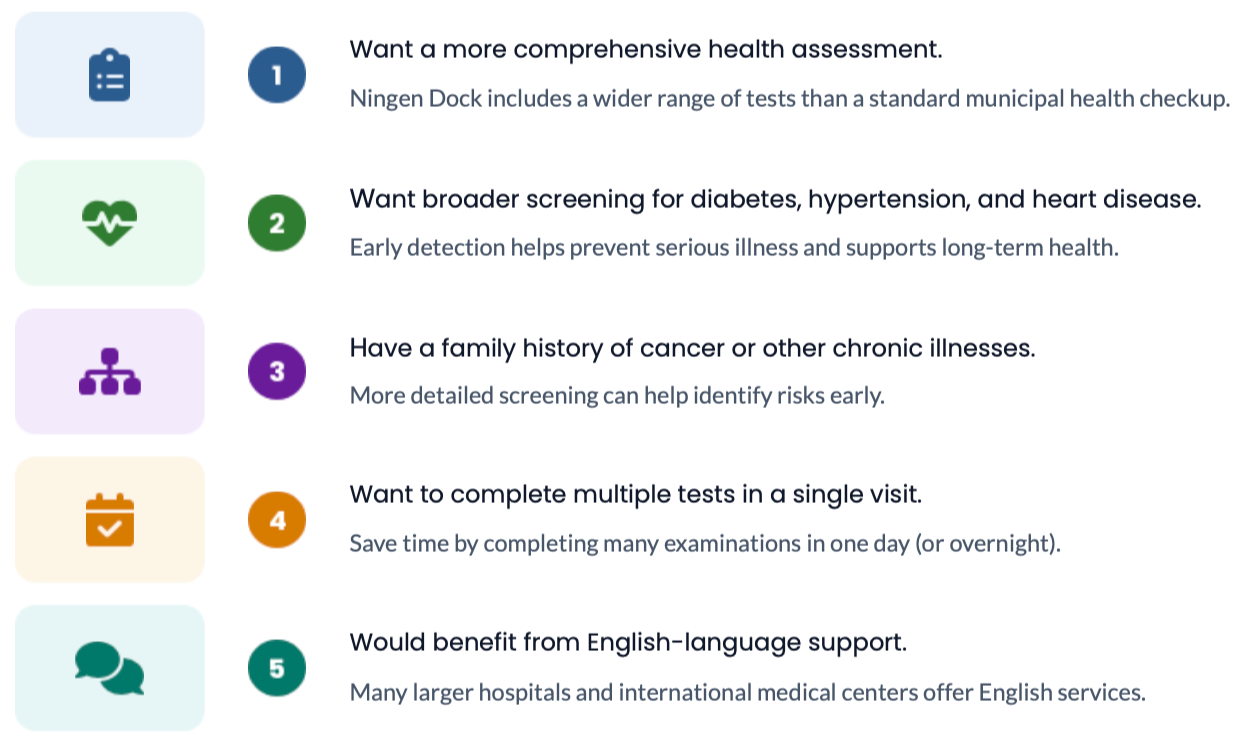
Municipal health checkups provide an excellent foundation for preventive healthcare. Some retirees, however, choose to go a step further by having a Ningen Dock (comprehensive medical checkup).
The quality of Japan's preventive health screening is highly regarded internationally, and some overseas visitors travel to Japan specifically for a Ningen Dock.
Compared with a standard municipal health checkup, a Ningen Dock offers a broader range of examinations. Depending on the course, it may include more detailed blood tests, ultrasound, endoscopy, CT or MRI scans, lung function testing, and other optional screening tests. Most programs are self-paid.
Comprehensive two-day Ningen Dock programs typically start at around JPY60,000 (about USD400). Fees vary depending on the hospital, the length of the program, and the examinations included.
Depending on your municipality and the hospital you choose, you may be eligible for a subsidy that helps offset part of the cost.
Who Should Consider a Ningen Dock ?
3. If a Health Problem Is Found, Don't Ignore It
No one enjoys receiving abnormal test results.
It can be tempting to postpone additional examinations, especially if you feel perfectly healthy.
One of the main goals of preventive healthcare is to identify problems before they become emergencies.
If your annual health check recommends additional testing, it is usually best to follow up promptly.
Fortunately, Japan's healthcare system makes it relatively easy to see specialists when necessary. Your primary doctor can explain the results, recommend the appropriate specialist, and help coordinate your care.
4. Don't Overlook Dental and Eye Care
When people think about preventive healthcare, they often focus on annual medical checkups. However, good dental and eye care are just as important for maintaining your health and independence in retirement.
Unlike municipal health checkups, there is no routine government-sponsored annual dental examination for adults.
Good oral health is closely linked to nutrition, heart health, diabetes management, and overall quality of life.
Eye care deserves the same attention. Conditions such as glaucoma, cataracts, diabetic retinopathy, and age-related macular degeneration often develop gradually and may not cause noticeable symptoms in their early stages.
Regular checkups are generally covered by Japan's public health insurance. In most cases, patients pay a 30% copayment, with out-of-pocket costs typically ranging from JPY2,500 to JPY3,500 per visit.
5.Prevention Doesn't End with an Annual Health Checkup
Annual health checkups are an important starting point, but preventive healthcare is ultimately about the choices you make every day.
The goal is to remain healthy, independent, and able to enjoy retirement.
Build Your Own Preventive Healthcare Plan
Consider making the following habits part of your routine:
Monitor your vital signs. Track your blood pressure, weight, and, if appropriate, blood sugar. Wearable devices can also monitor your heart rate, sleep quality, and VO₂ max (cardiorespiratory fitness), helping you spot changes over time.
Stay active. One advantage of living in Japan is that daily life encourages walking. Reliable public transportation and walkable neighborhoods make it easy to stay active. Whether you enjoy walking, golf, hiking, or swimming, regular exercise helps maintain muscle strength, balance, and heart health.
Eat a balanced diet. Healthy eating supports blood pressure, blood sugar, cholesterol, and a healthy weight. A traditional Japanese diet, rich in fish and vegetables, can provide a good foundation.
Prioritize sleep. Poor sleep increases the risk of heart disease, diabetes, depression, and cognitive decline. If you have persistent snoring or daytime fatigue, talk to your doctor about possible sleep apnea and whether CPAP therapy is appropriate.
Related articles
Why Japanese People Live So Long – Realistic Habits Any Expat Can Copy
6.Know Where to Turn Before You Need Help
As we age, healthcare needs often become more complex. You may need help not only from doctors, but also from care managers or community support services.
One valuable resource that many foreign residents are unaware of is the Community General Support Center (地域包括支援センター).
These centers are operated by local municipalities and are designed to help older adults and their families navigate later life. Their services vary by municipality but may include:
Information about Japan's Long-Term Care Insurance (介護保険) system
Advice on home care and community services
Support for family caregivers
Dementia consultation
Referrals to appropriate healthcare or facilities
Many people first learn about these centers only after a crisis, such as a fall, hospitalization, or the diagnosis of dementia.
Instead, consider becoming familiar with your local center before you need its services. Knowing where to ask for help can make a difficult situation much easier to manage.
Related article
Senior Care in Japan: Costs, Choices, and What Foreigners Should Know

7. Q&A
Q1.Do I have to participate in my municipality's annual health checkup?
A2. No. Municipal health checkups are highly recommended but voluntary. However, they are subsidized and provide an excellent opportunity to detect potential health problems before symptoms develop.
Q2. Is a Ningen Dock better than a municipal health checkup?
A2. It depends on your individual circumstances.
A Ningen Dock provides a more comprehensive health assessment, but it also costs more. For many retirees, a municipal health checkup combined with any additional screening tests recommended by their physician may be sufficient.
The right choice depends on your medical history, family history, and personal preferences.
In my parents' case, annual Ningen Dock examinations detected prostate cancer and esophageal cancer at an early stage.
While their experience demonstrates the potential benefits of comprehensive screening, the decision should ultimately be based on your individual risk factors and preference.
Q3. Are Ningen Dock programs available in English?
A3. Increasingly, yes.
Many large hospitals and medical centers—particularly in major metropolitan areas—now offer English-language support or international patient services.
However, availability varies, so it is best to check with the hospital before making a reservation.
Q4. How often should I have a health checkup?
A4. For most retirees, participating in the annual municipal health checkup is a sensible starting point. Depending on your health, your physician may recommend additional examinations or more frequent monitoring.
Q5. Should I also see a dentist and eye doctor regularly?
A5. Yes. Annual health checkups are only one part of preventive healthcare.Dental checkups are generally recommended every three to six months, while eye examinations are typically recommended once a year.
The appropriate frequency may vary depending on your individual health needs and your healthcare provider's recommendations.
8.Wrap-Up
Prevention Is Also Good Financial Planning
Japan's healthcare system remains one of the most affordable and accessible in the world.
However, as the population continues to age, policymakers are reviewing how to maintain the system's long-term sustainability. Changes to patient cost-sharing and other healthcare policies remain an ongoing topic of discussion.
While no one can predict future policy changes, one principle is unlikely to change: preventing disease is generally less costly—and often leads to better outcomes—than treating advanced illness.
Simply put, good health is one of the highest-return investments you can make during retirement.
Aki | Japanese | Former Head of HR in Global Finance
Aki has served as Head of Human Resources in the global financial sector.
With over two decades of experience navigating labor law, residency, and wealth protection in both Tokyo and Chicago, she now provides the "insider’s roadmap" for foreigners planning a stable, high-value long-term life and retirement in Japan.
