

When Your Spouse Becomes Your Care Plan: Navigating One of Retirement's Biggest Transitions
How to preserve dignity, independence, and peace of mind as care needs change.
Most of us know, somewhere in the back of our minds, that it may become part of our lives one day. Yet few people take practical steps until it becomes a reality.
Some may have experienced caring for aging parents. Caring for your spouse, however, is different—both of you are growing older together.
This article explores what happens when your spouse becomes your primary care plan. Understanding your options now won't eliminate the challenges, but it can make the decisions far less overwhelming when the time comes.
Quick Summary
The Myth of Solo Care: Relying solely on an aging spouse for long-term care can quickly become overwhelming.
Japan's Support System: Long-Term Care Insurance builds a professional support team around the couple.
Support That Evolves: Care services can be adjusted as needs change over time.
Making Informed Decisions: The right living arrangement should support both spouses.
For Foreign Residents: Be aware of financial assistance and spouse visa considerations when planning long-term care.
Table of Contents
1. The Retirement Transition Most Couples Never Discuss
2. Japan's Goal: Supporting Independence
3. Behind Every Care Plan Is a Team
4. Support Evolves as Needs Change
5. Living at Home or Moving to a Care Facility?
6. Additional Considerations for International Couples
7. Q&A
8. Wrap-Up

1.The Retirement Transition Most Couples Never Discuss
Most couples naturally assume that if one of them becomes ill, the other will step in as the caregiver.
But as both spouses grow older, that assumption becomes more complicated.
In Japan, the term roro kaigo (老老介護)—older adults caring for older adults—has become increasingly common. Data from the Ministry of Health, Labour and Welfare (MHLW) shows that 63.5% of cohabiting primary caregivers in Japan are seniors themselves.
Another expression, ninnin kaigo (認認介護), describes situations in which one spouse with dementia cares for another who also has cognitive impairment.
The question is:
How long can two older adults realistically care for each other without additional support?
Recognizing that question is the first step.
2. Japan's Goal: Supporting Independence
Many foreigners assume that long-term care is largely the family's responsibility. Others assume the government simply takes over.
In reality, Japan's approach strikes a balance between the two.
The goal is to support the family while helping older adults maintain their dignity and independence for as long as possible.
This philosophy is reflected throughout Japan's long-term care system.
Eligibility
Foreign residents enrolled in Japan's mandatory Long-Term Care Insurance (介護保険) can access long-term care services if they meet the eligibility requirements—generally those aged 65 and over—and complete an official care-level evaluation.
Community Integrated Support Center (地域包括支援センター)
For many families, the first point of contact is the Community Integrated Support Center.
These centers serve as a local consultation point for seniors and their families. Staff can explain available services, guide you through the care-level evaluation process, and introduce care managers in your area.
Even if you are unsure whether long-term care is needed, the Community Integrated Support Center is the best place to start. Seeking advice early can make future decisions much easier.
Their consultation services are free of charge.
Care manager (ケアマネジャー).
Once care-level is finalized, one of the most important people you meet is the care manager. Think of the care manager as the project manager for your care.
They coordinate services from multiple providers, adjust the care plan as needs change, communicate with healthcare professionals, and help families navigate decisions over time.
Rather than expecting one spouse to shoulder every responsibility, Japan's long-term care system is designed to build a support network around both the person receiving care and the spouse or family members providing that care.
As you'll see in the next section, that support network is not static. It evolves over time as a person's condition, goals, and daily needs change.
Related article
Senior Care in Japan: Costs, Choices, and What Foreigners Should Know
3. Behind Every Care Plan Is a Team
Long-term care in Japan becomes a collaborative effort involving both professionals and family members.
Depending on the person's condition, the care team may include:
A care manager
Home helpers
Day service staff
Visiting nurses
Physicians
Rehabilitation specialists
Assistive equipment providers
Family members
The care recipient
NOTE: Home helpers are for basic survival (diaper changes, basic cleaning, meal setup). They will not weed the garden, cook for visiting guests, or do chores in parts of the house the patient doesn't use.
Regular Care Plan Reviews
One aspect of Japan's long-term care system that many foreigners may not be aware of is the regular care plan review meeting, which is typically held every six months.
Whenever possible, the care recipient also participates in these meetings.
The purpose is to review the current care plan and discuss topics such as:
Progress toward short-term goals (i.e. independing living, or preventing falls or maintaining nutrition)
Daily living and mobility
Assistive equipment needed at home
Frequency and scope of home helper visits
Rehabilitation needs
Visiting nurse or physician services
The care manager's ongoing support
Team Approach - A Real-Life Example
At one recent care plan review meeting for my father, one topic quickly became clear.
His hearing had gradually declined, making telephone conversations increasingly difficult. His hearing aids were no longer providing enough amplification.
Rather than accepting this as an unavoidable part of aging, the discussion immediately turned to possible solutions.
The care manager suggested exploring a telephone amplification device.
The assistive equipment provider then introduced several products that could make conversations easier.
Instead of focusing on what my father could no longer do, the discussion focused on what would help him continue doing things for himself.
4. Support Evolves as Needs Change
Long-term care is a continuous process of reassessment and adjustment.
As a person's condition changes, so does the support surrounding them.
Someone who initially needs only occasional assistance may later benefit from visiting nurses, rehabilitation services, assistive equipment, or home modifications.
Others may eventually require regular physician visits or more intensive support.
For example:
Preparing daily meals becomes difficult
Meal delivery services or shopping assistance may reduce the burden on both spouses.
Bathing becomes unsafe
Home helpers or bathing assistance can reduce the risk of falls.
Additional daytime support becomes helpful
Adult day care may provide meals, bathing assistance, rehabilitation, exercise, and recreational activities.
It also helps older adults stay active while giving the caregiving spouse time to rest or manage other responsibilities.
Medical conditions become more complex
Visiting nurses may monitor blood pressure, oxygen saturation, medications, nutrition, sleep, bowel function, and overall health.
When necessary, visiting physicians can provide medical care at home.
Most services and assistive equipment are covered by Japan's Long-Term Care Insurance. The level of financial support depends on the person's certified care level, with additional costs generally paid out of pocket if service limits are exceeded.
The important point is this: long-term care is not a fixed package of services. It evolves as a person's needs change, providing the right support at the right time.
5. Living at Home or Moving to a Care Facility?
The care manager and care team help make it possible for many older adults to continue living at home.
As care needs change, however, some families may begin considering whether it is time to move to a care facility.
Home care often works well when:
The person strongly wishes to remain at home.
The spouse is physically and emotionally able to provide support.
Community services can fill the gaps.
The home can be adapted safely.
Medical needs remain manageable.
A care facility may become a better option when:
Care needs exceed what one spouse can safely provide.
Dementia creates safety concerns such as wandering.
Frequent medical supervision is required.
The caregiver's own health begins to decline.
Both spouses are becoming physically exhausted.
Offers a safer and more supportive living environment
One lesson I have learned is that the decision is rarely about choosing home or a facility.
It is about choosing the environment that best supports the safety, independence, and quality of life of both spouses.
Not all facilities are the same, either.Each serves different needs, levels of independence, and budgets.
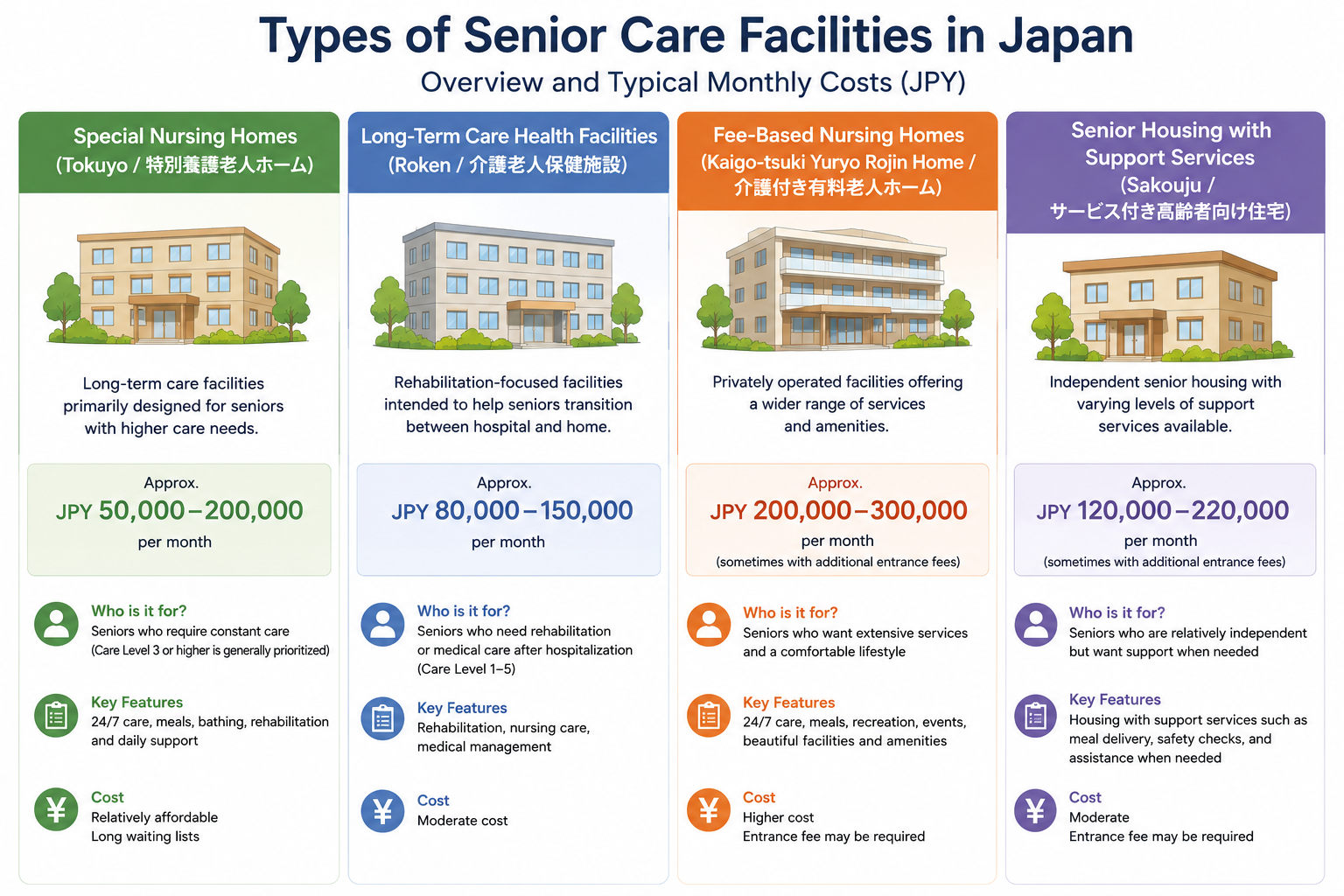
Note: Costs are approximate and vary significantly depending on the facility, location, room type, care needs, and additional services or entrance fees.
Tokuyo (Special Nursing Homes) is the place for heavy care but has massive waitlists, while Sakouju is perfect for maintaining independent living with light support.
Some couples choose to move while they are still active enough to adjust to a new environment, make new friends, and participate in community activities.
In some cases, only the care recipient moves into a facility.
Understanding your options before a major transition allows you to make these decisions while both partners can actively participate in the conversation.
6. Additional Considerations for International Couples
For international couples living in Japan, long-term care may involve additional decisions beyond those faced by Japanese families.
Financial Assistance
Long-Term Care Insurance is only one part of Japan's support system.
Depending on the person's medical condition, additional financial assistance may also be available.
For example, Japan provides subsidies for certain Designated Intractable Diseases (指定難病), including conditions such as Parkinson's disease and some forms of rheumatoid arthritis.
Municipal governments may also provide services such as:
Home modifications
Assistive equipment
Transportation assistance
Meal delivery
Emergency response systems
Caregiver support programs
Eligibility and available services vary by municipality.
A care manager or your local Community Integrated Support Center is often the best place to ask what support may be available.
⚠️ If You Hold a Spouse Visa
For foreign residents living in Japan on a Spouse visa, the death of a Japanese spouse may also affect future residency.
Although you are not required to leave Japan immediately, there are important legal procedures and deadlines to be aware of.
For example:
Notify your local municipality of your spouse's death.
Notify the Immigration Services Agency within 14 days of your spouse's death.
If you wish to remain in Japan, you will generally need to change to another appropriate residence status within 6 months.
In some cases, widowed spouses who have established a stable life in Japan may be eligible to apply for Long-Term Resident (定住者) status. Factors that may be considered include:
The length of the marriage
Your history of living in Japan
Financial independence
Japanese language ability
Compliance with tax, pension, and insurance obligations
Losing a spouse is emotionally overwhelming. Understanding these requirements in advance—or consulting an immigration specialist if necessary—can make an already difficult transition more manageable.
Related articles
Thinking About Returning to the United States After 20 Years in Japan?
Your Children Live Overseas: Planning Senior Care in Japan Before a Crisis Occurs

7.Q&A
Q1. When should we contact the Community Integrated Support Center?
A1.Earlier than most people think.
When my father fell and was hospitalized, I didn't fully understand Japan's long-term care system or the care options available to us. As a result, we had to make important decisions quickly.
You don't need to have everything planned in advance. But understanding where to turn and what options are available can make it much easier to make informed decisions when the time comes.
Q2. What if the care manager introduced by the Community Integrated Support Center isn't the right fit?
A2. You can change your care manager.
In my father's case, we needed a care manager as soon as possible, so the Community Integrated Support Center introduced one and we accepted their recommendation. Fortunately, he has been an excellent care manager.
However, not every care manager is the right fit for every family. If you are not comfortable with their communication style or the quality of support, you can ask the Community Integrated Support Center to help you change to another care manager.
Q3. I don't agree with the assigned care level. Can I request a reassessment?
Q3. Yes.
The care level is determined through an official assessment process, which includes an interview, a physician's opinion, and other relevant information.
If you believe the assigned care level doesn't seem appropriate or no longer reflects the person's actual condition or needs, discuss it with your care manager.
A reassessment does not guarantee a change in care level, but it may be worth requesting.
Q4: I don’t speak fluent Japanese. Can I still use these services?
A4.Yes.
But you shouldn't navigate it entirely alone. Larger metropolitan ward offices and Community Integrated Support Center increasingly have access to phone interpretation services or English documentation.
However, this is exactly why establishing your healthcare team early—including an English-fluent primary care doctor—is vital.
8.Wrap-Up
When my mother cared for her parents-in-law, she was expected to handle almost everything at home. As the wife of the eldest son, that was simply what society expected of her at the time.
Much has changed since then. With the introduction of Japan's Long-Term Care Insurance system, families today have access to professional services and a network of support that previous generations did not have.
When your spouse needs long-term care, the transition can still be physically and emotionally challenging for both of you.
But remember: you don't have to navigate it alone. There is a team that can support you along the way.
Aki | Japanese | Former Head of HR in Global Finance
With over two decades of experience navigating labor law, residency, and wealth protection in both Tokyo and Chicago, she now provides the "insider’s roadmap" for foreigners planning a stable, high-value long-term life and retirement in Japan.
