

Why Japanese People Live So Long – Realistic Habits Any Expat Can Copy
Japan consistently ranks among the top five countries in the world for life expectancy. But longevity is never the result of a single habit or miracle food. It is shaped by a quiet but powerful combination of diet, healthcare access, daily lifestyle, social systems, and long-term stability.
In this article, I explain both the well-known and the lesser-known reasons behind Japan’s remarkable longevity—based on data, lived experience, and cultural realities. More importantly, I explore what parts of Japan’s health culture foreigners can realistically adopt, wherever they live.
This blog covers:
The Facts: Japan’s Life Expectancy
The Japanese Diet: More Than “Healthy” Stereotypes
Walking as a Daily Habit: A Built-in Fitness System
Universal Healthcare & Easy Medical Access
Medical Quality & Preventive Care
Public Hygiene & Infrastructure
Growing Challenges
Mental & Emotional Well-Being in Daily Life
Aging, Frailty, and the Challenge of Long-Term Care
Regional Differences in Health & Medical Access
8. Q&A
9. Wrap up

1. The Facts: Japan’s Life Expectancy
Life expectancy rankings vary depending on the data source and the year of reference. For this blog, I use 2024 data from World Population Review.
Top 5 Countries by Life Expectancy (2024)
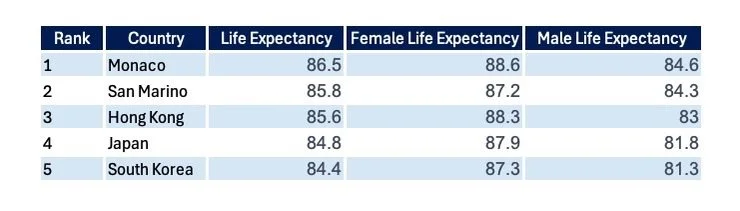
As this chart shows, Japan does not always rank No.1 overall when micro-states and special territories are included. However, among large, well-populated countries, Japan has remained at the absolute top level of global longevity for decades.
Even more important than the exact ranking is that Japan does not achieve long life expectancy through a single factor—it achieves it through a system of everyday health support that quietly works across an entire society.
Japan vs USA simple comparison table
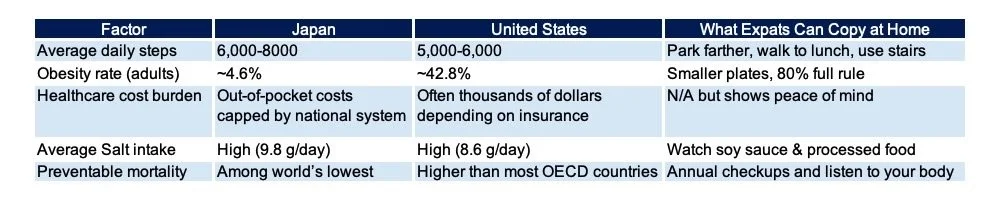
Source: OECD Health at a Glance (Obesity rate: Japan & United States/Preventable mortality: Japan & United States), Nikkei × National Geographic Japan, Med Sci Sports Exerc.
2. The Japanese Diet: More Than “Healthy” Stereotypes
Yes, Japanese people eat a lot of fish, tofu, and vegetables — but the real longevity magic isn’t any one superfood. It’s the overall pattern that has evolved over decades. Research (led by Japan’s National Cancer Center) shows this combination is what actually moves the needle on life expectancy:
Extremely low saturated fat → significantly less heart attacks compared to the West
Lots of omega-3 from fish → healthier blood vessels
Tons of soy and plants (Vegetables, Fruits, Beans, Whole grains, Seaweed) → lower rates of breast, prostate, and colon cancers
Green tea every day → extra antioxidants, zero sugar
Once people started eating a little meat and dairy (but kept the fish + veg base and didn’t abandon portion control), stroke deaths crashed while heart-disease rates stayed tiny.
In other words, Japan did not achieve the world’s longest life expectancy by eating only traditional food, nor by fully adopting a Western diet. Instead, it found a powerful middle path—a near-ideal hybrid of mostly plants and fish, with just enough meat and dairy to correct earlier nutritional weaknesses.
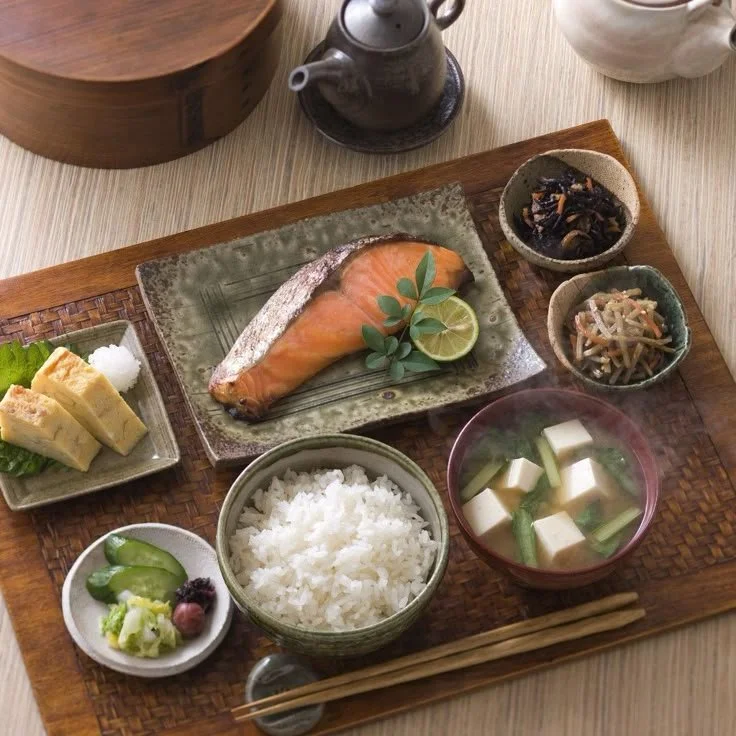
“Mago wa Yasashii” (まごはやさしい): A Traditional Japanese Food Balance Rule
In Japan, there is a well-known dietary guideline called “Mago wa Yasashii”, a mnemonic that represents seven food groups to include daily for balanced nutrition:
ま (Ma – Beans/Legumes): Tofu, natto, miso. Rich in plant-based protein, fiber, and isoflavones.
ご (Go – Sesame & Nuts): Sesame seeds and nuts. High in protein, minerals, healthy fats, and vitamin E.
わ (Wa – Seaweed): Seaweeds. Excellent sources of minerals, calcium, and dietary fiber.
や (Ya – Vegetables): Provide vitamins, minerals, and fiber, with different vegetables offering different nutrients.
さ (Sa – Fish): High-quality protein, DHA, and EPA (essential fatty acids).
し (Shi – Mushrooms): Shiitake and other mushrooms. Rich in fiber, minerals, and vitamin D.
い (I – Potatoes & Tubers): Potatoes and sweet potatoes. Good sources of carbohydrates and fiber.
This simple rule reflects how nutritional balance has long been built into everyday Japanese home cooking.
Tiny Portion & Presentation Also Matter
Compared with Western meals, portion sizes in Japan are naturally smaller. Meals emphasize visual balance, seasonal variety and moderation. This structure quietly supports long-term weight control, without strict calorie counting.
Real Story – High Quality, Small Portions
Last weekend, we took our American friends to a well-known upscale restaurant in Japan. The first course was a cold soup—beautifully presented—but it was served in an incredibly small bowl. Honestly, it was about two teaspoons of soup.
Then came the main dish.
The meat was excellent—tender, flavorful, perfectly cooked. The plate was beautiful.
But there were only six small cubes on the plate.
The food was unforgettable in quality—but unforgettable in portion size, too. And that contrast captures something essential about Japanese dining: less quantity, more intention.
⚠️ A Gentle Pitfall: Salt Intake Deserves Attention
People who frequently eat soy and fish—two foundations of the Japanese diet—often consume higher levels of salt as well.
As a result, while the diet supports heart health and longevity, excess sodium can raise blood pressure, increasing the risk of stroke. Stroke remains one of the major causes of dementia and long-term bedridden conditions in Japan.
✅ Gentle Takeaways
Longevity does not require strict rules. It is built through daily repetition of balanced, moderate choices.
Modern health habits work best when combined with traditional wisdom. Reducing salt while preserving balance may further strengthen Japan’s already remarkable longevity.
3. Walking as a Daily Habit: A Built-in Fitness System
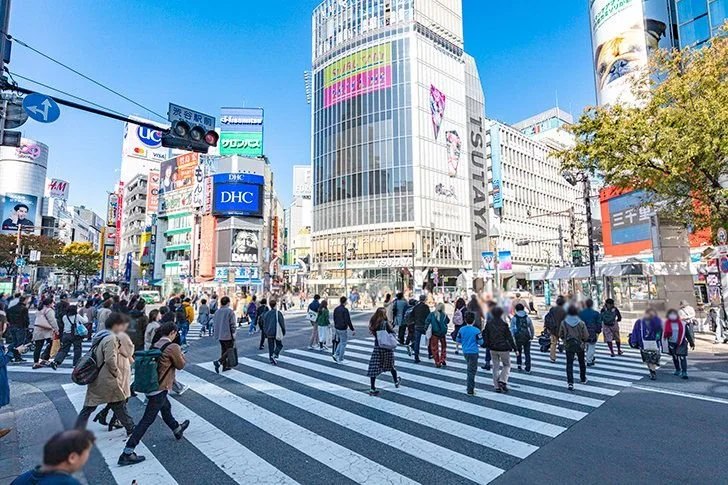
Japan is a walking society.
10,000 steps per day is normal
Train stations, stairs, shopping districts encourage movement
Daily errands require physical activity
In contrast, traffic structure make it difficult to walk, as the country is too big.
Many Americans go to the gym
Some even have gyms at home
But everyday life itself often requires little walking
Real Story: When Walking Becomes a Habit
When my husband first arrived in Japan, he could not walk long distances at all.
At the same time, I remembered how our neighbors in the U.S. would drive their car just to throw out the garbage—only about 15 meters away.
Today, after years of living in Japan, my husband can now walk even longer than I can. Nothing special changed—only daily habits.
✅ Gentle Takeaways:
You don’t need 10,000 steps to start. Even adding 2,000–3,000 extra steps a day through small habits can improve stamina and metabolic health.
Consistency matters more than intensity. Japan’s strength is not athletic training—it is steady, lifelong movement.
4. Universal Healthcare & Easy Medical Access
Japan’s National Health Insurance System ensures:
Anyone can visit any clinic or hospital without restriction (although large hospitals may require a referral letter)
Costs remain affordable
Annual health checkups are standard
Diseases are detected and treated early
Key Advantages
There are no system-wide long waiting lists like in Canada, and access to tests and specialists is usually fast.
Immediate access to specialists
Clear, transparent billing
No exhausting battles with insurance companies
There is no strict separation between medical, dental, and vision care
Healthcare affordability directly supports longevity.
See also: How to Get Medical Care in Japan as a Foreigner (Real Tips + Free Hospital List)

5. Medical Quality
Japan continues to rank among the top-performing nations when evaluated under global health-system metrics. According to the OECD’s “Health at a Glance” series:
Japan’s preventable mortality (deaths avoidable with proper public health & medical care) is among the lowest in OECD countries: about 86 per 100,000 population, compared with an OECD average of around 145.
The rate of treatable mortality (deaths avoidable through effective medical care) in Japan is also substantially below the OECD average.
These indicators reflect the capability of the healthcare system to deliver timely, effective, and equitable care—even in advanced age.
According to The Lancet, between 1990 and 2021, life expectancy in Japan increased significantly—from 79.4 years to 85.2 years. This remarkable gain was driven primarily by:
Reduced mortality from stroke (adding 1.5 years to life expectancy)
Reduced mortality from ischemic heart disease (+1.0 year)
Reduced mortality from cancers, especially stomach cancer (+0.5 years)
At the same time, the data also show that regional disparities between prefectures have widened, meaning that while the national average remains extremely high, local health outcomes differ more than before.
Preventive Medicine as a National Policy
In Japan, prevention is treated as a core national strategy, not just a personal health choice. Both the government and medical institutions actively promote health across three levels of prevention:
Primary Prevention (一次予防): Building Healthy Lifestyles
Focused on:
Health promotion
Lifestyle improvement
Reducing risk factors before disease develops
Secondary Prevention (二次予防): Early Detection & Early Treatment
Focused on:
Early diagnosis through screenings
Prompt treatment before conditions become severe
Tertiary Prevention (三次予防): Preventing Complications & Supporting Recovery
Focused on:
Preventing disease progression
Avoiding complications
Supporting rehabilitation and social reintegration
How This Policy Works in Practice
Annual health checkups are mandatory for employees covered by employer-provided health insurance, and people enrolled in National Health Insurance are also eligible for subsidized checkups.
Public health education
Support for preventing complications, restoring function, and returning to society is built into long-term care and rehabilitation systems.
Through these layered prevention efforts, Japan aims to:
Reduce long-term medical costs
Extend healthy life expectancy (健康寿命), not just total lifespan
These policies are promoted by the Ministry of Health, Labor and Welfare.
6. Public Hygiene & Infrastructure
Japan’s:
Clean water supply
Modern sewage systems
Strict hygiene standards
Strong infectious disease control
have dramatically reduced:
Infant mortality
Deaths from infectious diseases
Spread of epidemics
Public hygiene is one of the invisible pillars of longevity.

7. Growing Challenges
Japan’s long life expectancy is a remarkable achievement—but it also brings new challenges. They are the next frontier of health policy and daily life in a super-aging nation.
Mental & Emotional Well-Being in Daily Life
From my experience in HR, I have seen a clear increase in mental health challenges in both the United States and Japan. Stress, burnout, anxiety, addiction, and depression are no longer rare or exceptional—they have become part of everyday reality. I have also seen how these challenges increasingly affect employees’ families as well.
The economic consequences are also substantial. According to an estimate reported by Nikkei, psychological distress and related mental health conditions are estimated to cause annual economic losses of approximately JPY7.6 trillion (roughly USD 50 billion), driven in large part by:
a. Absenteeism
b. Reduced workplace productivity
c. Long-term disengagement from work
d. Delayed consultation and treatment
Long working hours, social pressure, isolation among the elderly, and the cultural tendency to endure silently can all delay early support. While awareness is gradually improving, access to counseling and psychiatric care still carries more stigma in Japan than in many Western countries.
One concept that left a strong impression on me is neurodiversity—"the idea that people experience and interact with the world in many different ways, and that there is no single “right” way of thinking, learning, or behaving. Differences are not viewed as deficits, but as part of natural human variation”(Harvard Health Publishing). This perspective, introduced to many global readers through, is beginning to reshape conversations around mental health and inclusion.
In response to growing needs, Japan has begun expanding:
a. Workplace mental health consultations, especially for employees working long overtime hours
b. Stress-check systems at the organizational level
c. Early-intervention programs
d. Multidisciplinary team-based care, where not only psychiatrists, but also nurses, clinical psychologists, and occupational therapist work together as a group
This marks an important shift: from silent endurance toward structured mental health support as part of preventive care.
See also: Psychiatry in Japan vs. the U.S.: What Expats Should Know About Mental Health & Medical Leave
Aging, Frailty, and the Challenge of Long-Term Care
Japan’s success in extending life expectancy also means that more people are living into very advanced age. With this comes increased risk of:
Frailty
Falls and fractures
Cognitive decline
Long-term bedridden conditions (寝たきり)
While Japan has built one of the world’s most comprehensive public long-term care insurance systems, demand is growing rapidly as the population continues to age. The key challenge today is no longer simply how long people live, but:
How well they can live—physically, mentally, socially and financially—through their later years.
Social Connection & Ikigai (Purpose in Daily Life)
One often-cited “secret” of Japan’s longevity is not medical at all—it is social connection and a sense of purpose.
This may take many forms:
Ongoing participation in some activities
Gardening, hobbies, volunteering
Part-time work or community roles after retirement
Daily routines that create rhythm and responsibility
Regional Differences in Health & Medical Access
Although Japan’s healthcare system is nationally standardized, regional differences do exist.
Urban areas tend to have:
Greater concentrations of specialists
Large medical centers
Easier access to advanced treatment
Some rural areas, by contrast, face:
Fewer physicians
Longer travel times to hospitals
Aging populations with limited local medical resources
In response, AI, telemedicine, digital health technologies, and regional medical networks are expected to play a much larger role going forward.
Real Story
One of the American friends we met last week—the same friend we took to the restaurant with the very small dinner portions—works in the medical field. He mentioned that doctors in the U.S. are already using AI more and more in daily practice.
That made a lot of sense to me. No human being can possibly keep up with the enormous volume of medical articles, studies, and data being published around the world every day.
By letting AI handle part of that information overload, medical professionals can spend more time focusing on what only humans can do—such as understanding the individual characteristics of each patient’s condition and making complex, judgment-based decisions.

8. Q&A
Q1. Can foreigners use Japan’s public healthcare system?
A1. Yes. If you live in Japan with a mid- to long-term visa (generally over 3 months) and are registered as a resident, you are required to enroll in Japan’s National Health Insurance (NHI) or an employee health insurance plan.
Once enrolled, you can:
Visit almost any clinic or hospital
Pay only 30% of the medical cost (the rest is covered by insurance)
Access the same level of care as Japanese citizens
There is no concept of “in-network vs. out-of-network” like in the U.S.
See also: How to Get Medical Care in Japan as a Foreigner (Real Tips + Free Hospital List)
Q2. Do I need a family doctor or referral to see a specialist?
A2. Usually, no. Japan allows free access to most clinics and hospitals without a referral.
However:
Large university hospitals and advanced acute-care hospitals often require a referral letter
If you go without one, you may pay an extra entrance fee (usually JPY5,000–JPY10,000)
Q3. I know that the ingredients in “Mago wa Yasashii” are healthy—but how can I actually cook them?
A3. This is a very real question—because traditional Japanese dishes often require time, preparation, and multiple steps. For busy working people, that can feel completely unrealistic. By dinnertime, you’re exhausted—and the kids are already hungry.
In Japan, you often see magical-sounding articles like “Working parents who make five dishes in 20 minutes.”
Cooking is deeply rooted in Japanese daily culture. But for most real families—including myself—that pace simply isn’t sustainable every day.
At the same time, recent surveys show that many Americans do feel confident about their home cooking and their efforts to eat healthy. So this is not about effort or motivation. It’s about how to make healthy choices simpler and more repeatable, even on the busiest days.
Here’s the core truth: You simply need to use healthy ingredients—and plan simply.
✅ Practical, Real-Life Cooking Tips for Busy Families
a. Use local Asian grocery stores wisely
Asian grocery stores offer Tofu, frozen fish, seaweed, mushrooms, pre-cut vegetables and ready-to-cook items. These save both time and mental energy.
b. Batch-cook once a week
Get one or two simple cookbooks, cook on the weekend, and prepare meals for the coming week. Even 3–4 base dishes can be mixed and reused with different sides or seasonings.
c. It doesn’t have to be Japanese food
You don’t need miso soup and grilled fish every night.
Choose your favorite cuisines—Italian, Mexican, Mediterranean, American—just:
Use more vegetables
Add tofu or fish
Reduce heavy cream and deep frying
Healthy structure matters more than the cuisine itself.
d. Planning matters more than cooking skill
The biggest difference between “healthy eating” and “giving up” is not technique—it’s planning. Decide your meals for the week in advance, shop once and remove daily decision stress.
When cooking becomes another project with a deadline, people (like me) naturally resist it. Planning turns it from a burden into a routine.
Q4. Is it true that Japanese people don’t get fat because of genetics?
A4. No. When Japanese move to the US and eat the standard American diet + drive everywhere, obesity rates become similar. It’s environment and habits, not DNA.
9. Wrap-Up: Longevity Is a System, Not a Miracle
Japan’s long life expectancy is not a mystery.
It is the result of:
Balanced diet
Walkable daily life
Universal healthcare
Affordable medical costs
High medical standards
Preventive medicine
Public hygiene
Social safety
Longevity is not built by one superfood or one habit.
It is built by a society designed to support health quietly, every day.
Health is something we often take for granted—until it is challenged. Yet health is the true foundation of our daily life. I hope this blog encourages you to reflect on your own habits and helps you make small, sustainable choices toward a healthier life.
If this article sparked any thoughts, experiences, or questions, Jager and I would love to hear from you. Please feel free to share your comments below.
