

When Employment Disputes Reshape Your Retirement in Japan: Tribunal, Court, or Negotiated Exit?
Before You Choose a Dispute Pathway
An employment dispute in your late career is not just a legal conflict.
For foreign professionals in Japan, it often becomes the decisive pivot in your retirement architecture.
The choice between:
Labor Tribunal (労働審判)
Civil Court litigation (裁判)
Negotiated resignation
Early retirement programs
Voluntary Resignation
can materially affect:
Pension accrual and benefit calculation
Visa and residency stability
Healthcare continuity
Cash-flow runway before pension activation
Psychological transition into retirement
This article evaluates dispute pathways not by legal doctrine, but by retirement impact.
In this article, we cover:
1. When Employment Conflict Intersects with Retirement Planning
2. The Structural Comparison: Retirement Impact View
3. Pathway Analysis Through a Retirement Lens
4. Timing as the Decisive Variable
5. Liquidity and Transition Risk
6. Psychological Transition
7. Wrap Up

1. When Employment Conflict Intersects with Retirement Planning
Retirement planning is usually framed around pensions, investments, and healthcare.
But for many foreign professionals in Japan,employment conflict can become an equally decisive variable.
A demotion.
A role becoming obsolete.
A restructuring labeled “voluntary.”
A recommended resignation.
A compensation dispute — including unpaid overtime or bonus reductions.
Workplace conduct issues, including harassment allegations.
In your 30s–40s, it is a career setback.
In your late 50s–early 60s,
it is a retirement timing pivot.Japanese companies typically follow institutional patterns: mandatory executive retirement (役職定年), reduced-salary re-employment, or structured early retirement programs—challenging yet framed and predictable.
Foreign-affiliated firms differ: disputes can strike at any age, driven by performance or restructuring rather than tenure—seniority provides little shield.
Unlike the U.S. at-will system (termination for almost any reason, or none, with minimal notice), Japanese courts scrutinize dismissals and typically require objective rationality and social acceptability,demanding strong evidence, warnings, and procedure—even in foreign branches.
This is not merely conflict resolution, but calculating retirement impact—and selecting the path that best protects long-term stability.
2.The Structural Comparison: Retirement Impact View
Below is a comparison of dispute pathways.
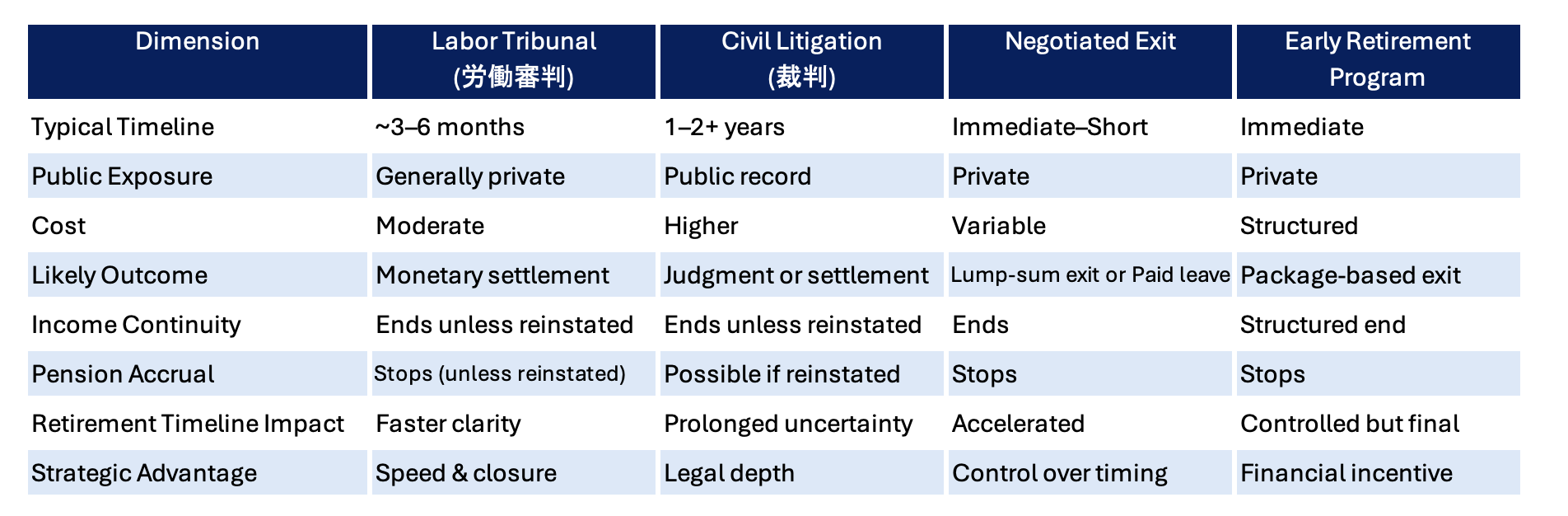
Note:
• For foreign professionals, negotiating a paid leave period rather than immediate termination with a lump sum payment may provide critical time to secure alternative employment and maintain visa status and health insurance continuity.
• “Structured end” means the termination is handled through a formal, predefined procedure rather than through ad hoc conflict or abrupt dismissal.
The most important variable here is not legal theory. It is time compression versus uncertainty expansion.
3.Pathway Analysis Through a Retirement Lens
A. Labor Tribunal (労働審判)
By design, the labor tribunal procedure is time-boxed (generally within three hearing dates), which is why it often delivers faster closure than civil litigation.
Retirement Impact
Compressed uncertainty
Faster clarity on financial outcome
Shorter emotional disruption
Employment status generally continues until formal termination
For professionals nearing retirement, speed can protect optionality. A quicker resolution allows you to model pension timing, cash flow, and healthcare transition without prolonged ambiguity.
Strategic Considerations
Legal representation is generally required
You must substantiate your claims
Settlement-forward, practicality-driven
Most cases conclude with financial compromise rather than reinstatement
If retirement timing stability is your priority, tribunal speed may align with that objective.
B. Civil Court Litigation (裁判)
Civil litigation is more formal and may extend for one to two years or longer. Outcomes may include reinstatement, damages, or settlement.
Retirement Impact
Extended uncertainty
Continued employment status until termination is finalized
Ongoing legal expenses
Emotional strain over a prolonged period
Strategic Considerations
Long-term legal representation is required
The evidentiary burden is significant
Courts assess whether the employer’s actions were objectively reasonable and legally justified under applicable labor standards
Emotional and financial reserves must be sufficient to sustain duration
If you are already financially stable and near pension eligibility, extended litigation may reduce the quality of your transition, even if legally justified.
C. Negotiated Settlement and Exit (Recommended resignation)
Many employment disputes conclude through negotiated resignation. In practice, a large proportion of “recommended resignations” follow this path.
Retirement Impact
Immediate or near-term liquidity
Paid leave (garden leave) may provide transition time rather than a lump sum payment
Pension accrual typically stops upon termination
For foreign professionals, negotiating paid leave before formal termination can be strategically valuable. Continued employment status during this period may allow:
Time to secure alternative employment
Visa continuity
Health insurance stability
Strategic Considerations
Severance terms, bonus eligibility, and termination date are negotiated
Agreement provides immediate closure
If negotiation stalls, legal representation is often required
Unless agreement is reached, unilateral dismissal is legally difficult; during negotiation, salary and benefits typically continue
Some employers place employees on home leave due to system access or risk concerns
When Negotiations Stall
If discussions reach an impasse, both sides may involve legal counsel. This does not mean litigation has begun. Attorney-to-attorney communication often shifts the process from emotional exchange to structured negotiation based on legal standards and market practice.
In recommended resignation cases, reinstatement is rarely the realistic outcome. Employers generally seek a mutually agreed separation over prolonged dispute. Severance terms are guided by internal frameworks and precedent; while limited flexibility may exist, additional compensation typically requires reasonable justification and higher-level approval.
At this stage, the matter remains negotiation, not litigation. For professionals nearing retirement, this structure can preserve salary continuity during discussions and provide time to stabilize cash flow and transition planning.

D. Early Retirement Programs (早期退職制度)
Japanese companies often introduce early retirement programs during periods of restructuring or cost adjustment. These programs are typically implemented on a temporary basis, with defined eligibility criteria, application deadlines.
Although framed as voluntary, early retirement programs operate within a structured institutional design.
They often include:
A limited application period and target participation numbers
Emphasis on voluntary decision-making rather than compulsory dismissal
Programs are often treated as involuntary termination (会社都合) rather than voluntary resignation, which can improve unemployment insurance timing/benefit conditions compared with voluntary resignation.
Enhanced severance payments
Outplacement or re-employment support
Buyout of unused paid leave
From a retirement planning perspective, early retirement programs provide clarity and structure — but they also accelerate timing.
Retirement Impact
Immediate separation under predefined terms
Pension accrual ends upon departure
Income replacement must be modeled carefully
Re-employment uncertainty becomes a central variable
Enhanced severance in early retirement programs commonly ranges from approximately 3 months to 18 months of salary, depending on company policy and tenure. However, market conditions and industry norms vary.
Strategic Considerations
Realistic assessment of re-employment prospects at your current age and within your industry
Confirmation that visa status is independent of the employer and not jeopardized by separation
Evaluation of whether the severance package sufficiently bridges the period until pension eligibility or alternative income begins
Assessment of psychological and financial readiness for an earlier-than-planned transition
Re-employment prospects deserve particular attention. In Japan, lateral re-employment opportunities after the late 50s are often limited. Available positions are often part-time or lower in compensation. Opportunities frequently concentrate in sectors such as caregiving, hospitality, construction, education, or food services. Even highly qualified professionals may encounter pre-screening barriers before reaching the interview stage.
This structural reality should be factored into retirement modeling.
Early retirement programs are not inherently negative. In some cases, they provide a controlled and financially supported exit. However, they represent a structural pivot point. Once accepted, reversal is rarely possible.
E. Voluntary Resignation (Voluntary Termination)
Not all late-career employment disruption results in formal dispute.
A demotion, reduced role, or organizational restructure may not justify legal challenge — yet may signal structural stagnation. In such cases, one option remains:
Voluntary resignation.
Unlike recommended resignation or early retirement programs, this path is initiated by the employee and typically does not include enhanced severance or company-initiated unemployment benefits.
Retirement Impact
Immediate end of salary and employer-sponsored benefits
Pension accrual stops
Visa continuity may be affected if status is employer-dependent
No additional severance beyond company benefits/retirement allowance
Full control over timing
Financially and legally, this is the least protected exit path. However, it offers one element other options do not: autonomy.
Strategic Considerations
Alternative employment should ideally be secured before notice is given
Visa status and sponsorship requirements must be confirmed
Cash-flow runway should be modeled conservatively
Psychological readiness for transition should be assessed
In Japan, mandatory retirement at 60 or 65 will eventually require similar structural adjustments anyway. Choosing to exit earlier can be viable — but only if timing is deliberate rather than reactive.
Critical Visa Considerations
For foreign professionals without Permanent Residency (永住者) or Spouse/Long-Term Resident status, visa structure must be secured before resignation.
Potential pathways include:
Permanent Resident (永住者) — Employment changes do not affect residency
Spouse / Long-Term Resident status — Work without employer dependency
Business Manager Visa (経営・管理) — For those establishing a company (office presence and capital requirements apply)
Highly Skilled Professional (高度専門職) — May provide stability when transitioning to a new employer
Standard Work Visa — Requires new employer sponsorship
Resigning before securing alternative sponsorship or status may create immediate residency instability.
NOTE: Requirements evolve; confirm with official sources.
Second-Career and Business Transition
Common post-employment paths include:
Independent consulting or advisory services
Board or outside director roles
Partnership in an existing company
Launching a small business under a Business Manager visa
Remote advisory work for overseas entities (if visa permits)
Transitioning from employment to self-employment materially alters retirement structure:
Pension contributions may shift to National Pension
Health insurance moves to National Health Insurance
Income becomes variable
Cash-flow volatility increases
Tax planning complexity rises
Voluntary resignation can be strategically sound — particularly in one’s 50s when transition planning begins early.
In dual-income households, a spouse’s income may provide temporary stabilization.
See also
Navigating Mandatory Retirement in Japan and Life After 60
PIP in Japan: Is It the Beginning of the End? An Expat Guide to Survival, Strategy, and Negotiation

4.Timing as the Decisive Variable
At the edge of retirement, the decisive factor is rarely legal theory. It is timing.
A dispute five years before pension eligibility carries very different consequences from one occurring twelve months before benefit activation. Litigation that extends beyond planned retirement may preserve principle — but alter liquidity, healthcare structure, and psychological transition.
The question is not simply:
Which pathway is legally stronger?
It is:
Which pathway aligns with my retirement timeline?
When pension accrual is nearly complete, prolonged uncertainty may offer limited structural benefit. When financial runway is short, compressed resolution may be more stabilizing than extended litigation.
Retirement decisions are rarely reversible. Dispute timelines often are not fully controllable.
Understanding that interaction is critical.
5.Liquidity and Transition Risk
Employment disputes close to retirement affect more than salary continuity.
They may accelerate:
Pension activation decisions
Health insurance transitions
Visa status reassessment
Tax residency changes
Cross-Border Pension Coordination (U.S.–Japan Totalization)
For professionals coordinating Japanese pension coverage with U.S. Social Security under the U.S.–Japan Totalization Agreement, timing becomes particularly sensitive.
A prolonged dispute or early termination can create contribution gaps in Japan’s Employees’ Pension Insurance (Welfare Pension) or National Pension. (for self-employed) While totalization allows coverage periods in both countries to be combined, minimum U.S. credit requirements still apply (generally at least 6 U.S. credits to qualify for totalization).
Unexpected contribution gaps may alter claiming strategy, reduce Japanese accrual, affect U.S. benefit calculations, or accelerate reliance on personal assets.
Tax Treatment of Severance and Retirement Allowances (Japan)
In Japan, retirement allowances (退職一時金) are generally taxed more favorably than ordinary salary income.
Unlike regular wages:
Retirement allowances are taxed under a separate “retirement income” framework, which typically results in lower effective taxation compared with employment income.
Social insurance contributions (Employees’ Pension and Health Insurance) are not levied on retirement allowances.
Resident tax (住民税) on retirement income is assessed in the year the payment is received and does not increase resident tax in the following year.
From a liquidity perspective, this distinction matters.
For professionals approaching retirement, understanding how the payment is classified and reported is essential to accurately model net cash runway and transition timing.
For foreign professionals, these layers compound quickly. A dispute can unintentionally trigger cross-border structural consequences before long-term planning is complete.

6.Psychological Transition
Late-career conflict carries emotional weight.
After decades of contribution, professionals often expect a controlled transition. Litigation or forced negotiation disrupts that expectation.
Retirement itself is a shift — from institutional structure to personal governance. Prolonged conflict can intensify that shift and delay closure.
Acknowledging this dimension is not sentimental.
It is strategic risk awareness.
7.Wrap Up
Labor Tribunal offers speed and compressed resolution.
Civil Court provides depth but extends uncertainty.
Negotiated settlement delivers liquidity but may accelerate transition.
Early retirement programs offer structure but narrow optionality.
Voluntary resignation provides autonomy but requires careful preparation.
Employment disputes can affect anyone — local or foreign. When conflict occurs close to retirement, the consequences extend beyond employment. They may influence pension structure, residency decisions, and even whether returning to one’s home country becomes part of the equation.
Late-career transition is a structural shift.
Understanding the financial, legal, and cross-border implications allows you to respond deliberately rather than react under pressure.
If you have comments or questions, please share them below in the comment field.
If you found this article useful, consider sharing it with colleagues, friends, or family members who may benefit.
Related Articles
The Retirement Checklist for Japan (2026 Edition)
NISA and iDeCo for Foreign Residents in Japan: Practical Options for US Persons
References
National Tax Agency (Japan), Tax Treatment of Retirement Income
National Tax Agency (Japan), Living and Taxes Guide
