

When Your Employer Wants You to Leave: A Risk Management Guide for Foreigners in Japan
Losing a job is stressful anywhere.
You might feel completely secure today. Your KPIs are green, and you have a great relationship with your manager. But corporate stability is a mirage. Leadership changes, your manager leaves the firm.
Almost overnight, a new boss can turn a dream role into an aggressive performance review loop.
It can happen to anyone.
This article explains how to navigate the situation strategically, separate emotion from reality, and protect the foundations of your life in Japan when the corporate winds change.
Quick Summary
• Know the Process: While unilateral dismissal is almost impossible in Japan, resignation recommendations are a common management tool.
• Catch the Warning Signs Early: Resignation recommendations rarely emerge out of nowhere. Pay attention to changes in feedback, performance discussions, management behavior, and organizational priorities.
• Protect Your Runway: Time on payroll can be more valuable than a larger one-time payment, particularly for foreign residents managing visa and healthcare considerations.
Table of Contents
1. The Myth of Lifetime Security
2. Warning Signs Usually Appear First
3. Typical Progression: From Warning Signs to Resolution
4. Don't Fight the Wrong Battle: Evaluating Your True Objectives
5. Negotiate for Time, Not Just Money
6. Foreign Residents: Separation Checklist
7. Wrap Up

1. The Myth of Lifetime Security
One of the most common misconceptions among foreign employees is that Japanese labor law makes them virtually impossible to terminate. A foreign employee once literally told me, "The company simply cannot fire me."
While unilateral, immediate terminations are heavily restricted by law, this protection should never be mistaken for absolute immunity. If serious misconduct is involved, immediate disciplinary dismissal becomes a very real operational threat.
In practice, companies legally execute corporate exits through a structured process known as a Resignation Recommendation (退職勧奨).
By the time HR actually sits down with you to deliver this recommendation, your specific performance history, behavioral data and severance package have already been carefully documented and reviewed by leadership and corporate labor attorneys based on the internal policies.
2. Warning Signs Usually Appear First
Like professional baseball players, a company will not push you out just because you are in a temporary slump. However, when issues run deeper, red flags begin to accumulate across three distinct risk areas.
Typical industry examples include:
Behavioral shifts: Constructive feedback is normal, but when an employee's negative campaign about company become consistently disruptive, or when behavior borders on harassment, managers receive a red flag.
Performance Red Flags: This can start even before Day 1 with sloppy application or onboarding documents.
In active roles, consistently missing deadlines, delivering partial deliverables, or failing to adapt when business priorities shift will quickly document a pattern of non-performance.
Environmental and Personal Context: Not every separation is caused by poor performance. A change in management, a business downturn, new technology, or a strategic shift can fundamentally change the role.
In some cases, entire functions are outsourced, merged, relocated, reorganized, or eliminated altogether.
At the same time, employees change as well. Personal circumstances evolve, career goals shift, and what once felt like a good fit may no longer be the right long-term path.
A Case Study from the Field
To understand how these shifts happen in the real world, consider the story of one professional from the U.S. who had long been a top performer. After a close colleague left for a more senior role elsewhere, however, she gradually lost motivation.
With support from her manager, she pursued an MBA in search of a new challenge. Even after completing the program, her enthusiasm for the role never returned. Over time, the impact became visible. She became less engaged and made several significant communication errors during external meetings.
Eventually, management suggested that she consider moving on. Shortly after the conversation, she came to HR and, surprisingly, seemed relieved.
Looking back, the discussion did not create the problem. It simply accelerated a transition that was already underway.
3. Typical Progression: From Warning Signs to Resolution
Most workplace separations follow a progression similar to the following:
Stage 1: Catch Early Warning Signs
Fight — not through confrontation, but through performance. You must assess your situation objectively and identify warning signs early:
Gradual exclusion from key projects or important meetings
Repeated feedback regarding performance, behavior, or communication style
Noticeable increase in daily management scrutiny.
Ignoring these indicators or assuming that everything will resolve itself often accelerates the path toward a resignation recommendation. Recognizing the situation early allows you to proactively adjust course before management's positions become entrenched.
Stage 2: Performance Improvement Plan (PIP)
Take it seriously. Many employees successfully navigate this stage.
Some Japanese operations invest considerable effort into genuinely avoiding involuntary terminations through structured retraining, role adjustments, or internal transfers.
Exploring opportunities with a different manager, department, or project team during this window is highly worthwhile.
Instead of reacting defensively, evaluate the program objectively:
Are the stated expectations clear, transparent, and measurable?
Are the performance goals realistic and achievable?
Is management genuinely providing the resources to help you succeed?
Some PIPs are legitimate improvement programs.
Others serve primarily as documentation before a separation process.
Either way, employees who wish to remain with the company should fully engage.
Stage 3: Resignation Recommendation
If alignment cannot be restored, the company will initiate a formal conversation. At this point, the core question shifts completely: Is preserving this specific employment relationship still the best structural outcome for you?
4.Don't Fight the Wrong Battle: Evaluating Your True Objectives
When an employer delivers a resignation recommendation, the natural reaction is defensive anger.
Many professionals immediately begin researching legal escalation. However, before pursuing that path, it is worth understanding what the escalation process typically looks like in practice.
Legally, a resignation recommendation is merely a request. You are under no obligation to accept it. If you wish to remain with the firm, you have the absolute right to state clearly: "I have no intention to leave."
Yet, as a matter of practical risk management, simply refusing the request does not reset the clock. If you choose to decline an initial package, you must immediately address and eliminate the root causes that triggered the recommendation in the first place.
Legal dispute roadmap in Japan
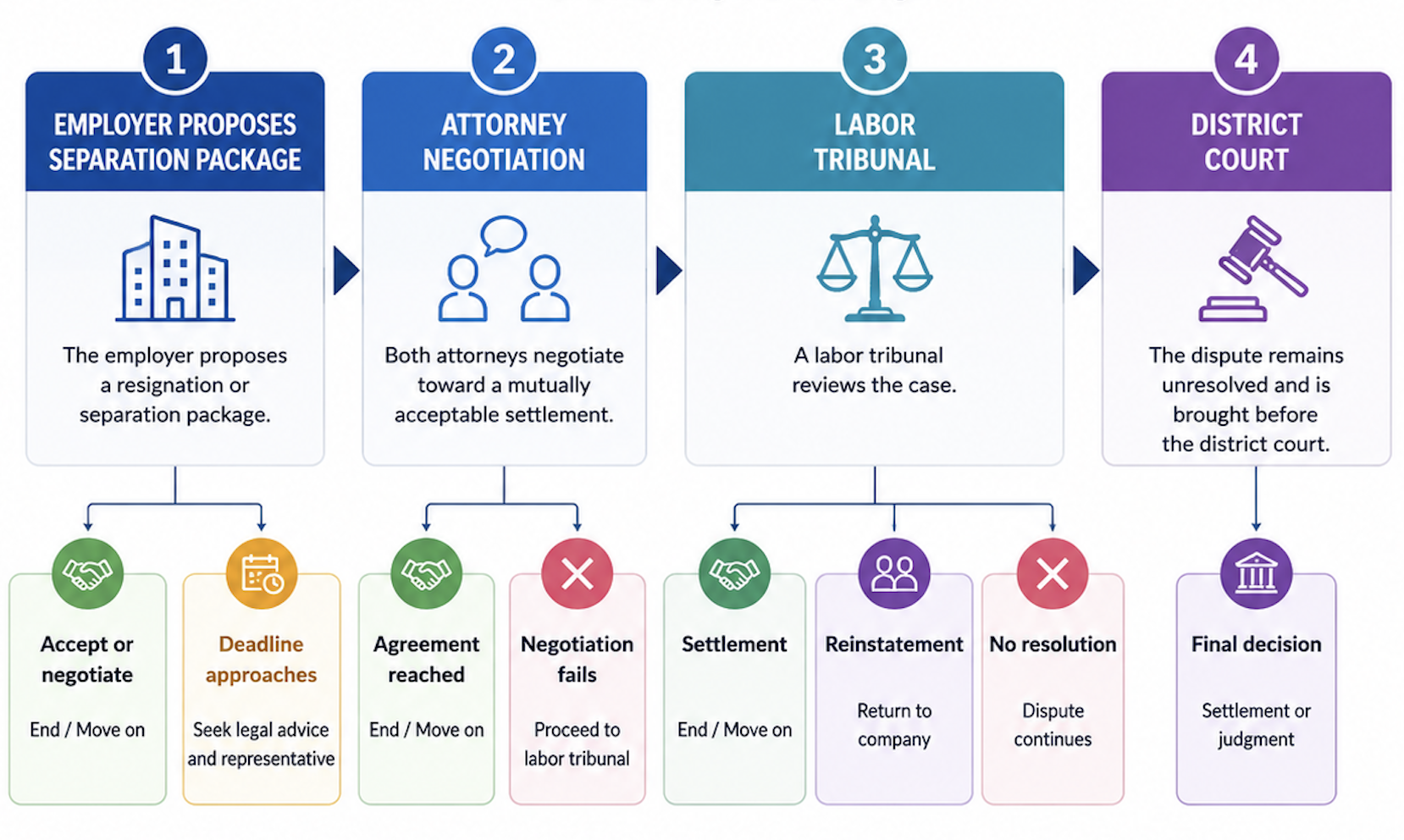
Risk Analysis: Defining Your Strategic Objective
Before moving past Step 1 on the roadmap, separate emotion from strategy and ask a fundamental question: What specific outcome am I actually trying to achieve? A legal victory does not always translate into a career victory.
Consider the operational risks of both paths:
Reinstatement Path (Step 2, 3 and 4): Pushing for reinstatement via a Labor Tribunal can protect your immediate tenure, however it triggers the Reinstatement Paradox. Returning to an office where organizational trust is deeply impacted often leaves you trapped in a compromised, uncomfortable work environment.
Negotiated Exit Path (Step 1): You have the legal right to take the agreement home, review the terms carefully, and consult an attorney before signing.
This path allows you to evaluate your options, negotiate where appropriate, and make a considered decision based on your career goals, financial situation, and personal priorities.
The goal is to evaluate which path best protects your financial runway, mental well-being, and future marketability in Japan.
When You Have to Fight
That said, there are situations where pursuing a formal challenge is justified or even necessary.
Examples include:
Clear violations of an employment contract (i.e. unpaid salary, over time disputes)
Serious breaches of labor laws or workplace regulations (i.e. discrimination, harassment, or unlawful retaliation)
In such cases, seeking legal advice before making any significant decision is strongly recommended. Employees may also seek assistance from the Labor Standards Inspection Office.
Related article
When Employment Disputes Reshape Your Retirement in Japan: Tribunal, Court, or Negotiated Exit?
5.Negotiate for Time, Not Just Money
When discussing a departure package, many employees focus almost exclusively on severance pay.
For foreign residents, however, time can be even more valuable than money.
Negotiating for a later departure date, garden leave, paid leave, unsued PTO (Paid time off) buy out or additional months on payroll can provide important advantages, including:
• Greater visa stability while searching for a new role
• More time for a structured job search
• Continued salary and cash flow
• Ongoing health insurance coverage
• Continued pension contributions
A seamless transition between employers is ideal. It helps avoid gaps in health insurance coverage, pension contributions, and other administrative obligations that may later affect visa renewals or Permanent Residency applications.
If you recognize the warning signs early, consider beginning your job search before the situation reaches the resignation recommendation stage. Any job search activities should, of course, remain strictly confidential.
Why Time Matters
According to Japanese labor statistics, the average unemployment period is approximately 3.6 months. Finding a suitable role often takes longer than people expect.
This is why experienced negotiators frequently focus on how much time the package provides. In many cases, an additional two or three months on payroll may be worth more than a larger one-time payment.
Under a negotiated Paid Leave (Garden Leave) arrangement, you remain on the payroll but are relieved of daily duties. While the company will typically cut off your internal system and PC access for data security, your salary, health insurance, and visa sponsorship continue uninterrupted.
This allows you to focus entirely on job hunting while maintaining total financial and regulatory safety.
5. Foreign Residents: Separation Checklist
Use the following checklist to avoid unnecessary complications.
Immigration & Residency
☐ Notification: Report your official change of employer to Immigration within 14 days of your final termination date.
☐ Status Audit: Confirm whether your current visa status remains valid. Foreign residents holding work visas (such as Engineer / Specialist in Humanities / International Services) must remain aware that being completely unemployed for an extended period without engaging in a documented, active job search can trigger immigration status reviews.
☐ Log Maintenance: Keep meticulous records of all your job-search activities, applications, and interview confirmations to present to Immigration if required.
Related Article
Before changing jobs, make sure you understand the immigration and long-term residency implications.
Japan Visa & PR Guide 2026–2027: Which Path Secures Your Long-Term Future?
Unemployment Office
Hello Work Hacks: Free Government Job Support for Foreigners in Japan
Family
☐ Dependent Check: Review whether your spouse's or children's visa status is structurally linked to your primary employment visa.
Health Insurance & Pension
☐ Prevent Gaps: Ensure there is no gap in health insurance coverage when transitioning between corporate payroll and your next sponsor or National Health Insurance.
☐ Premium Tracking: Keep hard copies of all health insurance premiums and pension contributions paid during your transition; these are strictly audited during Visa renewal and/or PR reviews.
Housing
☐ Corporate Housing Audit:Review any company-sponsored housing arrangements.
Financial & Tax Planning
☐ Package Breakdown: Understand your precise severance components, final salary payouts, and the specific tax rates applied to your retirement allowance.
☐ Review any company pension or retirement plans before leaving. (Retirement allowance and severance are different.)
☐ Emergency Buffer: Re-calculate your liquid budget based on the reality that a premium executive job search may take 4 to 6 months.
If You Leave Japan
☐ Pension Payout: Check whether you qualify for a lump-sum pension withdrawal payment (Dattai Ichijikin).
☐ Tax Management: Confirm all final municipal resident tax (Inhabitants Tax) obligations, bank account closures, and moving requirements before departure.Related Article
Related articles
Leaving Japan Vol.1: Visa, Exit Taxes, Pension Refunds, and What to Do Before You Go
6. Wrap up
If your employer signals that the relationship is ending, focus on protecting your interests, preserving your professionalism, and positioning yourself for what comes next.
At the time, the experience may feel deeply personal. Looking back, however, many people discover it was a turning point in their career.
In the long run, that mindset is often worth far more than winning any individual workplace dispute.
Aki | Japanese | Former Head of HR in Global Finance
Aki has served as Head of Human Resources in the global financial sector.
With over two decades of experience navigating labor law, residency, and wealth protection in both Tokyo and Chicago, she now provides the "insider’s roadmap" for foreigners planning a stable, high-value long-term life and retirement in Japan.
Referral
Japan Institute for Labour Policy and Training (JILPT), Various Unemployment Indicators," Useful Labour Statistics 2023 (PDF).
