

Japan Visa & PR Guide 2026–2027: Which Path Secures Your Long-Term Future?
For many foreign professionals and long-term residents planning to build a life in Japan, securing stable residency is one of the most important decisions you will make.
Japan does not offer a dedicated “retirement visa” or passive-income pathway like some other countries. When your current work visa ends or your personal circumstances change, you will need to qualify under an established status.
This article outlines the three main paths as they stand in 2026–2027, the key policy changes ahead, a practical side-by-side comparison, common pitfalls, and steps you can take now to protect your future in Japan.
What This Article Covers
1 Why Visa Choice Matters More Than Ever for Long-Term Stability
2 Three Main Paths
3 2026–2027 Key Changes
4 Practical Steps and Common Reasons Applications Fail
5 Q&A
6 Wrap-Up

1. Why Visa Choice Matters More Than Ever for Long-Term Stability
Japan’s foreign resident population reached a record 4.12 million by the end of 2025, with Permanent Residents (PR) forming the largest single group at approximately 947,000. Approval rates for PR applications have generally hovered around 60–65% in recent years, though outcomes can vary by immigration office and individual circumstances.
Once your work visa ends or your family situation changes, you must qualify under an existing status that allows indefinite stay.
Permanent Residency offers the strongest protection, but it requires careful preparation. The Spouse route can accelerate the timeline for mixed families, while Long-Term Resident provides flexibility in specific situations.
The choices you make in your 40s and 50s — around consistent pension and insurance payments, stable employment, and tax compliance — directly shape your options when work visas are no longer suitable.
2. The Three Main Paths
Permanent Residency (PR / 永住者)
This is the most secure option for most long-term residents. Once granted, it is indefinite and gives you nearly the same rights as Japanese citizens (except voting).
Long-Term Resident (定住者)
This flexible, case-by-case status has no fixed residence requirement. It is typically granted for divorce or bereavement involving a Japanese spouse, Japanese descendants, or other special humanitarian circumstances. It can serve as a bridge and usually counts toward future PR applications.
Spouse of a Japanese National (日本人の配偶者等)
This family-based status requires clear proof of a genuine and stable marriage. Immigration reviews cohabitation history, joint finances, communication records, and photos from different periods. Household income stability (typically around JPY3 million+ per year) and consistent co-residence are key factors. Interviews are becoming more common.
Note: A similar but separate status exists for spouses of Permanent Residents (永住者の配偶者等).While requirements for marriage genuineness, income, and cohabitation are broadly comparable, the path to Permanent Residency is generally more favorable under the Japanese national spouse category.
Note on Japanese Citizenship
Naturalization is the final step for those who want to become Japanese nationals. It requires renunciation of your original nationality, sufficient Japanese language ability, and a strong record of tax, pension, and social insurance compliance.
Routes to Permanent Residency
Most applicants qualify under current Immigration Services Agency guidelines through one of the following established routes:
Standard Route
In principle, 10 years of continuous residence in Japan, including at least 5 years under a work-related or family-based status, plus strong compliance in taxes, pension, health insurance, and good conduct.
Spouse Route
After 3+ years of a genuine and stable marriage and at least 1 year of continuous residence in Japan on the Spouse visa. This is often the fast option for mixed-nationality couples when evidence of the relationship is solid.
Highly Skilled Professional (HSP) Points Route
Using the points-based system: 70 points or higher allows application after 3 years of residence; 80 points or higher allows application after 1 year. Points are based on salary (e.g., JPY10 million contributes significantly), education, professional experience, Japanese language ability, and age.
Additional Recognized Exceptions
Other powerful exceptions to the standard 10-year rule include:
Long-Term Resident status with 5+ years of continuous residence
Recognized contributions to Japan in diplomatic, social, economic, or cultural fields with 5+ years of residence
Special Highly Skilled Professional (J-Skip) — introduced in 2023 to attract top-tier global talent. This highly selective fast-track allows eligible professionals to apply for Permanent Residency (PR) after just 1 year of residence in Japan.
Typical thresholds include a master’s degree or 10+ years of experience plus an annual income of at least JPY20 million (or JPY40 million+ for business management roles). J-Skip bypasses the standard points calculation and offers one of the quickest paths available for those who qualify.
This makes J-Skip one of the fastest options for highly qualified professionals who meet the strict criteria.
These options highlight why consistent record-keeping and strategic career decisions today can dramatically accelerate your path to long-term stability in Japan.
Exact eligibility depends on your personal situation. Always verify the latest guidelines with the Immigration Services Agency or consult a qualified administrative scrivener (gyoseishoshi/行政書士).
Side-by-Side Comparison
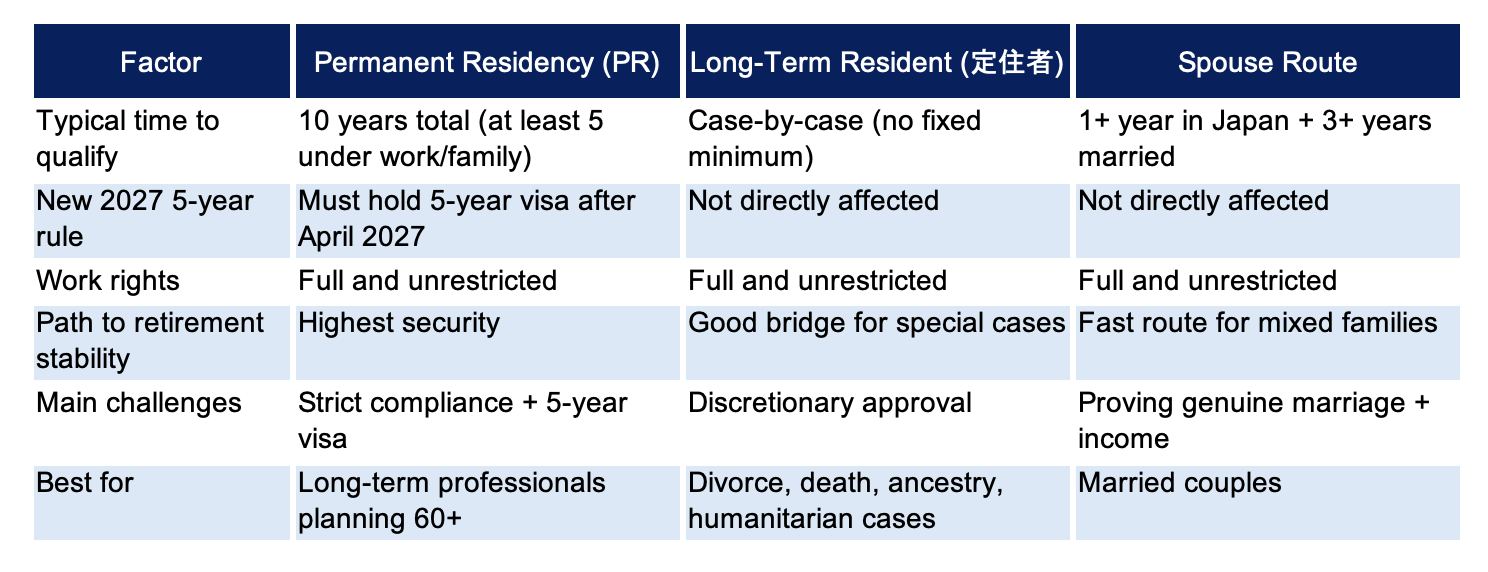
3. 2026–2027 Key Changes
Confirmed change
On February 24, 2026, the Immigration Services Agency revised its guidelines. From April 1, 2027, Permanent Residency (PR) applicants must hold the maximum period of stay on their current visa (typically five years) at the time of application.
Note: Applicants who receive a three-year visa on or before March 31,2027 may still apply for PR under the previous rules for their first application, even if submitted after April 1, 2027.
For those currently holding a three-year visa, this period is treated as the maximum until the grace period ends on March 31, 2027. If you meet other eligibility criteria, consider applying before the change takes full effect.
Policy Discussions Under Consideration
In addition to the confirmed change, several policy discussions are underway that may further tighten requirements, though details and timelines have not been finalized.
The application fee for Permanent Residency is currently JPY10,000. A bill approved in March 2026 raises the statutory upper limit to JPY300,000 (with similar increases proposed for status changes and extensions). Actual new fees will be set by cabinet order, with possible implementation from 2026 onward.
The government is considering adding a Japanese language proficiency requirement for PR applications, potentially from fiscal 2027, to support better community integration. Specific levels and exceptions remain under review.
Operational guidelines for naturalization, effective April 1, 2026, now apply a practical standard of approximately 10 years of continuous residence.
These developments reflect a broader emphasis on consistent compliance and long-term commitment to life in Japan. Because some elements are still under discussion, check the latest official guidelines regularly.

4. Practical Steps and Common Reasons Applications Fail
Start early. Update your tax, pension, and health insurance records, gather any needed cohabitation or relationship evidence, and confirm the latest requirements at your local immigration office.
Consulting a qualified administrative scrivener is recommended for complex cases.
Immigration authorities now review tax, social security, and employment records together. Even one weak area can affect your PR, Long-Term Resident, or Spouse visa application.
Here are the most common reasons applications are refused — grouped by the three areas authorities examine most closely — along with practical steps you can take today:
Tax Compliance
Unpaid tax, late filings, or repeated delays in paying tax are among the top reasons for refusal. Even small or previously corrected issues now receive closer scrutiny.
→ What to do: Keep complete, clean payment records for at least the past 5 years and file accurately every year.
Social Security (Pension + Health Insurance)
Gaps in National Pension enrollment, long-term non-payment of National Health Insurance premiums, or delayed employer enrollment in social insurance are viewed as signs that you have not fully met your obligations in Japan.
→ What to do: Ensure continuous enrollment and timely payments. Resolve any past issues quickly and keep proof of resolution.
Employment and Income Stability
Annual income below the informal self-sufficiency threshold (roughly JPY3 million per person), repeated job changes, or highly fluctuating self-employed earnings can raise concerns about long-term stability.
→ What to do: Aim for steady employment or consistent business performance and document how your work contributes to Japan.
Other Frequent Risks
Multiple traffic violations (especially DUI, repeated speeding, or even repeated minor offenses such as running a red light or illegal parking) or any criminal record.
Incomplete or inconsistent documentation, missing papers, or poor-quality translations.
Extended absences from Japan (a single trip longer than 3 months, total annual absences over 100 days, or frequent long returns home).
Problems with your guarantor (must be a Japanese national or Permanent Resident with stable income and clean records).
Failure to report job changes to Immigration within 14 days after changing or leaving an employer.
For Spouse visa holders: working beyond the permitted 28 hours per week on a dependent status (this can affect both PR and future visa renewals).
Addressing these areas now protects more than your visa application — it builds the foundation for smooth access to Japan’s senior healthcare and pension systems in retirement.

5. Q&A
Q1: What can I do if my PR application is rejected?
A1: You can visit the Immigration Office with your rejection notice to understand the specific reasons. If the issue is temporary (e.g., missing documents), you may reapply after correction. Consulting a visa specialist is recommended.
Q2: Should I apply for PR before April 2027 if I have a 3-year visa?
A2: Yes, if you are otherwise eligible. The grace period ends March 31, 2027 — after that you will need a 5-year visa.
Q3: Can Long-Term Resident lead to PR?
A3: Yes, it can count toward the 10-year requirement and is often used as a stepping stone.
Q4: What is the biggest reason spouse visa applications are refused?
A4: Insufficient proof that the marriage is genuine and stable.
Q5: Does a past late payment automatically disqualify me?
A5: Not automatically, but it significantly increases scrutiny — especially after the 2026 revisions.
Q6:Does J-Skip guarantee Permanent Residency after one year?
A6: No. J-Skip allows you to apply after one year, but approval still depends on strong overall compliance, good conduct, and demonstrating that your stay benefits Japan.
Q7: How important is the guarantor?
A7: Extremely. The guarantor must be a Japanese national or Permanent Resident with stable income and clean records. Issues with the guarantor can weaken or sink the application.
Q8: Can I use the shortened spouse route if my marriage is less than three years?
A8: Generally no. The fast-track usually requires at least three years of marriage plus one year of residence in Japan.
6. Wrap-Up
Choosing the right visa status is one of the most important decisions for anyone planning long-term future in Japan.
The 2026–2027 changes make one thing clear: your daily compliance now directly shapes your future options.
Now that you understand how your current visa path affects long-term life security. A single gap in your records today can affect your options tomorrow.
Next Monday we cover Pension & Contributions — how the choices you make on job changes, and residency directly impact your pension accrual and senior-care eligibility.
If you have experiences, tips, or questions, please share them in the comments.
And if you found this article helpful, please consider sharing it with friends, family, or colleagues who are living in or planning to move to Japan.
Disclaimer
This article provides general information based on publicly available Immigration Services Agency guidelines as of 2026. Requirements can change and individual outcomes vary. It is not legal advice. For personalized guidance, please consult the Immigration Services Agency directly or a qualified administrative scrivener.
References
Japan Times – Immigration Policy Coverage
Immigration Services Agency guidelines (Feb 2026 revision)
See also
How Much to Retire in Japan as an Expat: 2026 Costs, Visas, and Realistic Budgets
