

Matching Your Residency Status to Your Long-Term Life Plan
Most foreigners focus on one question:
"How do I qualify?"
But if you've already built a life in Japan, a more important question is:
"Which residency status best supports the life I want to build?"
You may plan to retire in Japan, raise a family here, run a business, or eventually become a Japanese citizen.
Life, however, doesn't always go according to plan. Family responsibilities, career changes, health issues, or retirement can all affect whether your current residency status still meets your needs.
This article will help you evaluate the residency status that best supports your long-term plans.
Quick summary
Major life events can change your residency options.
Immigration status and tax status are governed by different rules.
Permanent Residence offers flexibility, but planning early is increasingly important.
Review your residency strategy before life forces you to.
Table of Contents
1. Residency Status Risk Matrix
2. There Is No "Best" Status—Only the Right Priorities
3. Life Events That Can Change Your Residency Plans
4. Business Managers Face Different Questions
5. The Tightening Rules: Prepare for Permanent Residence Early
6. Q&A
7. Wrap Up
1. Residency Status Risk Matrix
Whether it's retirement, divorce, losing a job, closing a business, or spending more time overseas, different residency statuses respond very differently.
Instead of comparing application requirements, compare how each status supports your life over the next twenty years.
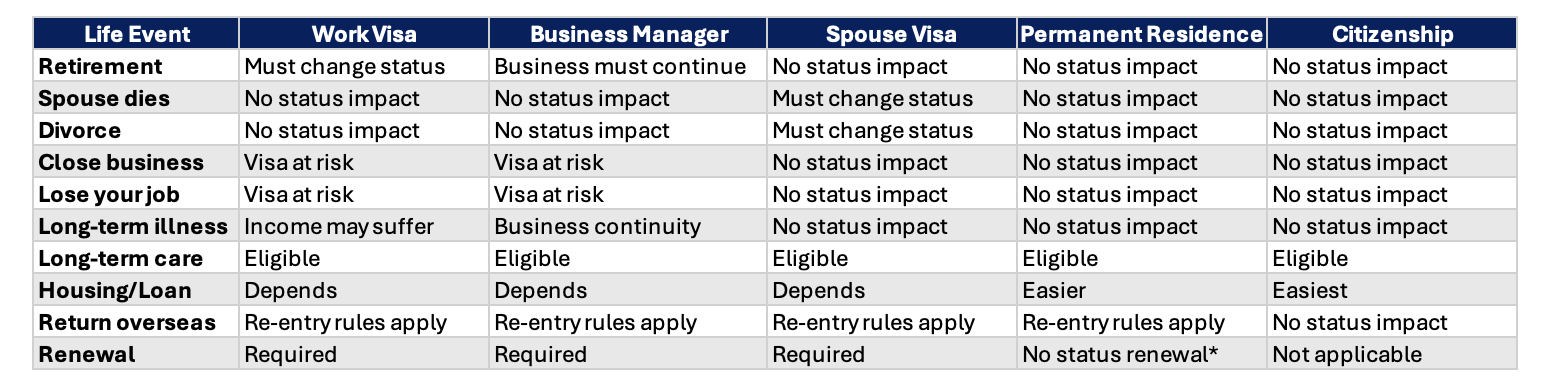
NOTE: the table reflects the primary status holder (not dependents)
*PR/Renewal: While PR status does not expire, physical Residence Cards must still be renewed every 7 years.
The comparison highlights important difference.
Work and Business Manager Visas depend on your professional activities. Retirement, changing jobs, or closing a business may require a different residency status.
Spouse Visas provide complete freedom to work, but your residency depends on your marriage. Divorce or the death of your spouse may require a different residency status.
Permanent Residence and Japanese citizenship offer greater independence from changes in employment or family circumstances, but they aren't automatically the right choice for everyone.
Every residency status has its own advantages and trade-offs.
The best choice depends on where you hope to be 10, 20, or even 30 years from now.
2. There Is No "Best" Status—Only the Right Priorities
Before reading further, ask yourself:
Retirement & Lifestyle
☐ I plan to retire in Japan.☐ I may eventually return to my home country.☐ I expect my circumstances to change over the next 10–20 years.
Career & Business
☐ I want the freedom to change jobs more easily.☐ I own—or plan to own—a business.
Family
☐ My children or parents live overseas.
Identity
☐ My original citizenship is an important part of my identity.
Financial Planning
☐ I have significant financial ties to more than one country.
☐ I expect to inherit property outside Japan.
Residency Goals
☐ I want to avoid renewing my residency status.☐ I want maximum long-term stability.
You don't need to answer every question today.
The purpose of this article is to help you identify which issues deserve your attention before a major life event forces a decision.
3. 6 Life Events That Can Change Your Residency Plans
Major life events often have unexpected consequences for your residency status.
Thinking through these scenarios now can help you avoid difficult decisions later.
1. What happens when I retire?
Japan does not have a retirement visa.
If your residency is based on employment, retiring mean losing the basis for your residency. Depending on your circumstances, you may need to qualify for Permanent Residence, change to another residency status, or leave Japan.
A Real Story
One employee retired with 2 years remaining on his Residence Card. Assuming the card alone allowed him to remain in Japan, he stayed unemployed until he discovered that his work visa required him to continue the authorized work activity.
He eventually had to return to work—not because he wanted to, but because he needed a legal basis to remain in Japan while applying for Permanent Residence.
Key takeaway
There is no age limit for applying for Permanent Residence.
However, if you plan to retire in Japan, applying while you are still employed is often much easier than waiting until after retirement.
Once you retire, you may need to demonstrate that you have sufficient financial resources to support yourself without employment.
Related article
Thinking About Returning to the United States After 20 Years in Japan?
2 What Happens If Your Spouse Dies or You Divorce?
A Spouse Visa offers considerable flexibility because it allows you to work without employment restrictions.
However, the basis for your Spouse Visa is your marriage.
If your spouse dies or you divorce, that basis no longer exists.
Depending on your circumstances, you may be eligible to change to another residency status, such as Long-Term Resident (定住者).
However, approval is not automatic. Immigration considers factors such as the length of your marriage, your financial stability, your integration into Japanese society, and whether you have fulfilled your public obligations, including your tax and social insurance obligations.
A Real Story
A long-term resident lost his Japanese wife in an accident. Believing his Residence Card remained valid, he assumed he could continue living in Japan without taking any immediate action.
He later discovered that the end of his marriage also required him to deal with his residency status.
Planning Tip
After the death of a spouse or a divorce, you must notify Immigration within 14 days, and if you wish to remain in Japan, apply for a new residency status within 6 months.
Related article
When Your Spouse Becomes Your Care Plan: Navigating One of Retirement's Biggest Transitions
3. How will inheritance work?
Many long-term residents spend years building a life in Japan—buying a home, saving for retirement, and raising a family. Yet few consider how their assets will be distributed when they or their spouse pass away.
Many people assume that living in Japan means Japanese inheritance law automatically applies.
Under Japan's Act on General Rules for Application of Laws, inheritance is generally governed by the national law of the deceased, although limited exceptions may apply.
Depending on the foreign country's laws, a legal loop called renvoi (反致) often applies, redirecting the jurisdiction back to Japanese civil law.
Separately, inheritance tax is governed under applicable tax laws, independent of asset distribution rules.
A Real Story
After her Japanese husband passed away, a foreign resident assumed she had little financial security because she was a foreign spouse.
Instead, she learned that she was a legal heir under Japanese law as he is a Japanese national, and inherited part of the family home and savings.
Those assets later helped demonstrate her financial independence when she applied for a Long-Term Resident visa.
Planning Tip
If your family has more than one nationality, don't assume a single country's laws will govern your inheritance.
Review your estate plan with a professional before a major life event forces you to.
4. Your Immigration Status and Tax Status Are Not the Same
Immigration status and tax residency are governed by different laws.
Your visa is determined under the Immigration Control and Refugee Recognition Act, while your tax status is determined under the Income Tax Act.
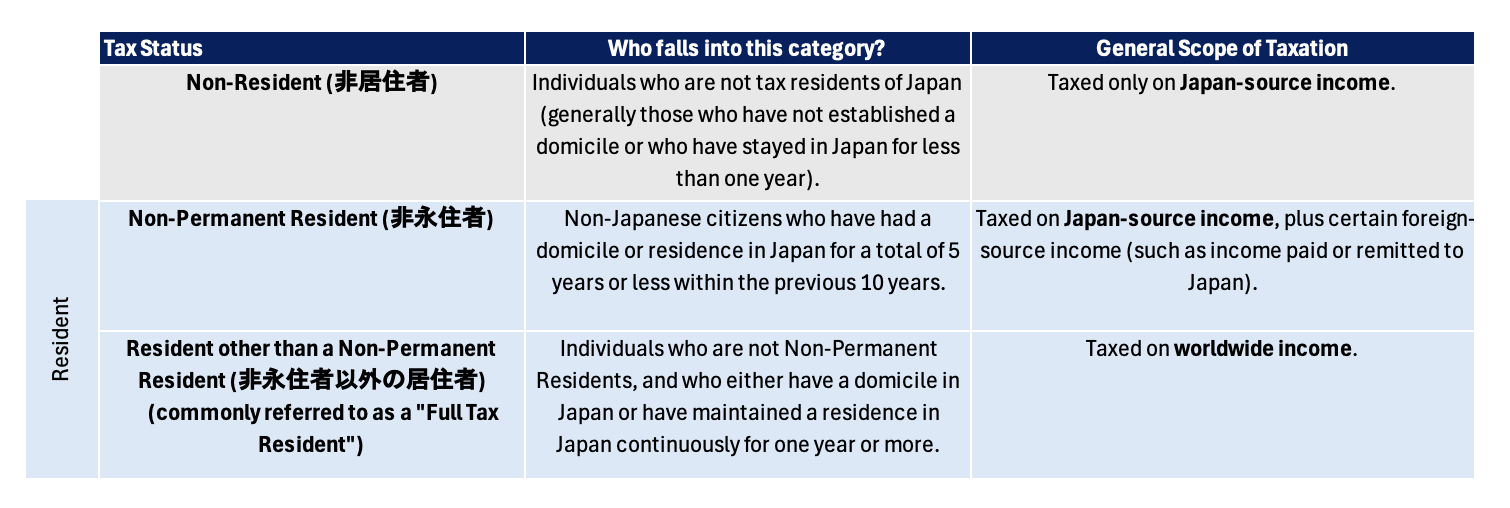
Under Japanese tax law, individuals generally fall into three categories:
The Critical Five-Year Threshold
For many long-term foreign residents, the most significant milestone is the five-year threshold.
Once you have had a domicile or residence in Japan for more than five of the previous ten years, you are no longer classified as a Non-Permanent Resident (非永住者) for income tax purposes. As a result, Japan generally taxes your worldwide income.
In addition, If your overseas assets exceed JPY 50 million, you are also required to file an Overseas Asset Report (国外財産調書) with the National Tax Agency.
This change occurs regardless of your immigration status. Your tax status is determined under the Income Tax Act, not immigration law.
Navigator Insight: Immigration planning and tax planning should go hand in hand.
Related article
5. Will I remain eligible for healthcare and long-term care?
Any foreign national who legally resides with Resident Registration in Japan for more than 3 months is generally required to enroll in either Employees' Health Insurance or the National Health Insurance system.From the age of 40, enrollment in Long-Term Care Insurance (介護保険) becomes mandatory through the insurance system.
Your eligibility for Japan's healthcare and long-term care benefits is based on your legal residence and enrollment in the public insurance system, not your visa category.
Planning Tip: If you plan to retire in Japan, maintaining a valid residence status is essential to ensure continued access to Japan's healthcare and long-term care system.
6. Where are my children and extended family?
Life doesn't always go according to plan. You may need to spend months—or even years—outside Japan to care for aging parents, support an adult child during an illness, childbirth, or childcare, or assist other family members overseas.
For many cross-border families, these responsibilities are unavoidable. However, immigration rules may not accommodate prolonged absences from Japan.
Permanent Residents must still comply with Japan's re-entry rules to maintain their status, while Japanese citizens are not subject to those restrictions.
Planning Tip: If your closest family lives outside Japan, consider how an extended stay abroad could affect your long-term residency plans.
The best residency status is not only the one that fits your life today—it is the one that gives you greater flexibility when life unexpectedly changes.
Navigator Insight: Immigration decisions should take future family responsibilities into account, not just your current circumstances.
Related articles
Your Children Live Overseas: Planning Senior Care in Japan Before a Crisis Occurs
Senior Care in Japan: Costs, Choices, and What Foreigners Should Know
4. Business Managers Face Different Questions
Many foreign entrepreneurs in Japan operate on a Business Manager Visa. They build successful companies and assume that retirement will be seamless: "I'll just stop working and live off my business savings in Japan."
This is a common misconception.
A Business Manager Visa requires an active business that continues to satisfy the requirements for that status of residence. If you close or sell the business to retire, the legal basis for your visa may no longer exist.
Navigator Insight:
If your long-term goal is to retire in Japan, consider obtaining Permanent Residence while your business is still operating and you continue to meet the eligibility requirements.
Or build an exit strategy for your business and your residency at the same time.
5. The Tightening Rules: Prepare for Permanent Residence Early
Obtaining Permanent Residence (PR) in Japan is becoming increasingly demanding.
Recent legislative changes and proposed revisions to the PR guidelines indicate a clear trend toward stricter screening and greater emphasis on long-term self-sufficiency.
Already in Effect
Information sharing between the National Tax Agency and the Immigration Services Agency began on July 1, 2026, enabling immigration authorities to verify applicants' tax compliance more efficiently.
Proposed Changes
Higher income expectations – Income may be expected to exceed the average Japanese household income.
Retirement readiness – Future pension income and financial assets may be assessed to demonstrate long-term financial independence.
Greater social integration – Compliance with civic responsibilities and understanding of Japanese society may become part of the evaluation.
Planning Tip
If Permanent Residence is part of your long-term plan, don't wait until retirement, selling your business, or another major life event.

6.Q&A
Q1. Can I change my residency status later if my circumstances change?
A1. Often, yes. Many foreign residents change their status of residence as their lives evolve—for example, from a Work Visa to Permanent Residence, or from Permanent Residence to Japanese citizenship.
The challenge is that major life events often happen. Retirement, divorce, selling a business, or family responsibilities overseas can all affect your residency options.
That's why it's important to review your residency status, rather than assuming your current status will always remain the best fit.
Q2. I had to give up my Permanent Residence after returning to my home country. Can I apply again?
A2. Yes. In general, you may apply for Permanent Residence again if you meet the eligibility requirements.
However, there is no "fast track" for former Permanent Residents. In most cases, you must start the process again—obtain an appropriate status of residence, satisfy the required period of residence in Japan, and submit a new Permanent Residence application under the rules in effect at that time.
8. Wrap Up
For people living a cross-border life, choosing—and maintaining—the right residency status can be one of the most important long-term decisions.
Some choose to become Japanese citizens and give up their original nationality. Others prefer to keep renewing their residency status to maintain their home citizenship.
Neither choice is inherently better—it depends on your priorities, your family, and the life you want to build.
What residency status do you currently hold, and where do you see yourself in 10 or 20 years? I'd love to hear your thoughts and experiences in the comments below.
Aki | Japanese | Former Head of HR in Global Finance
With over two decades of experience navigating labor law, residency, and wealth protection in both Tokyo and Chicago, she now provides the "insider’s roadmap" for foreigners planning a stable, high-value long-term life and retirement in Japan.
