

Choosing Retirement Living Option in Japan Starts with the Right Mindset
After you decide to retire in Japan, many more decisions follow—where to live, what support you may need, and how to prepare for the future.
Fortunately, Japan offers more retirement living options than many foreign residents realize.
But I believe the most important decision is to decide how you want to live as you grow older.
Once you answer that question, choosing where to live becomes much easier.
Quick Summary
Start with your mindset. Decide how you want to live before deciding where to live.
Know your options. Understand Japan's retirement living choices and the trade-offs each offers.
Find the right fit. Balance independence, care needs, finances, and lifestyle—not just the level of care.
Learn from experience. Discover the lessons my family learned through my father's retirement journey.
Table of Contents
1. Start with Your Mindset
2. Understanding Your Living Options in Japan
3. Choosing the Option That Fits You
4. My Father's Decision: Lessons Learned
5. Q&A
6. Wrap-up: The Best Choice Is Your Choice
1. Start with Your Mindset
Before comparing facilities or housing options, take a step back.
Ask yourself a different question.
What kind of life do I want to live as I grow older?
In the United States, retirement living is often determined by financial circumstances.
In Japan, long-term care insurance and relatively affordable care services give many people greater flexibility to choose the lifestyle that best suits them.
That's why I believe your mindset should come first.
I believe the answer begins with maintaining three kinds of independence.
Financial Independence
Financial independence doesn't necessarily mean having a large retirement fund.
It means remaining involved in your own financial decisions.
Can you still manage your money?
Do you understand your income and expenses?
Have you planned ahead to protect yourself from fraud and scams?
Maintaining control over these decisions is an important part of remaining independent.
Intellectual Independence
Retiring doesn't mean expiring.
Stay curious.
Keep learning.
Read.
Start a new hobby.
Challenge yourself.
Continue making your own decisions.
A healthy mind helps you adapt to the changes that retirement inevitably brings.
Personal Independence
This may be the most important of all.
Personal independence means taking responsibility for your own happiness.
No home, retirement community, or care facility can provide purpose for you.
Wherever you live, your attitude, relationships, and interests remain your responsibility.
The place you choose can support your life.
It cannot live your life for you.
These three forms of independence become the foundation for every decision that follows.
2. Understanding Your Living Options in Japan
In the U.S., many retirees follow a familiar progression:
Home
→ Retirement community
→ Assisted living
→ Nursing home
Japan offers much more flexibility.
Common options include:
Aging in place (staying at home with home helpers and adult day-care programs)
Senior Housing with Support Services / Sakouju (サービス付き高齢者向け住宅)
Fee-Based Nursing Homes (介護付き有料老人ホーム)
Group Homes for People with Dementia (認知症対応型共同生活介護)
Long-Term Care Health Facilities / Roken (介護老人保健施設)
Special Nursing Homes / Tokuyo (特別養護老人ホーム)
Community Living or Co-housing
Some people move several times as their care needs change.
Others choose a residence where they hope to remain for the rest of their lives, even if it costs more.
Neither approach is right or wrong.
The best choice depends on your priorities, your health, and the way you want to live.
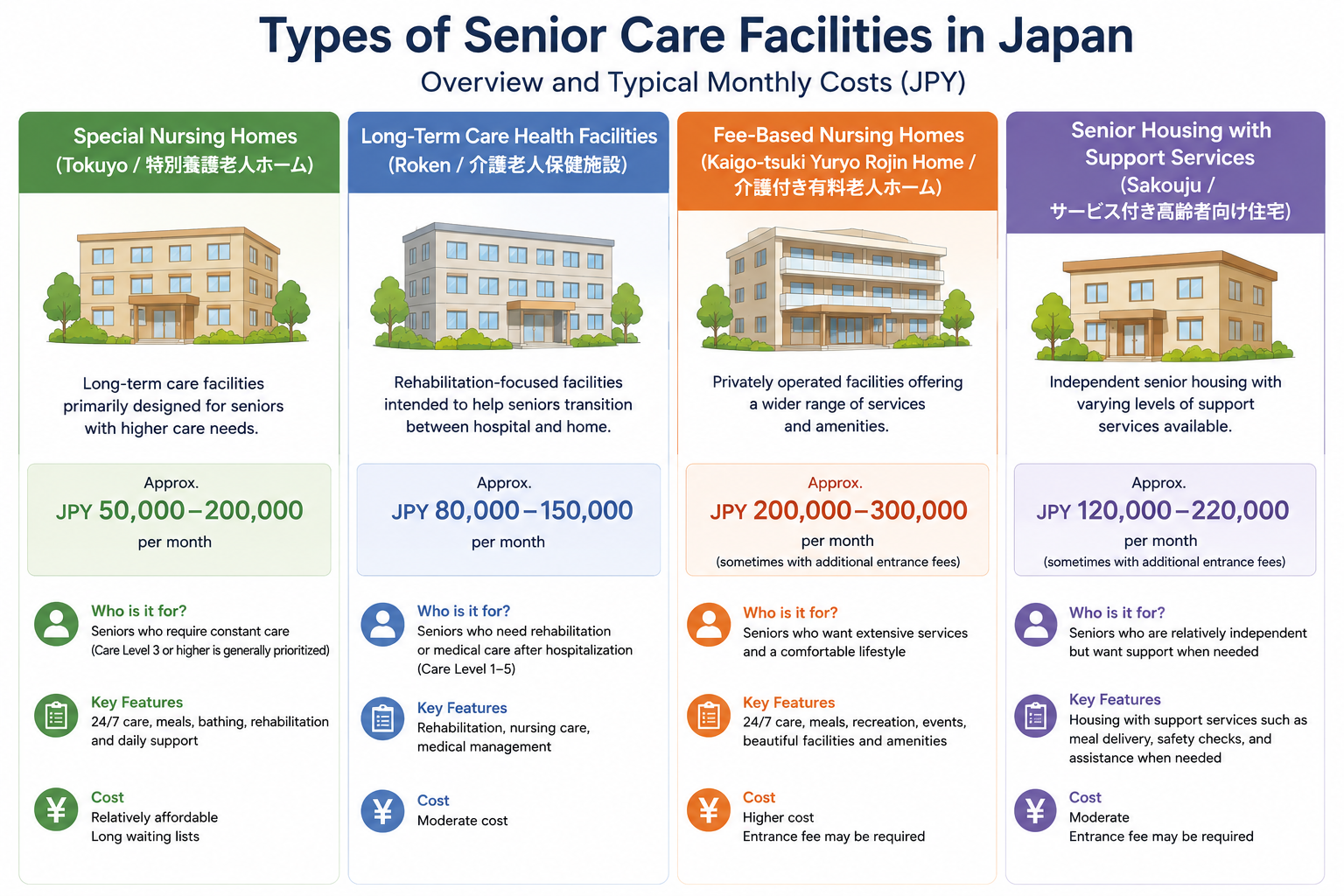
Note: This chart focuses on the four most common senior housing and care facilities. Many people also choose to age in place with home-care services or explore community-living arrangements.
3. Choosing the Option That Fits You
Instead of asking,
"Which facility is the best?"
Ask,
"Which environment best supports the life I want to live?"
Before making a decision, ask yourself:
☐ What level of care do I need today?
☐ How might my care needs change in the future?
☐ Can I comfortably afford this over the long term?
☐ Is it conveniently located near doctors, hospitals, shopping, and other essential services?
☐ Will my spouse, family, or friends be able to visit ?
☐ Should we move together, separately, or at different times?
☐ What kind of community and lifestyle would make me happiest?
☐ If my condition changes, will I need to move again?
☐ Is English-language support available if I need it?
☐ Will I feel comfortable with the culture, activities, and daily life offered there?
Every choice involves trade-offs.
Related articles
Your Children Live Overseas: Planning Senior Care in Japan Before a Crisis Occurs
Premium Care Roadmap: Navigating Quality and Optionality in Japanese Senior Living
4. My Father's Decision: Lessons Learned
An Unexpected Experience
After my mother passed away four years ago, my father continued living alone. Then he fell from his bicycle and was hospitalized.
When he was discharged from the hospital using a walker, our family had just 2 weeks to find somewhere for him to live. The only available option was a group home for people with dementia, so that's where he was admitted.
At the time, we didn't understand the differences between Japan's various care facilities, so it seemed like the ideal solution. The facility was clean, and the staff were always available. We felt relieved knowing he was safe.
But it turned out to be a huge mistake.
What He Missed Most
Soon after, however, he decided to return home.
He told me that what he missed most wasn't simply his house. It was the life and identity he had built there.
At home, he made his own decisions, managed his finances, stayed in touch with former colleagues, and looked after himself. In the facility, he became a resident instead of the person he had always been.
Simple decisions—when to take a bath, what to eat, which newspaper to read—gave him a sense of purpose and independence.
Today, with the support of a care manager, he receives home-care services, including daily helper visits, in-home rehabilitation, and regular nursing visits.
Living alone isn't easy. He still cooks, manages his finances, prepares his own tax return, and copes with occasional back pain while continuing to miss my mother.
What I Learned
Looking back, I learned two important lessons.
First, the right environment depends on the individual.
The facility cared for many residents with dementia, making meaningful conversation difficult. A senior housing with support serveices (サービス付き高齢者向け住宅),where residents are generally more independent, might have suited him better.
It wasn't that the facility was bad.
It simply wasn't the right fit for him.
Second, there is no single "best" place to grow older. Families naturally value safety and convenience, but those often come with a more structured way of living. For my father, that trade-off wasn't worth it.
Whenever I visit my father at home, he laughs, and his eyes are still full of determination. As long as he is able, he wants to remain in the home and life he has built.
Related article
Your Greatest Retirement Asset Is Your Health: A Foreigner's Guide to Preventive Healthcare in Japan

5.Q&A
Q1. Should I stay at home as long as possible?
A1.Not necessarily.
For some people, remaining at home provides independence and comfort.
For others, moving earlier may offer better social connections, easier access to care, and greater peace of mind.
The best decision depends on your priorities, health, finances, and support network.
Q2. Will I lose my independence if I move into a care facility?
A2. To some extent, yes. Every care facility has rules designed to keep residents safe. The level of independence you retain depends largely on choosing a facility that matches your physical and cognitive abilities.
Senior Housing with Support Services (Sakouju): Suitable for people who are independent or need only light support. Rules on going out, staying overnight elsewhere, and daily activities are generally quite flexible.
Fee-Based Nursing Homes: Provide more comprehensive support, but may have stricter safety rules depending on the facility and the resident's condition.
Special Nursing Homes (Tokuyo): Designed for people with higher care needs. Independent outings and extended overnight stays are often restricted for safety reasons.
Timing matters as much as facility type.
If maintaining your independence is your highest priority, moving earlier to a less restrictive facility may allow you to preserve more freedom while receiving the support you need.
Q3. What if I don't speak Japanese well?
A3. Language barriers often limit foreign residents to private facilities that provide English support, which can be expensive.
However, if you remain cognitively healthy, staying at home with an English-speaking care manager and home helpers may allow you to maintain more independence than moving into a full-care facility where communication is difficult.
Q4. My parents refuse to move into a care facility. What can I do?
A4. First of all, they cannot be forced to move, even if you live overseas and want them to be safe.
It is important to discuss their wishes before a transition move is actually required.
You can also consult your local Community General Support Center(地域包括支援センター) to understand what services are available and prepare for future care needs.
Q5. Can my spouse and I move into a facility together?
A5. Yes, but it requires careful planning.
Standard Special Nursing Homes/Tokuyoadmit residents based on their certified care level, making it difficult for couples to move in together.
However, Senior Housing with Support Services/Sakoju and many fee-based senior homes offer apartments for couples, allowing a healthy spouse to live with a partner who receives care services.
6.Wrap-up: The Best Choice Is Your Choice
Retirement doesn't free us from making difficult decisions.
My father understands the risks of living alone. He knows that one day he may fall again or become seriously ill.
At first, we tried to persuade him to stay in the facility because we didn't understand the different types of care facilities. We hoped he would adjust.
But we eventually realized that it wasn't the right fit for him.It was his decision to make.
All we can do is support him in living the life he has chosen.
We still encourage him to wear a personal emergency alarm, but whenever I visit, I find it sitting somewhere in the house instead of around his wrist.
Aki | Japanese | Former Head of HR in Global Finance
I believe building a long-term life in Japan requires seeing the bigger picture.
By understanding how visa, healthcare, taxes, retirement, senior care, inheritance, and family decisions fit together, you can make informed decisions and take calculated risks.
Do you have any questions or feedback? I'd love to hear from you in the comments below.
