

Your Children Live Overseas: Planning Senior Care in Japan Before a Crisis Occurs
For many foreign retirees, returnee Japanese, and international couples, retirement planning often focuses on finances.
How much should I save?
Will my pension be enough?
Yet as retirement progresses, another question gradually becomes more important: Who will help when I need care?
This article provides a framework to help you think through the practical realities of aging in Japan when your family lives overseas.
Quick Summary
Senior care is not a single decision—it is a series of decisions that evolve over time.
Even after entering a care facility, families are often involved in care meetings, medical decisions, emergencies, and financial matters.
Understanding how Japan's senior care system actually works can help international families prepare before a crisis occurs.
Table of Contens
1. What Keeps Seniors Going?
2. Senior Care Is a Series of Decisions
3. The Reality of Managing Care from Overseas
4. Medical Decisions Become Part of Care Planning
5. Cross-Border Senior Care Checklist
6. Q&A
7. Wrap Up
1. What Keeps Seniors Going?
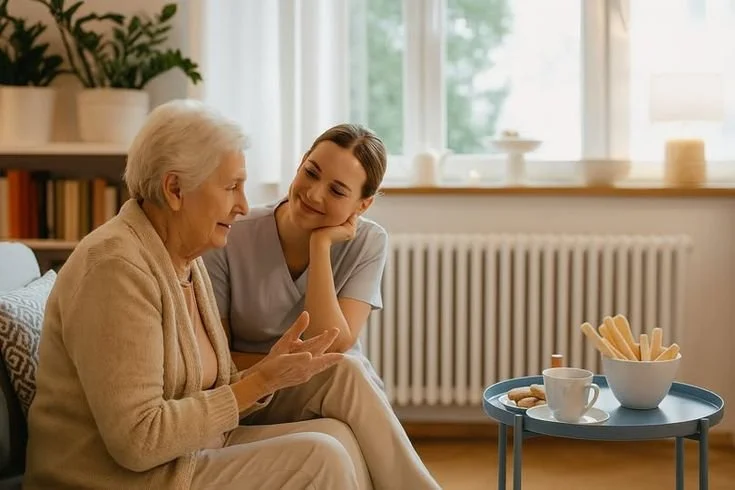
One lesson I have learned through both personal experience and conversations with friends is that senior care is not simply about safety.
Many people focus on practical considerations:
Medical support
Caregiver availability
Facility quality
Financial resources
All of these matter.
However, many seniors place equal importance on independence, familiar surroundings, and human connection. As a result, people often take very different approaches to aging.
For instance:
Option A | Aging in Place
Some, including my father, prefer to remain in their own homes for as long as possible. They value familiar neighborhoods, long-established routines, and the freedom to live on their own terms.
Option B | Planned Transition
Others choose to move into a senior residence while they are still healthy. They prefer to establish a new community early and reduce the burden on family members who may live overseas.
Of course, these are only two examples. Many families combine different approaches over time as circumstances change and care needs evolve.
Senior care is ultimately about finding the right balance between independence and security. The goal may not to eliminate every risk.
For international families, achieving that balance can be especially challenging when children, relatives, and support networks are spread across different countries.
2. Senior Care Is a Series of Decisions
Many people assume senior care is a single decision: "When should I enter a facility?"
In reality, it is often a series of decisions that evolve over many years.
A typical path may include:
Living independently
Home-care services
Hospitalization
Rehabilitation
Facility admission
Higher care levels
Transfer to a different facility
Medical decisions
End-of-life care
The exact path differs for every family. The goal is to begin planning early enough that your preferences can still guide the process.
When Should You Consider a Care Facility?
Decline in Activities of Daily Living (ADLs) such as:
Managing medications
Preparing meals and eating
Personal hygiene
Toileting
The second is progression of dementia symptoms such as:
Difficulty managing finances
Forgetting to lock doors
Unsafe use of gas appliances
Wandering behavior
Significant personality or emotional changes
The third is the spouse or family acting as caregiver.
Many international couples assume:
"My spouse will take care of me."
The real question is:
"Who takes care of my spouse?"
For international families, this question becomes particularly important when one spouse passes away first. A care plan that worked well as a couple may no longer be realistic for the surviving spouse.
Many families begin researching care options in their 60s or 70s and eventually transition into a facility during their 80s.
Typical Monthly Costs
Once a family begins considering facility care, the next question is often what type of facility is appropriate.
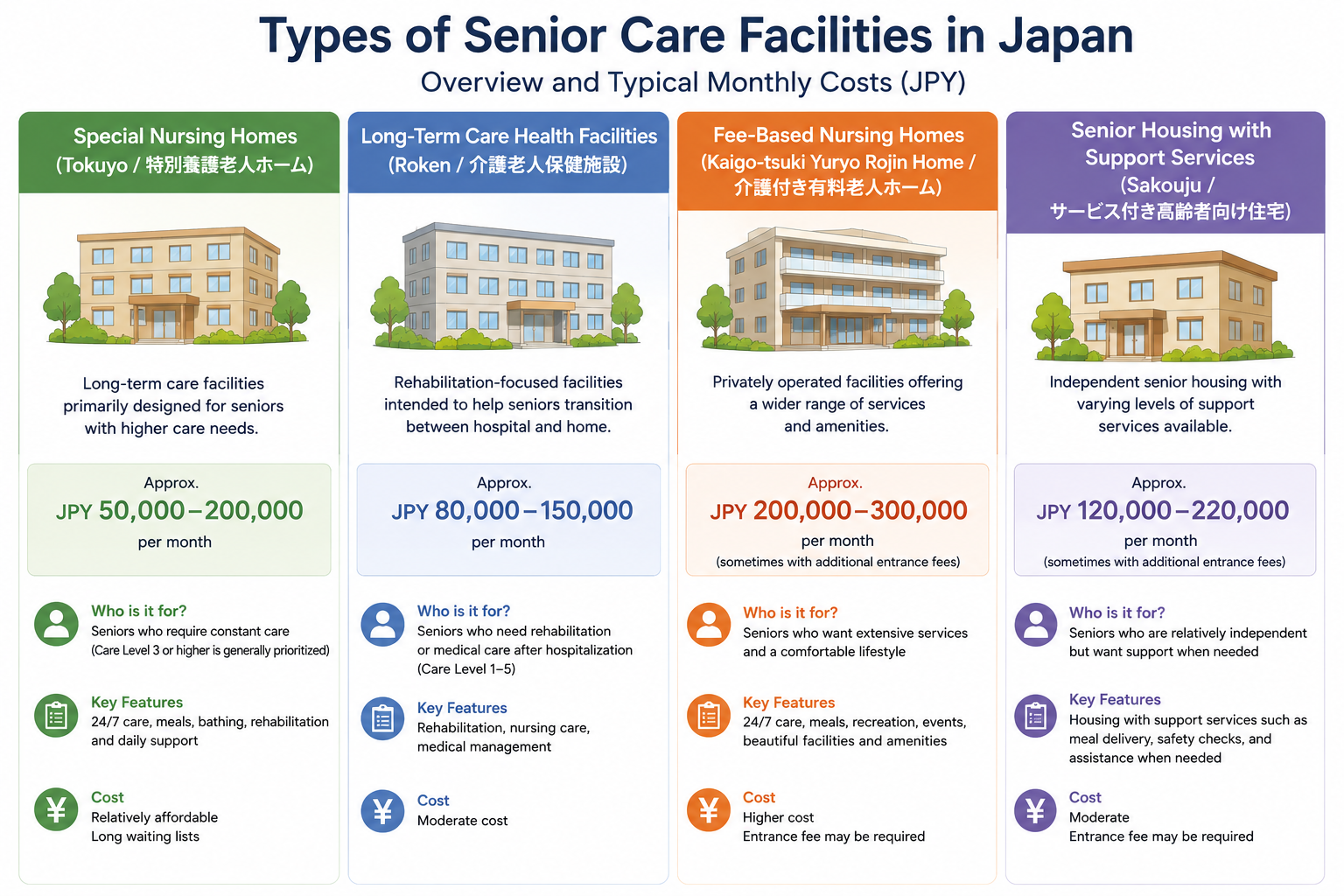
Eligibility, care levels, and available medical support differ significantly between facility types. Finding the right facility often requires balancing care needs, lifestyle preferences, location, family circumstances, and budget.
Staying at Home Until the End: What Does It Actually Require?
Many seniors wish to remain in their own homes for as long as possible. In Japan, this can often be supported through home-care services, visiting nurses, day-care programs, and physician house calls.
For some families, a spouse or family member assumes much of the caregiving responsibility. Others supplement care with professional caregivers and visiting services.
For international families, this reality deserves careful consideration. Aging at home may preserve independence, but it often requires significant human resources behind the scenes.
Related articles
Premium Care Roadmap: Navigating Quality and Optionality in Japanese Senior Living
Home Care Collective: A Case Study in Architecting Senior Support in Japan
The First Call: Community General Support Centers
For many families, the entire process begins with a call to the local Community General Support Center (地域包括支援センター). These centers act as the front door to Japan's senior care system.
They can help coordinate:
Long-Term Care Insurance applications
Care managers
Home-care services
Day-care services
Facility referrals
For families unfamiliar with Japan's system, this is often the most important first step.
Note: Many Community General Support Centers can now assist non-Japanese residents through English-speaking staff, multilingual interpretation services, or translation tools. The level of language support varies by municipality.
3. The Reality of Managing Care from Overseas
Many aspects of Japan's senior care system were built on the assumption that family members are nearby—or at least within the same country.
Even after in-home care service starts or a parent enters a care facility, family involvement often continues.
In practice, family members may be expected to help with practical matters such as replacing seasonal clothing, replenishing personal supplies, and serving as an advocate for a parent who is reluctant or unable to express their needs directly.
When family members live overseas, these responsibilities do not disappear. Instead, they often need to be supplemented through professional support services or local support networks.
When family members live overseas, these responsibilities do not disappear. Instead, they often need to be supplemented through professional support services or local support networks.
Care Assessments and Care Meetings
Once care manager started the senior care program via long term care insurance, regular assessments are conducted on semi-annually.
Many families are surprised to learn that care meetings often involve:
Care managers
Home helpers
Visiting nurses
Family members
These meetings review current care plan and discuss changes in physical and cognitive functioning.
Even when family members participate remotely through Zoom, language barriers and time differences can make participation difficult.
Medical Decisions
As health declines, families may be asked to make important decisions regarding:
Hospitalization
Resuscitation
Artificial nutrition
Life-prolonging treatment
The best time to discuss these issues is before a crisis occurs.
Banking and Capacity
Another frequently overlooked issue is financial capacity.
If cognitive decline becomes significant, access to financial accounts can become complicated.
By the time these issues become urgent, the individual may no longer have the legal capacity to create new authorizations or instructions.
Related articles
Will Your Accounts Freeze? Navigating Cognitive Decline & Banking in Japan [2026 Guide]
Emergencies
Perhaps the most difficult question is also the simplest:
Who can physically respond?
Who answers the hospital's phone call?
Who can visit within 24 hours?
For international families, these questions should be addressed before a crisis occurs.
4.Medical Decisions Become Part of Care Planning
Many families focus on where a parent will live.
Eventually, however, medical decisions become part of the conversation.
In Japan, hospitals are generally expected to preserve life whenever possible. As a result, families may face decisions regarding hospitalization, artificial nutrition, feeding tubes, intravenous hydration, and other life-prolonging treatments.
These conversations can be emotionally difficult, particularly when children live overseas and cannot easily participate in person.
Discussing and documenting your preferences while healthy can help ensure that your wishes are understood and respected if difficult decisions arise later.
5. Cross-Border Senior Care Checklist
Before a crisis occurs, consider the following:
Emergency Response
☐ Do I have a designated emergency contact in Japan?
☐ Who can physically respond if I am hospitalized or experience a medical emergency?
☐ Do I know which Community General Support Center (地域包括支援センター) serves my area?
Medical Decisions
☐ Have I discussed and document my care preferences and end-of-life wishes with my family?
☐ Does my family know where important medical information is stored?
Financial Planning
☐ Who can help manage my finances if I lose decision-making capacity?
☐ Do I have appropriate legal arrangements in place (e.g., Power of Attorney, voluntary guardianship, or adult guardianship)?
Family Communication
☐ Have my children or family members been informed about my care preferences?
☐ Do they know whom to contact in Japan if a crisis occurs?
Professional Support
☐ Have I identified local professionals who can assist with senior care, legal matters, and administrative procedures?
☐ Have I discussed my plans with my spouse, family members, or other key decision-makers?
This checklist is not about eliminating every risk. It is about ensuring that the people who help you already know what to do when the unexpected happens.

6.Q&A
Q1.What is the first step if I suddenly need help?
A1. Contact your local Community General Support Center (地域包括支援センター). These centers serve as the entry point to Japan's senior care system and can help coordinate care assessments, care managers, home-care services, and facility referrals.
(See Section 3 for more details.)
Q2. Are there ways to reduce the cost of senior care facilities?
A2. In some cases, yes. Certain expenses associated with senior care facilities—such as facility service fees, meals, nursing care costs, housing costs, and even adult diapers—may qualify for Japan's Medical Expense Deduction (医療費控除) when filing a tax return.
Eligibility depends on the type of facility and the services provided. For specific guidance, consult the facility directly or contact your local tax office.
However, if your pension income is low and no income tax is being withheld from your pension payments, you may not receive any tax benefit from the deduction. It is important to understand your individual tax situation before relying on this strategy.
Q3. Can Japanese senior care facilities provide medical care?
A3. It depends on the facility type.
Some facilities primarily provide daily living assistance and basic nursing support, while others maintain stronger medical partnerships and can accommodate residents with more complex healthcare needs.
When evaluating a facility, it is important to confirm:
Available nursing support
Relationships with nearby hospitals
Emergency response procedures
Whether the facility can accommodate your specific medical conditions
Q4. Should I consider returning to my home country later in life?
A4. Possibly.
For some foreign residents, returning to their home country becomes an attractive option as care needs increase. Others prefer to remain in Japan because of established social networks, healthcare providers, language familiarity, or a spouse's wishes.
The key point is that this decision becomes more difficult as health declines. If returning home is a possibility, it is worth discussing with your family and exploring the practical implications well before a crisis occurs.
8.Wrap-Up
After my mother passed away, my father chose to remain at home for as long as possible, even though our family initially wanted him to be safe at a facility with care services.
Over time, I came to understand his perspective. Independence and familiar surroundings matter deeply to him.
Looking back, I have also learned that cross-border family life rarely unfolds exactly as planned. I originally returned to Japan to help my parents when my father was diagnosed with cancer.
Senior care is a series of decisions that evolve as circumstances change. The goal is to have the conversations early enough that your wishes can still guide the journey.
Aki | Japanese | Former Head of HR in Global Finance
Aki has served as Head of Human Resources in the global financial sector.
With over two decades of experience navigating labor law, residency, and wealth protection in both Tokyo and Chicago, she now provides the "insider’s roadmap" for foreigners planning a stable, high-value long-term life and retirement in Japan.
