

Prevention Is Better Than Cure: How to Prevent Mental Health Issues at Work in Japan
Why Prevention Matters
According to a 2024 Japanese government survey, 68.3% of all workers report experiencing strong anxiety, concerns, or stress related to their job or working life. Workplace stress remains a reality for the majority of employees.
For foreign workers, additional challenges may arise, including language barrier, cultural differences, or fear that mental health leave could jeopardize visa renewals
However, companies often respond only after employees reach exhaustion — through medical leave, resignation, or long-term absence. From an HR perspective, recovery measures frequently come too late. Prevention is far more effective.
Many employees — Japanese and foreign alike — hesitate to seek help, dismissing stress as simply being busy or trying to endure difficult periods.
Fortunately, Japan is gradually shifting toward preventive approaches, including workplace stress checks and structured mental health programs.
This blog focuses on practical, actionable steps you can use to protect your mental health while working in Japan, including prevention approaches that are uniquely available in Japan.
What This Blog Covers
1. Major causes of work-related mental health cases
2. Japan’s Prevention Model: Three Stages
A. Primary Prevention — Prevent stress before it occurs
B. Secondary Prevention — Detect Issues Early
C. Tertiary Prevention — Support Return to Work
3. Four Types of Mental Health Care in Companies
4. Practical steps employees can take today
5. Q&A
6. Wrap Up

1. Major causes of work-related mental health cases
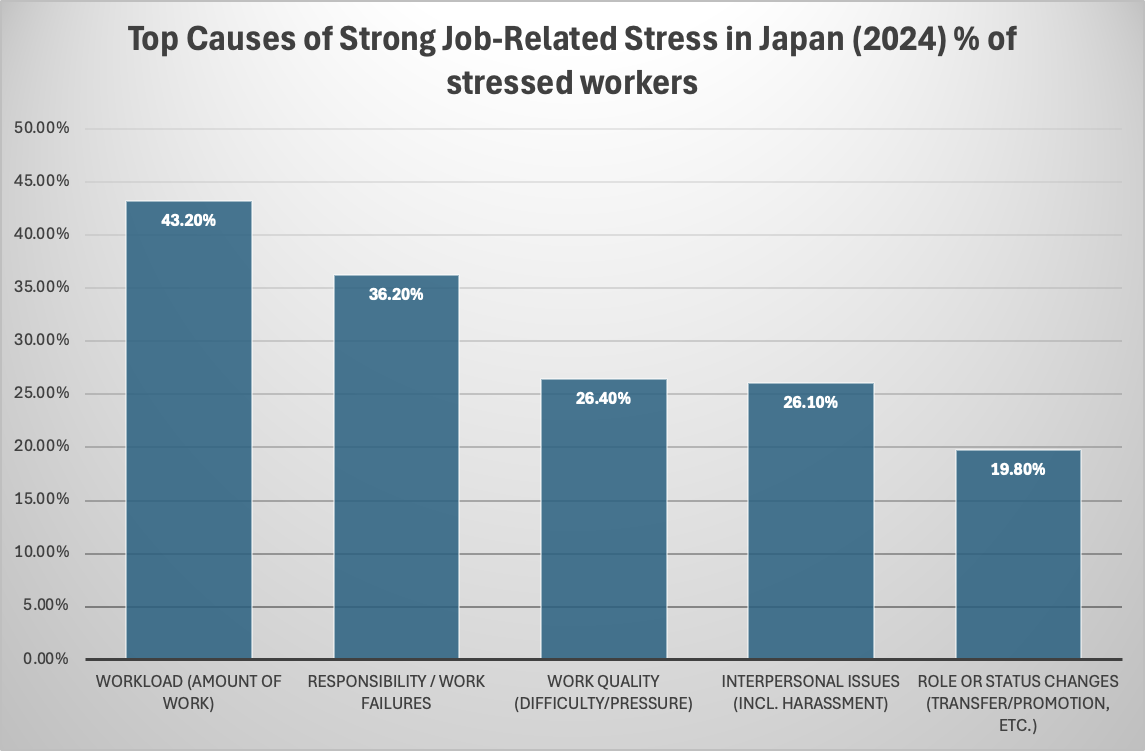
Recent Japanese government data analyzing work-related mental disorder cases shows that mental health problems are often triggered not by isolated incidents, but by ongoing workplace pressures.
The chart below summarizes the main causes reported by workers experiencing strong job-related stress in Japan.
Source: Japan Ministry of Health, Labour and Welfare (MHLW), 2024 Labour Safety and Health Survey
Rising Workers’ Compensation Claims for Mental Disorders
At the same time, the number of workers’ compensation claims related to mental disorders continues to rise, now exceeding three times the level recorded in 2010.
Recent trends show:
Cases involving female workers have increased, now exceeding those involving men.
Workplace factors such as interpersonal conflict and power harassment have grown significantly as causes of claims between FY2022 and FY2024.
These trends show that workplace mental health challenges are not limited to traditionally high-risk industries such as healthcare, transportation, or construction. Increasingly, the same pressures are affecting employees in ordinary office environments as well.
2.Japan’s Prevention Model: Three Stages
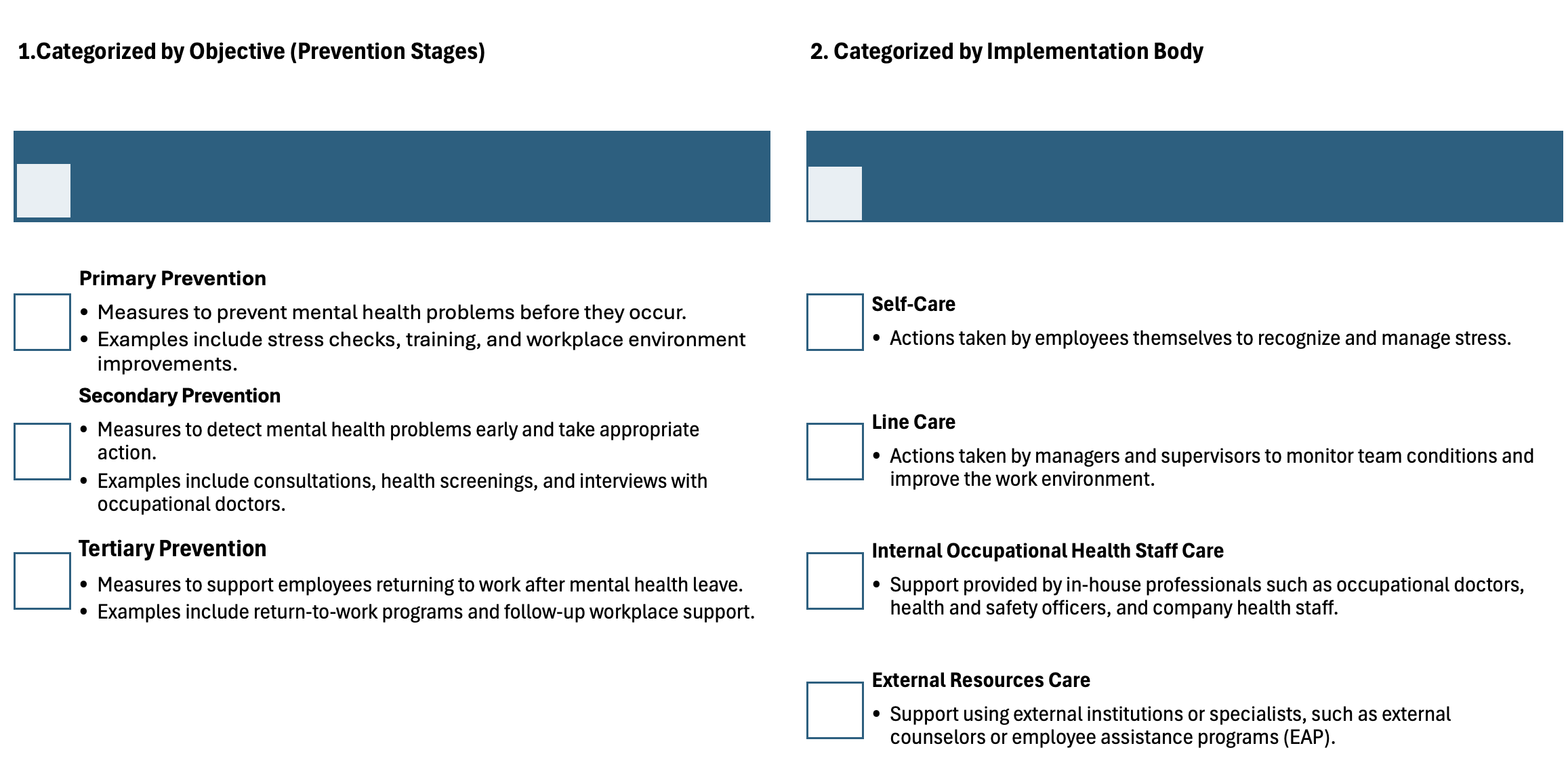
The Ministry of Health, Labour and Welfare (MHLW) promotes a three-stage approach to workplace mental health prevention. While the framework itself may sound technical, the important question is:
What can you do in daily work life?
Below is a practical interpretation for workers.
Source: MHLW Mental Health Guidelines
A. Primary Prevention — Prevent stress before it occurs
This is the most important stage. Once mental health deteriorates, recovery often takes significant time. In reality, many employees pay attention to physical illness but ignore mental exhaustion until it becomes serious.
Primary prevention focuses on everyday habits and workplace practices that prevent stress from accumulating.
Practical preventive measures include:
• Avoid excessive workload and long working hours
Workload spikes sometimes occur due to seasonal demand or project deadlines. However, when monthly overtime exceeds 80 hours, it reaches what the Ministry of Health, Labour and Welfare (MHLW) refers to as the “karoshi (death from overwork) risk line,” where risks of serious health problems, including heart and brain disorders, increase significantly.
When overtime exceeds 80 hours in a month, employees have the right to request an interview with an occupational doctor, and companies must arrange it.
o Before reaching burnout, employees should discuss workload priorities with their supervisors and request adjustments or resource support when necessary.
o Some employees can sustain long working hours and may even feel constrained by overtime limits. However, sustainable long-term performance requires understanding personal limits. Fatigue can lead to judgment errors even before employees notice symptoms themselves.
Related blog―>Overtime in Japan: What’s Legal, What’s Not, and How to Protect Yourself
• Take paid time off
Some employees hesitate to take time off, or workplace culture may discourage it. However, regular breaks improve mental resilience. In high-performing teams, paid time off (PTO) is often normalized and encouraged by leadership.
o Planning leave in advance helps coordination within teams.
o Employees generally do not need to disclose detailed reasons for taking leave; stating it is personal leave is sufficient. However, when taking sudden sick day off, informing managers that you are unwell helps maintain accountability and allows teams to adjust responsibilities.
o Some employees experience situations where supervisors or colleagues contact them during holidays or days off. Legally, employees are not obligated to work on approved days off. To avoid disruption, it helps to assign emergency contacts in advance and clarify availability expectations within the team.
• Maintain healthy sleep habits
Sleep is one of the strongest predictors of mental health and performance.
Practical sleep guidelines include:
o Aim for at least six hours of quality sleep, ideally seven to nine hours.
o A short nap of about 15 minutes during lunch can improve alertness; naps longer than 30 minutes may increase fatigue.
o Frequent nighttime waking or suspected sleep apnea should be medically evaluated; CPAP treatment significantly improves sleep quality for many people.
o Avoid bringing work stress into bed. While not always easy, learning to consciously stop thinking about work improves sleep over time.
o Avoid caffeine intake late in the day.
o Optimize sleep environment by adjusting light, temperature, and noise levels.
o Check your sleep quality using the sleep monitoring device or application
• Maintain balanced eating habits
Emerging research in nutritional psychiatry suggests that diet influences brain function and emotional stability.
Common recommendations in Japan include:
o Eat fish regularly. Fish and seafood contain omega-3 fatty acids such as EPA and DHA, which may help prevent worsening depression symptoms. Common fish such as mackerel, sardines, and tuna are good options.
o Pay attention to meal timing. Morning light exposure and breakfast help regulate the body clock, while late-night light and meals disrupt it.
o Avoid relying continuously on quick meals such as instant noodles. Improving nutritional quality, even gradually, helps sustain energy and mental resilience.

• Incorporate movement or exercise
Physical activity improves both physical and mental recovery.
Practical approaches include:
o Aim for at least 60 minutes of exercise per week.
o Traditional Japanese radio exercises (radio taiso) offer simple full-body movement routines. Many versions are available on YouTube for easy practice at home or work.
o Improve workplace ergonomics to avoid excessive sitting.
o Bathing culture in Japan offers relaxation benefits: soaking in 38–40°C water for about 20 minutes promotes relaxation more effectively than showering alone.
o Practice slow breathing exercises, such as inhaling for four seconds and exhaling for eight seconds, to reduce tension and anxiety.
• Create time to disconnect from work
Continuous connection to work through email or messaging apps prevents mental recovery. Setting boundaries outside working hours helps maintain long-term energy and focus.
Stress Checks: A Unique System in Japan
In Japan, companies with 50 or more employees are legally required to conduct annual stress checks.
Employees complete anonymous questionnaires designed to measure psychological stress levels, and workers identified as experiencing high stress may request consultations with an occupational doctor.
While stress checks are sometimes treated as a formality, they can help employees recognize early warning signs and encourage timely action before problems become serious.
A free online stress check tool (in Japanese) is also available from the Ministry of Health, Labour and Welfare:
Goal of Primary Prevention:
Stop mental health problems before they begin.

B. Secondary Prevention — Detect Issues Early
Even with preventive measures, stress sometimes becomes unavoidable. Secondary prevention focuses on early detection and early action, before problems become severe.
Employees should seek support when they notice:
Persistent sleep problems
Continuous fatigue or exhaustion
Loss of motivation or difficulty concentrating
Anxiety about going to work or stress during work hours
Irritability or emotional instability
Increased anger or frustration
Obsessive or repetitive worrying that is difficult to stop
Early consultation often prevents long-term absence or resignation.
Maintain open communication with supervisors, colleagues, or specialists
Government surveys show that 74.7% of workers experiencing stress consulted someone, most commonly:
Family or friends (62.1%)
Supervisors or managers (58.9%)
However, about 25% consulted no one at all, which often allows problems to worsen.
If stress begins to build, the first step is often simply to talk to someone you trust or seek support inside or outside the workplace before situations escalate.
✅When stress comes from relationships with your supervisor
Manager relationships are a frequent source of workplace stress.
Practical options include:
Maintaining a professional distance where possible
Exploring whether internal transfer opportunities are available
If the relationship cannot be improved and continues to damage your well-being, considering a job change may be healthier than sacrificing mental health.
Long-term stress caused by management relationships should not be ignored.
✅When harassment occurs
Do not blame yourself.
Keep detailed records of incidents, including dates, messages, and witnesses.
Consult supervisors, HR, or legal professionals if necessary.
Documenting incidents early helps protect yourself if formal action becomes necessary.
✅Balancing childcare and work
Work–family balance is another common stress source.
Possible measures include:
Taking paid leave or half-days periodically to rest and reset, even if leave is often saved for children's events
Outsourcing household tasks when possible; parenting pressure is temporary, but burnout can have long-term effects
Considering relocation closer to workplace or childcare facilities if feasible
Sharing responsibilities clearly between partners
Accepting that career progression may temporarily slow, but recovery and career growth are still possible later. Protecting well-being is more important than maintaining speed at all costs.
✅Stress caused by promotion or new responsibilities
Unexpectedly, promotions and new roles frequently trigger stress.
Consider:
Promotion means greater responsibility; analyze workload changes and discuss needed support with supervisors early
If speaking with your manager feels difficult, seek advice from trusted colleagues or mentors outside your department
Highly responsible employees tend to push themselves too hard, so conscious rest and workload management become even more important.
Goal of Secondary Prevention
Intervene early before problems become severe.
C. Tertiary Prevention — Support Return to Work
When employees take mental health leave, proper support is necessary to ensure successful return and prevent relapse.
Common measures include:
• Return-to-work programs
• Temporary workload adjustments
• Flexible schedules during recovery
• Follow-up meetings after return
A rushed return without adjustments often leads to recurrence.
Related blog -> Adjustment Disorder in Japan: How to Navigate Work, Stress, and Your Rights
Goal of Tertiary Prevention:
Help employees return safely and prevent relapse.

3.Four Types of Mental Health Care in Companies
Government guidelines describe four support approaches.
Self-care (Employee)
Employees recognize and manage their own stress.
Line care (Manager)
Managers monitor teams and adjust environments.
Internal occupational health care
HR, occupational doctors, supportive colleagues and internal consultation channels
External professional resources
Psychiatrists and psychosomatic physicians、Licensed psychologists or counselors. External counselors and EAP services provide professional help.
4.Practical Steps You Can Take Today
A.Monitor workload trends
If overtime becomes constant rather than temporary, action is needed.
B.Pay attention to management behavior
Management style often causes more stress than workload.
C.Use consultation channels early
HR or counseling works best before burnout.
D. Maintain recovery habits
Sleep, exercise, and social connection matter more than people think.
E. Recognize early warning signs
Loss of motivation, insomnia, or anxiety are signals, not
Support Services Available in Foreign Languages
Telephone Consultation Service for Foreign Workers (Multilingual)
Free consultation service for foreign workers regarding working conditions, labor issues, and workplace concerns.
Yorisoi Hotline – Foreign Language Support (Multilingual)
A nationwide helpline offering support for a wide range of personal and social concerns, including financial, family, and emotional issues.
Labour Standards Advice Hotline (Multilingual)
Government-operated consultation service providing advice on labor rights, working conditions, unpaid wages, and workplace problems
Human Rights Counseling for Foreign Nationals (Multilingual)
Consultation services offered by the Ministry of Justice for issues related to discrimination, harassment, or human rights concerns.
TELL Lifeline (English Support)
Confidential counseling and crisis support in English for individuals experiencing emotional distress or suicidal thoughts in Japan.
International emotional support network offering crisis support and information on local helplines around the world.
Seeking help early is a sign of strength, not weakness. Support is available, and you do not have to navigate difficult situations alone.

5.Q&A
Q1. Will consulting HR hurt my career?
A1. In healthy companies, early consultation helps prevent bigger problems. HR can take into account language barriers and cultural differences, connect you with appropriate professionals, and coordinate necessary support with your manager when needed.
Supporting employees so they can work safely and sustainably is part of HR’s responsibility and also part of a company’s legal duty of care toward employees.
Q2. When should I seek help?
A2. When sleep problems, mood changes, or loss of motivation continue for several weeks. Acting early makes recovery much easier.
Q3. Do stress checks help?
A3. Yes. Stress checks help identify risks early. Sometimes employees experience stress without clearly recognizing symptoms themselves.
Consulting an occupational doctor or workplace health professional can be a good first step before seeking treatment from a psychiatrist if needed.
Q4. Is overtime itself illegal?
A4. Not necessarily. Overtime itself is legal under certain conditions, but excessive overtime is a major health risk and may violate labor regulations if legal limits are exceeded.
Related blog-> Overtime in Japan: What’s Legal, What’s Not, and How to Protect Yourself
Q5. Should I change jobs if stress continues?
A5. If workplace conditions do not improve after discussing the situation and seeking support, changing jobs may be the healthier choice. Long-term mental health should not be sacrificed for a job.
Q6. What do good companies do differently?
A6. Healthy organizations increasingly focus on:
Reasonable workload distribution
Manager communication and leadership training
Stress monitoring systems
Flexible work arrangements
Early HR intervention
Mental health is increasingly seen as part of productivity and risk management, not merely employee welfare.
6.Wrap-Up
Mental health problems rarely appear suddenly. In most cases, they build gradually through unmanaged pressure, poor communication, and lack of recovery time.
The good news is that many cases are preventable when employees, managers, and companies act early. Prevention is not about working less — it is about working sustainably so that both performance and well-being can be maintained over the long term.
If this article helps you or someone around you, please consider sharing it with friends or colleagues who may benefit from it.
If you have experiences or questions about working in Japan, feel free to leave a comment or send me a note!
Reference and Acknowledgment
Parts of this article reference publicly available information and guidelines published by the Ministry of Health, Labour and Welfare of Japan, which allows the use of its materials for informational purposes.
For official mental health information and tools, please refer to:
Ministry of Health, Labour and Welfare — Mental Health Portal
Other References
Guidelines for Workplace Mental Health Promotion (MHLW))
Survey Results on Work-Related Mental Health and Workers’ Compensation Claims (MHLW)
Healthy Sleep Guidelines and Information Portal (MHLW)
Research Report on Sleep, Health, and Lifestyle Improvement (MHLW Research Grant Project)
Related blog
What Actually Violates Labor Law in Japan — and How to Avoid “Black Companies” (HR Insider Guide)
Japan's Workforce Rebalance: The Mid-Career Foreigner's Strategic Edge
