

What Actually Violates Labor Law in Japan — and How to Avoid “Black Companies” (HR Insider Guide)
The term “black company” (ブラック企業) is widely used in Japan to describe employers that systematically violate labor laws or exploit employees through excessive overtime, harassment, or unfair dismissals.
From an HR and labor-law perspective, however, even Japanese employees often struggle to identify what actually constitutes a legal violation.
This article explains common Labor Standards Act violations, why they often go unnoticed, and how to protect yourself—drawing on real HR experience.
This blog covers:
What Actually Violates Labor Law in Japan
How to Avoid Black Companies—Before You Accept the Job
If You Realize the Company Is “Black” After You Start Working
Q&A
Wrap Up

1. What Actually Violates Labor Law in Japan
Understanding what violates labor law is critical, because many labor problems in Japan are difficult to raise openly. Employees often hesitate to “make waves,” especially in small or traditional organizations. As a result, violations tend to remain hidden until they become serious.
Below are common violations of the Japanese Labor Standards Act, each of which carries statutory penalties. These are not “gray areas” or cultural misunderstandings—they are clear legal boundaries.
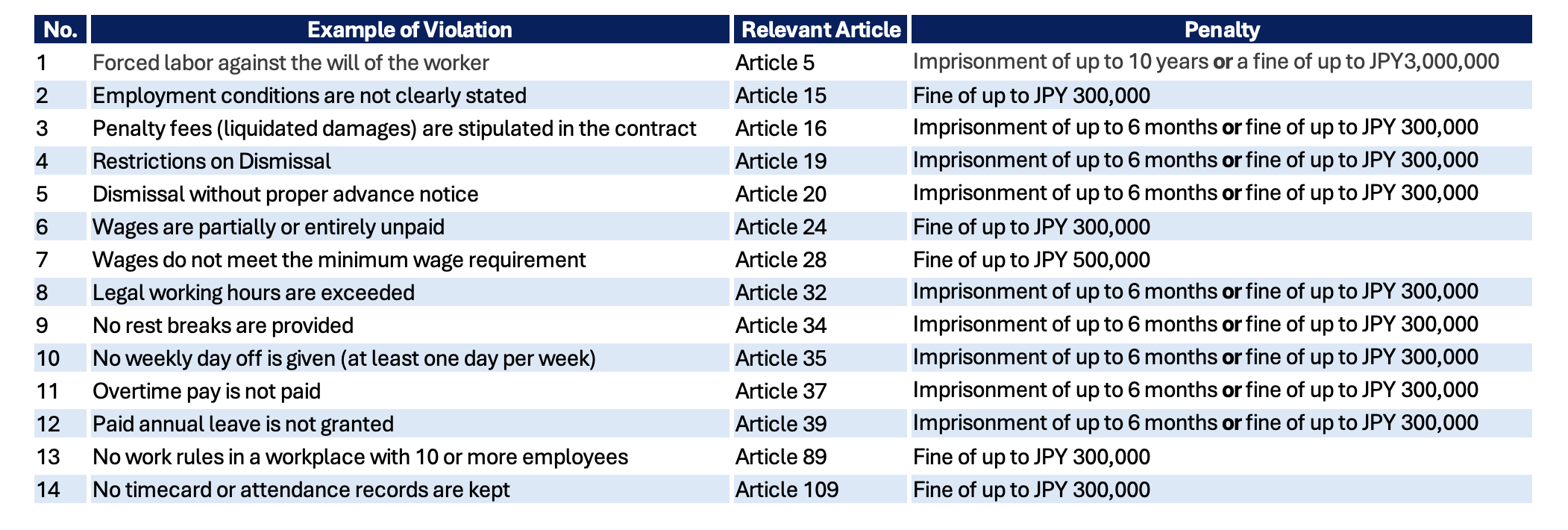
Common Red Flags You Should Not Ignore
While many types of labor law violations exist, the examples below reflect the problems employees most commonly face in practice.
#1 Forced labor or preventing resignation
Employers may illegally restrain employees by forcing you to stay until sales quotas are met even late at night or refusing to accept resignation.
#2 Employment contracts can be valid even if agreed verbally
Under Japanese law, an employment contract can be legally valid even if terms such as wages are communicated only verbally. This is sometimes seen in short-term or part-time work, where employees are simply told the hourly wage without receiving detailed written conditions.
However, employers are legally required to provide key working conditions at the time of hiring. These include:
Contract duration (or whether employment is indefinite)
Workplace location and job duties
Working hours, break periods, days off, and leave
Compensation, payment schedule, and payment method
Matters related to resignation or dismissal
Conditions for renewal of fixed-term contracts, if applicable
Without written documentation, it becomes difficult to prove agreed conditions if disputes arise. For this reason, employees should always request written employment terms to avoid future misunderstandings or conflicts.
#3 Illegal penalty clauses in contracts
Clauses such as:
“You must pay JPY1,000,000 if you resign early”
“Training costs must be repaid upon resignation”
are generally illegal under the Labor Standards Act, even if written in the contract.
#4 Dismissal during protected periods
Employers may not dismiss employees:
During medical leave for work-related injury or illness and for 30 days after
During maternity leave and for 30 days after
These protections are strict and non-negotiable.
Real-World Example
If you develop a mental health condition caused by your job—such as stress or harassment—and take medical leave based on a doctor’s diagnosis, the company cannot legally terminate your employment during that leave or for 30 days after you return.
✅ Note: This protection applies only to work-related conditions. Determining whether a mental health issue is work-related can be complex and typically depends on medical evidence.
#5 “Soft” dismissal tactics
Phrases like:
“You don’t need to come in anymore”
“This role isn’t a good fit—please resign”
are not legally valid dismissals.
These practices are especially common in small and mid-sized companies with weak HR oversight.
#7 Minimum wage violations
If you are unsure, always check the regional minimum wage, not national averages. Many violations occur simply because employees do not verify this. Search your prefecture on the MHLW site for the current rate—underpayment is a direct violation with penalties.
#11 Unpaid or unrecorded overtime
Statements such as:
“Everyone stays until the boss leaves”
“Overtime is included in your salary”
should trigger immediate caution. Overtime must be recorded, calculated, and paid unless a very specific exemption applies.
Related blog-> Overtime in Japan: What’s Legal, What’s Not, and How to Protect Yourself
#13 No work rules in larger workplaces
Any workplace with 10 or more employees (including part-time staff) must have written work rules. If none exist—or employees have never seen them—that is a compliance red flag.
✅A Note on Harassment Laws in Japan (Especially Important for Foreigners)
Harassment is not regulated under the Labor Standards Act itself.
Instead, employer obligations arise under:
The Act on Comprehensive Promotion of Labor Policies (Power Harassment Prevention Act)
The Equal Employment Opportunity Act
The Childcare and Family Care Leave Act
Employers are legally required to implement measures to prevent power harassment, sexual harassment, harassment related to pregnancy, childbirth, and childcare leave, and other recognized forms of workplace harassment.
However, harassment occurring at the workplace including at company drinking events—may fall under Civil Code Article 709 (tort liability). In serious cases, victims may seek damages, and extreme conduct can even result in criminal charges.
This distinction is especially important for foreigners, who may expect a single “HR law” to cover everything.
A Real HR Case: Power Harassment and a Practical Resolution
A young foreign employee in the IT department approached HR to report repeated power harassment by a supervisor, citing frequent harsh and intimidating reprimands.
When interviewed, the supervisor acknowledged his tone had become overly strict but insisted performance issues justified strong guidance. HR clarified that performance management does not require intimidation and monitored the situation, but the behavior persisted.
The situation improved only after a mentor closer in age was assigned as an intermediary. The supervisor’s evaluation was also affected, as management behavior is part of leadership accountability. With appropriate support, the employee overcame initial performance challenges, and the working relationship eventually stabilized.

2. How to Avoid Black Companies—Before You Accept the Job
A. Review All Employment Documents Carefully
You should receive written documentation before starting work. This may include:
Offer letter
Employment contract
Labor conditions notice (労働条件通知書)
If none of these are provided, that is a serious warning sign. Pay particular attention to whether the required items listed in Section 1 are properly stated in the contract, and also confirm the following:
Whether a probation period applies
Compensation and working conditions during the probation period
Details of any retirement allowance plan (if applicable — this differs from severance pay for involuntary termination)
Job duties and responsibilities
Vague language or verbal-only explanations create risk. Pay attention to statements that feel unusual or unclear, and ensure your job duties are clearly stated in writing.
B. Observe the People—Especially the Leaders
From long experience across both Japanese and international companies, one principle consistently holds true: organizations reflect their leaders, and people shape culture. The importance of company culture cannot be overstated.
You may never meet the CEO during recruitment, but the people you interact with during interviews matter greatly. Pay close attention and ask yourself:
Do they treat you with respect?
Do they answer difficult questions directly?
Do they take responsibility when discussing challenges?
Can you respect them as both professionals and individuals?
Real HR Insight
Simple behaviors—such as basic greetings, openness to questions, and a willingness to listen—are often underestimated. Their absence becomes painfully clear only after you experience a dysfunctional culture.
One company I worked for in Japan consistently delivered strong results. The reason was not perks or policies, but people. High performers with strong character created fair competition and a demanding yet growth-oriented environment. Leaders were not “soft,” but they were principled, consistent, and trustworthy. Growth came from people, not slogans.
By contrast, I once worked under a president who was technically capable but deeply distrustful of employees. Governance was centralized entirely around him—a warning sign I failed to recognize early. As expected, harassment and compliance issues surfaced, and the company had already lost a labor tribunal case the previous year. It was a hard lesson learned.
C. Check Time Management Systems and Overtime Rules
Ask whether the company uses:
Timecards
Attendance management software
Clear overtime approval processes
Transparent overtime calculation rules
If working hours are tracked informally—or not tracked at all—unpaid overtime is highly likely.
In addition, if your role involves shift work, night or early-morning hours, deemed working hours (みなし労働時間制), or managerial status (管理職), make sure these conditions are clearly stated in your contract, including whether overtime applies and how it is calculated. Ambiguity in this area often leads to disputes.
Related blog-> The Hidden Line in Your Japanese Employment Contract That Controls Your Overtime Pay

D. Watch Turnover Rates
Frequent hiring for the same role is a strong warning sign. While some industries naturally experience higher turnover, repeated vacancies often reflect poor management, unrealistic expectations, or unhealthy workplace culture.
Consider asking:
What has the turnover rate been over the past year? (HR should know this.)
What are the main reasons for voluntary resignations?
(Details about involuntary terminations may not be disclosed.)How many positions are currently open for the same role?
Evasive or vague answers may be as telling as the numbers themselves. If you prefer not to ask directly, your recruitment agent can ask on your behalf.
E. Observe the Office Environment
Even small details can be revealing:
Is office equipment poorly maintained or frequently missing?
Do teams blame each other for mistakes or shortages?
Does the atmosphere feel tense, silent, or fearful?
Disorganization at this level often mirrors deeper governance and leadership issues. In healthy environments, teams tend to support one another and share responsibilities—even for mundane tasks.
F. Assess the HR Function (or Lack of One)
Key warning signs include:
No dedicated HR personnel
Slow, dismissive, or inconsistent responses to employee questions
No written work rules (就業規則), despite having 10 or more employees
In some companies, the CEO or president doubles as HR, overseas HR manages the Japan entity, or HR responsibilities are combined with finance or corporate services. This does not automatically mean the company is a “black company.”
However, weak or understaffed HR functions increase the risk that legal violations go unnoticed or unaddressed, especially in Japan’s complex labor-law environment.
Real HR Case
I was once asked to support the HR function of a small Japan-based affiliate by a colleague in Singapore. Because the Japan entity was small, HR was managed remotely from headquarters.
During my first visit, two foreign employees independently approached me because they did not know where else to turn. One raised concerns about unpaid overtime, while the other sought guidance on how to arrange upcoming maternity and childcare leave.
✅Questions to Ask During Interviews
(These questions help identify legal and cultural risks before accepting an offer.)
Working Hours & Overtime
How are working hours tracked?
How is overtime approved and calculated?
Are there roles where overtime is not paid? If so, why?
Role Expectations & Performance
What does success look like in the first 6–12 months?
What challenges has this role faced recently?
Why did the previous person leave this position?
HR & Governance
Is there a dedicated HR contact in Japan?
Are written work rules (就業規則) available to employees?
How are workplace concerns or conflicts typically handled?
Culture & Leadership
How do managers give feedback when performance issues arise?
How does the team handle mistakes or problems?
What do you value most in your leaders?
Tip: Pay attention not only to the answers, but how they are answered. Evasive or overly vague responses often signal deeper issues.
✅ No company is perfect. The key is whether problems are acknowledged and corrected—or ignored.

3. If You Realize the Company Is Black After You Start Working
If problems emerge, do not wait and hope they will resolve themselves. Early action gives you more options and better protection.
A. Keep Detailed Records
Document everything carefully, including:
Actual working hours (not just official schedules)
Emails, chat messages, and written instructions
Directions related to overtime, workload, or harassment
A clear timeline of facts and supporting evidence
Accurate and organized records are essential if a dispute arises later.
B.Review the Work Rules and Your Contract
Check whether the company’s actual practices align with:
Your employment contract
Written work rules (就業規則), if available
Discrepancies matter. Even if informal practices are “common,” employers are required to follow both the law and their own rules.
C. Seek Consultation Early
Do not hesitate to seek outside advice. Options include:
The Labor Standards Inspection Office (労働基準監督署)
External labor attorneys
✅ Note
Certified labor and social security consultants (社会保険労務士) mainly specialize in payroll administration, social insurance procedures, and HR compliance matters, and they play an important role in everyday HR operations.
However, when disputes escalate or negotiation with an employer becomes necessary, consulting a labor-law attorney experienced in negotiation and litigation may be more appropriate.
Many labor-law attorneys offer free initial consultations, during which they can help you understand:
The seriousness of your situation
Whether legal action or negotiation is appropriate
Estimated costs if representation becomes necessary
For foreign employees, visa implications may also be involved, making early consultation with the right professional especially important.
D. If You Decide to Leave
If you decide resignation is the best option, protect yourself by taking the following steps:
Secure your next employment to maintain your visa status and health insurance coverage, if applicable.
Notify the company at least two weeks in advance (Check the rules of employment)
Think carefully about the reason you give for resigning
Keep a copy of your resignation letter
Request issuance of your separation notice (離職票) if you intend to apply for unemployment benefits
Use your remaining paid time off, or confirm whether unused leave will be paid out
Cooperate reasonably with handover responsibilities
Retrieve all personal belongings before your last day

4.Q&A
Q1. How can I tell if my company is “black,” or just busy and demanding?
A1: Long hours alone do not make a company illegal. Red flags include unpaid overtime, unclear rules, pressure not to record working hours, harassment, refusal to accept resignation or difficult to take time off. If problems are systematic and management dismisses concerns, it may indicate a black company.
Q2. Is unpaid overtime really that common in Japan?
A2: Yes. One of the most common violations is overtime that is expected but not recorded or paid. Statements like “Everyone stays until the boss leaves” or “Overtime is included in your salary” should be examined carefully.
Q3. My manager says I am a “manager,” so overtime does not apply. Is that legal?
A3: Not automatically. Only employees who meet strict legal criteria qualify as exempt managerial employees. Many companies misuse the title “manager” to avoid paying overtime, which can be a violation.
See also Section 1-e Managerial Position-> The Hidden Line in Your Japanese Employment Contract That Controls Your Overtime Pay
Q4. The work rules say one thing, but actual practice is different. Does that matter?
A4: Yes. Discrepancies between written rules and actual practice are significant. Even if employees “agree” to informal practices, companies are still required to follow the law and their own rules.
Q5. I’m a foreign employee. Does my visa status limit my labor rights?
A5: No. Labor law protections apply regardless of nationality or visa status. However, visa implications can complicate decisions, so foreign employees should seek advice early from professionals familiar with both labor and immigration issues.
Q6. Can a company refuse to let me resign?
A6: No. Preventing resignation or forcing continued work may constitute illegal forced labor. Even contractual clauses restricting resignation are generally unenforceable.
5.Wrap Up
Black companies exist not because employees are weak, but because systems allow silence. Knowledge is your strongest protection. By understanding what violates labor law, keeping accurate records, and seeking consultation early, you give yourself real options and leverage.
If you found this article helpful, I welcome your comments or feedback—especially if you have questions or experiences you’d like to share. Thoughtful discussion helps others recognize risks earlier.
And if you think this information could help someone else, please consider sharing this link with your family, friends, or colleagues. The more people understand their rights, the harder it becomes for unfair practices to continue.
References
English translation of the Labor Standards Act
Labor policy and equality information — Ministry of Health, Labour and Welfare
Labor Standards Inspection Office (Japanese government)
See also
Japan's Workforce Rebalance: The Mid-Career Foreigner's Strategic Edge
