

The Hidden Line in Your Japanese Employment Contract That Controls Your Overtime Pay
You probably missed it when you signed. Just one tiny line near the top decides whether you get paid for overtime… or work hundreds of hours for free.
Example:
固定残業代として45時間分含む
管理監督者
But that single line determines how you work and get paid for overtime.
This is not rare.
📊 2024 Government Data — Unpaid Wages in Japan Are Massive
In 2024 alone, Japan’s Labor Standards Offices (労働基準監督署) ordered companies to pay JPY16.2 billion in unpaid wages (including overtime) to 181,177 workers across 21,495 resolved cases. Once the Labor Standards Office intervened, 96% of the cases were corrected.
And that’s only the tip of the iceberg.
The real total — including attorney-negotiated settlements, quiet payouts, and unreported overtime — is believed to be much higher. Let’s make sure you are not one of those cases.
This article covers:
1. Working Systems in Japan
2. The Contract Line Checklist
3. Five Contract Clauses Foreign Workers in Japan Often Misunderstand
4. 60-Second Self-Check (Do This Tonight)
5. Real Cases
6. What To Do If Your Clause Looks Wrong
7. Q&A
8. Wrap up
1. Working Systems in Japan
Below is a simple explanation of each system listed in the chart, written with clarity and legal accuracy for foreign readers.
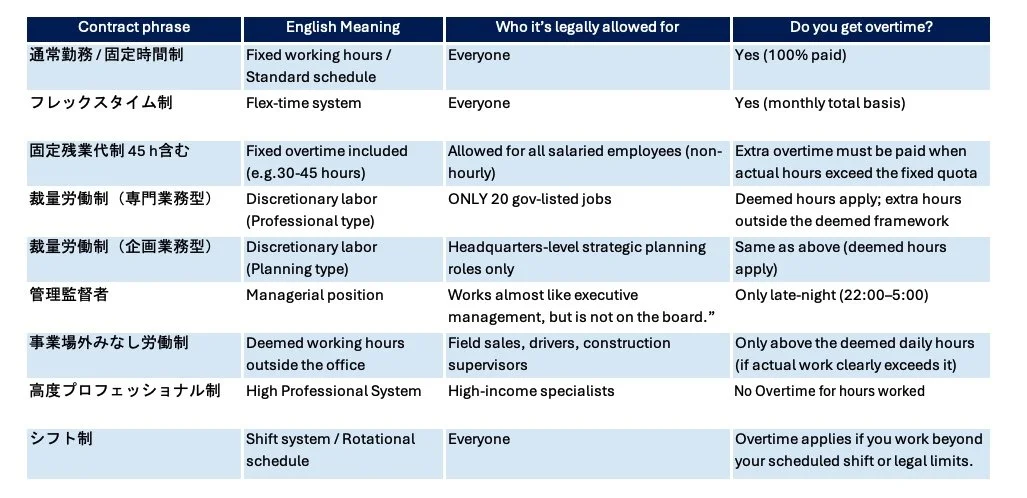
a. Fixed Working Hours (Typically 9:00–18:00)
What it means:
Start and end times are fixed.
Overtime:
Applies to anything above 8 hours/day or 40 hours/week.
Overtime premiums range from 25% to 60% depending on when you work.
Why it matters:
This is the legal baseline for all other working-hour systems in Japan.
b. Flex-Time System (フレックスタイム制)
What it means:
Includes a core time (e.g., 11:00–15:00) plus flexible time.
Employees must meet the monthly prescribed total hours (e.g., 177 hours per month).
Overtime:
Only occurs when the monthly total exceeds the prescribed hours.
A long day does not automatically create overtime unless the monthly total is exceeded.
c. Fixed overtime (固定残業代制)
What it means:
A set number of overtime hours (e.g., 30-45h/month) are pre-included in your salary.
The employer must clearly state the number of hours and the monetary amount in the contract.
Overtime:
Extra overtime must be paid when actual work exceeds the fixed overtime amount.
Employers must keep accurate time records; “unlimited overtime included” is illegal.
d. Discretionary Labor System (Professional Type / Planning Type)
What it means:
You are “deemed” to have worked a fixed number of hours regardless of actual hours.
The deemed daily working hours must be defined in a labor-management agreement.
Due to the nature of the work, its performance must be largely entrusted to the employee’s own discretion.
Legal restrictions:
Both types require strict health checks and proper procedural steps.
Employee consent is mandatory (no signature → invalid).
Professional type applies only to 20 government-listed job categories.
Planning type applies to roles that involve planning, proposal development, research, and analysis
Overtime:
Extra hours beyond the deemed framework must still be paid.
“Discretionary” does not mean “unlimited hours without pay.”
e. Managerial Position (管理監督者)
What it means:
Refers to someone who has substantial authority and operates in a position close to top management.
Determined by actual authority, not by job title (e.g., “Manager,” “Lead,” “Director”).
Legal restrictions:
The role must involve meaningful decision-making authority, such as hiring and firing, budget planning, or business strategy.
The employee must have a high level of autonomy and receive compensation appropriate for a high management-level position.
Their working style must be free from ordinary, hour-by-hour supervision.
Overtime:
No obligation to pay overtime or holiday premiums.
Employers must still pay late-night premiums (22:00–5:00).
f. Off-Site Deemed Working Hours (事業場外みなし労働時間制)
What it means:
Used when working hours cannot reasonably be tracked, such as field sales, on-site supervisors, or roles with frequent client visits.
Employees are treated as having worked a preset number of hours per day.
Important note:
Due to modern communication tools (smartphones, teams, GPS, etc.), fewer roles now qualify because employers can check working hours remotely.
Overtime:
If actual work clearly exceeds the deemed hours, additional overtime must be paid.
g. High Professional System (高度プロフェッショナル制度 / 高プロ)
What it means:
For certain high-income specialists (finance, R&D, analytics).
Removes working-hour regulations entirely; controls work by output, not time.
Overtime:
No overtime for hours worked.
Strict health management is required.
Usage remains extremely low and socially controversial.
h. Shift system (シフト制)
What it means:
Workdays and working hours are not fixed at the time of signing the employment contract.
Instead, they are determined later through weekly or monthly shift schedules.
Overtime:
Overtime must be paid if you work beyond your scheduled shift or beyond statutory limits (8 hours/day, 40 hours/week).
2. The Contract Line Checklist
Search for these exact phrases in your contract:
通常勤務 / 固定時間制 → standard hours
フレックスタイム制 → flex-time
裁量労働制(専門業務型) → discretionary labor (professional)
裁量労働制(企画業務型) → discretionary labor (planning)
管理監督者 → managerial/supervisory
固定残業代 XX時間分含む → fixed overtime included
事業場外みなし労働時間制 → off-site deemed hours
高度プロフェッショナル制 →high Professional System
シフト制 →Shift system / Rotational schedule
The risk is not the phrase itself. The risk is when the phrase doesn’t match your actual job.

3. Five Contract Clauses Foreign Workers in Japan Often Misunderstand
Below are the systems frequently misused in contracts given to foreign employees in Japan.
A. Invalid Fixed Overtime (固定残業代)
This system loosely resembles the U.S. “exempt salary” concept, which does not require overtime pay. But the Japanese version is very different: if actual overtime exceeds the fixed amount, employers must still pay additional overtime.
❌ Illegal or risky patterns (commonly seen in foreigner contracts)
No clear breakdown of how many hours and how much money the fixed overtime payment covers
Fixed overtime set at unreasonable levels (e.g., 60–80 hours per month)
Actual overtime regularly exceeds the fixed hours, but no additional pay provided
✔ Checklist before signing
The number of fixed overtime hours is clearly specified (e.g., 45 hours).
The monetary amount corresponding to those hours is written.
The fixed overtime hours do not exceed typical 36-Agreement limits.
The contract explicitly states that overtime beyond the fixed amount will be paid separately.
The fixed overtime payment is paid whether or not you actually work those hours.
B. Fake “Managerial” Position (管理監督者/kanri Kantoku-sha)
Under Japanese law, employers are not required to pay overtime or holiday/weekend premiums to employees classified as “managerial/Kanri Kantoku-sha” (管理監督者), except for late-night work premium.
❌ Illegal or risky patterns
Some companies label employees as “managers / Kanri Kantoku-sha” to avoid paying overtime, or do so without understanding the consequences.
In Japan, the legal definition of a Kanri Kantoku-sha (管理監督者) is extremely strict.
Job title alone does not matter — the law evaluates the actual role.
✔ Check before signing
A “Team Lead,” “Associate Director,” “Section Manager,” “Supervisor,” or “Global Role” almost never meets the legal criteria for Kanri Kantoku-sha/管理監督者. If your position does not clearly satisfy the requirements, you still retain full overtime rights.
Confirm with HR whether your role is legally eligible for overtime exemption.
👉 Related guide: Overtime in Japan: What’s Legal, What’s Not, and How to Protect Yourself (McDonald’s branch manager case)
C. Wrong-Type Discretionary Labor
Creative and technical foreigners — designers, writers, producers, marketers, engineers, analysts — are frequently placed under:
裁量労働制(専門業務型) — Discretionary Labor System (Professional Type)
❌ Illegal or risky patterns
However, this system is legally allowed only for 20 very specific job categories defined by the government. If your role does not exactly match one of those categories, the clause is invalid.
Result:
Foreigners may unknowingly work unpaid overtime under a system that legally cannot apply to their job duties.
Important examples:
Even within tech or creative fields, not everyone qualifies. For instance:
A programmer whose main duty is coding (not systems analysis or design) is not covered.
Audio engineers or camera operators in broadcasting and film also do not qualify, because their work is performed under a director’s instructions rather than independent professional discretion.
✔ Check before signing
Official list of the 20 tasks (Page 6–7, Japanese only):
If your duties are unclear, ask HR to confirm whether your role legally qualifies.
D. Off-Site Deemed Hours (事業場外みなし労働時間制)
This system assumes a fixed number of hours worked (e.g., 8 hours), regardless of actual hours, but it is often misused.
❌ Common misuse patterns
Even if the worker clearly works beyond the deemed hours, overtime is not paid
Employers apply this system even when supervisors can track actual hours through email, chat, smartphones, GPS, or work systems
Companies treat the “8 hours deemed” rule as a blanket exemption from overtime — which is illegal
✔ Legal reality
If actual work clearly exceeds the deemed hours → additional overtime must be paid
If communication tools allow accurate tracking, the system should not be used
E. Other Common Violations
Even when none of the clauses above are used, some companies simply do not pay overtime or calculate premiums correctly.
You should always verify:
Your actual working hours
Your payslip
Whether all premiums (late-night, holiday, excess overtime) are reflected
👉 Related guide: How to Read a Japanese Payslip & withholding tax slip - What Foreign Workers Need To Know.

4. 60-Second Self-Check (Do This Tonight)
a. Is my job on the 20-task discretionary labor (Professional type) list?
Check the official list (Japanese only, PDF pages 6–7):
b. Did I sign a separate consent form for discretionary labor (裁量労働制)?
This is required by law. No signature = the system is invalid.
c. Do I actually meet the legal criteria for “managerial” status (管理監督者)?
This means you work closely with top management and hold substantial decision-making authority.
d. Does my salary include fixed overtime (固定残業代)?
If yes → calculate whether the fixed hours are realistic compared to your actual workload.
If any answer makes you uncomfortable, you may have a valid claim.
5. Real Cases
Social Welfare Facility – Systematic Underpayment of Overtime (2024)
A Labor Standards Office inspection found a welfare facility had miscalculated overtime by excluding required allowances, left overtime beyond 40 hours unpaid, and relied on self-reported hours that differed from timecards by up to two hours. The facility was ordered to correct all unpaid overtime.
https://www.mhlw.go.jp/content/11202000/001529189.pdf
Sumitomo Mitsui Trust AM – Misclassified “Manager” (Tokyo District Court, 2021)
A specialist was labeled a 管理監督者 (managerial employee) despite lacking authority over staff or working conditions. The court ruled he did not qualify as management and awarded full unpaid overtime with surcharge.
https://www.zenkiren.com/Portals/0/html/jinji/hannrei/shoshi/09405.html
False Reporting and Unpaid Overtime for Nine Workers (2024)
After a worker reported unpaid overtime, inspectors confirmed that premiums were missing and that the employer falsely claimed the payments had been made. The company was referred for prosecution for failing to pay about JPY 500,000 in overtime to nine employees.
https://www.mhlw.go.jp/content/11202000/001529189.pdf

6. What To Do If Your Clause Looks Wrong
a. Double-check your contract and the Rules of Employment (就業規則)
Make sure the working-hours system listed in both documents matches your actual duties.
b. Save every record
Useful evidence includes:
Attendance records / timecards
Outlook or Google Calendar
Daily work reports (業務日報)
PC login/logoff history
Emails showing overtime instructions or approvals
Overtime request/approval records
Payslips
These become critical if your case needs verification.
c. Get free advice
Labor Standards Office (労働基準監督署) – free
Prefectural Labor Bureau (労働局) – free
Hou Terasu (法テラス) – free or reduced-cost consultation depending on income; foreign-language support available
Labor attorneys (弁護士) – many offer free initial consultations
They can tell you very quickly whether your clause is likely illegal.
d. Ask your HR—based on the advice above
Send a simple, neutral, bilingual message:
Japanese (copy/paste):
「私の勤務時間制度について確認させてください。専門業務型裁量労働制の対象業務に該当するか、根拠資料をご提示いただけますか?」
English:
“Could you please provide the legal basis showing that my job qualifies for the discretionary labor system?”
This one question alone often triggers internal correction.
e. If confirmed illegal, the employer must take corrective action
If nothing changes, escalate the case to the Labor Standards Office.
You can typically claim up to 3 years of unpaid overtime.
f. If negotiations fail, consider legal action
Labor disputes can escalate to court or tribunal. Negotiating alone is difficult, and foreign workers may depend on their employer for visa sponsorship—so consulting a labor attorney can make the process far safer.

7. Q&A
Q: I signed the contract. Too late?
A: No. Illegal clauses are void even if you signed.
Q2. Does flex-time remove overtime?
A2. No. Monthly totals decide overtime.
Q3. Does discretionary labor mean unlimited hours?
A3. No. It sets “deemed hours.” Extra work still counts.
Q4. Does remote work eliminate over time tracking?
A4. No. Same rules apply. Even if you work from home, your employer is still legally responsible for managing and recording your working hours. In fact, some managers may monitor logs (PC activity, chat timestamps, login records) more closely because the work is remote.
Q5. Can my employer force me into discretionary labor?
A5. No. Consent required in writing
Q6. I work shifts from Wednesday through Sunday, and my company says my statutory holiday is Monday. How do I calculate my overtime in this case?
A6. In a shift-based schedule, overtime depends on whether the day you work is a statutory holiday or a non-statutory holiday.
a. Working on your statutory holiday (Monday)
Since Monday is your company’s designated statutory holiday (法定休日),
if you work on Monday you must receive a 35% premium on top of your regular wage.
b. Working on other days (Wednesday–Sunday)
These are non-statutory holidays (法定外休日) for you.For these days, overtime is paid only when your total hours exceed the statutory limit, typically:
Over 8 hours per day → 25% premium
Or if your weekly hours exceed 40 hours → 25% premium
(except late work)
Summary:
Work on Monday → always 35% premium
Work on Wed–Sun → 25% premium only when you exceed daily/weekly limits
8. Wrap Up
The U.S. exempt vs. non-exempt system is often simpler and gives employees more discretion:
Exempt → salary, no overtime rules
Non-exempt → hourly, overtime must be paid
Japan’s system is more complex, with multiple working-hour categories — but it isn’t necessarily worse. When you understand the classifications correctly, Japan’s rules can protect workers, prevent overwork, and ensure fair pay for your time.
I hope this guide helps you navigate Japan’s work-hour systems and avoid the common traps that lead to unpaid overtime.
Your experience matters.
If you’ve encountered confusing contract terms, fixed overtime clauses, or questions about your working hours, feel free to share in the comments. Your story could help someone else avoid the same problem.
👉 Related guide:
Japan Tax Returns for Employees in 2026: Filing Rules, Refunds, and Deadlines
Legal Help in Japan: What Expats Should Know About Attorneys
Referral:
フレックスタイム制(Flex-time System)
https://www.mhlw.go.jp/stf/seisakunitsuite/bunya/koyou_roudou/roudoukijun/flextime_index.html裁量労働制の概要(Overview of the Discretionary Labor System)
https://www.mhlw.go.jp/stf/seisakunitsuite/bunya/koyou_roudou/roudoukijun/roudouzikan/sairyo.html裁量労働制に関する資料(PDF 1)
https://www.mhlw.go.jp/content/001164346.pdf裁量労働制に関する資料(PDF 2)
https://www.mhlw.go.jp/content/001164442.pdf
