

Raising Kids in Japan as Working Expats: Maternity Benefits, Daycare Waitlists, and Don't-Miss Supports
Raising children abroad is never easy. But starting young can offer meaningful advantages—especially when it comes to overcoming language barriers and helping children adapt early to a bilingual, multicultural environment. Over the years, I have seen many children grow up to be remarkably resilient, flexible, and confident across cultures.
In the last decade, Japan has significantly expanded support for working parents. At the same time, the system has continued to evolve, becoming highly detailed and procedural—often confusing even for Japanese families and HR professionals.
This practical guide is designed to help foreign parents understand what maternity and childcare support is available. Some benefits require individual applications, while others are handled through employers and payroll. Knowing what exists—and how it is administered—can help you avoid missed opportunities.
This blog covers:
1. Maternity and Childcare Benefits in Japan
2. Common Pitfalls Foreign Employees Face When Accessing Benefits
3. Daycare vs. Kindergarten vs. Certified Children’s Centers
4. Securing Daycare (Hoikuen): The Biggest Challenge
5. Returning to Work: Logistics and Emergencies
6. Q&A
7. Wrap Up

1. Maternity and Childcare Benefits in Japan
Generous Benefits — But Navigate Carefully.
These benefits are available to both mothers and fathers, regardless of nationality, as long as you areproperly enrolled in the relevant insurance schemes. That said, the system is procedural and eligibility-based. Understanding what applies to you—and what does not—is essential.
Maternity Leave (産前産後休業)
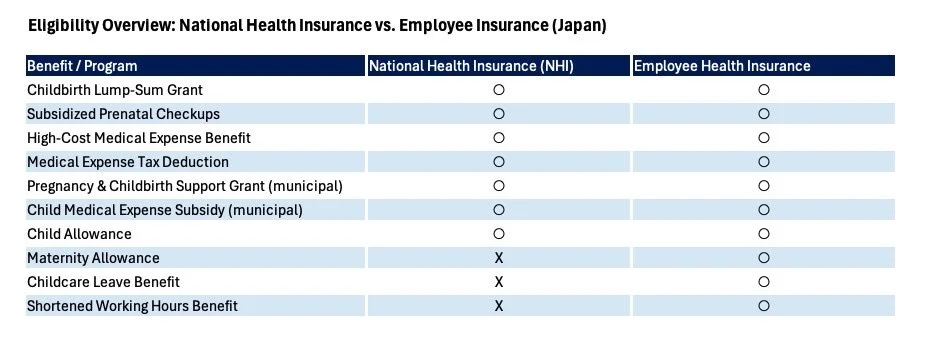
Maternity leave in Japan is legally guaranteed for mothers, but it is not financially covered by National Health Insurance (NHI). Income support, where available, depends on enrollment in employee health insurance or Employment Insurance.
Duration
Starts 6 weeks before the expected due date
14 weeks before for multiple pregnancies
Continues until 8 weeks after childbirth
Income Support (Employee Health Insurance)
Employers are not legally required to pay salary during maternity leave. (Some employers voluntarily provide partial or full pay)
Eligible employees enrolled in employee health insurance may receive a
Maternity Allowance (出産手当金). 67% of average daily salary
Post-Childbirth Paternity Leave Benefit (出生時育児休業=産後パパ育休/出生時育児休業給付金)
Timing
Fathers who take childcare leave within 8 weeks after the child’s birth
Income support (Employment Insurance)
67% of average daily salary
Childbirth Lump-Sum Grant (出産一時金/National Health Insurance/Employee Health Insurance)
One-time payment of JPY 500,000 per birth
In most cases, paid directly to the hospital, significantly reducing out-of-pocket delivery costs.
Childcare Leave (育児休業)
Childcare leave is available to both parents and is one of the most misunderstood systems for foreign employees.
Duration
Available until the child turns 1 year old
Extendable to up to age 2 if daycare placement is unavailable
Income Support (Employment Insurance)
67% of salary for the first 180 days, then 50% of salary thereafter(育児休業給付金)
Monthly payments are capped (approximately JPY 315,000/month at the upper limit, based on 2026 reference levels)
Social Insurance Premium Exemptions for employees (社会保険免除)
Health and pension premiums may be reduced or waived during certain leave periods
Recent Developments (reform 2025 onward)
Recent reforms reflect Japan’s broader effort to normalize childcare leave, particularly encouraging greater participation by fathers and improving flexibility for working parents.
Post-Childbirth Leave Support Benefit (出生後休業支援給付金/Employment Insurance)
If both parents take at least 14 days of childcare leave within 8 weeks after the child’s birth,
Combined with standard childcare leave benefits, total support can reach approximately 100% of take-home pay
The effective benefit rate is around 80% of gross salary, subject to caps and eligibility conditions
Shortened Working Hours Benefit (育児時短就業給付金/Employment Insurance)
Available to parents raising children under 2 years old
Provides approximately 10% of salary while working reduced hours
Childcare-Related Days Off(育児等休暇)
Up to 5 days per year until the child completes Grade 3 of elementary school
In principle, these days are unpaid
Family Care Leave(介護休暇)
Leave itself is unpaid, but Care Leave Benefits (介護休業給付金/Employment Insurance) may apply
Provides approximately 67% of wages
Payable for up to 93 days, which can be taken in up to three separate periods
Overtime Exemption (残業免除)
Employees raising children below elementary school age may request exemption from overtime work
Remote Work Options (在宅勤務という選択肢)
Employers are encouraged (best-effort obligation) to offer telework options to employees raising children under 3 years old
This is not automatic and typically requires discussion and negotiation with HR and direct supervisors
Looking Ahead: Possible Changes in 2026
The Ministry of Health, Labor and Welfare has announced plans to eliminate out-of-pocket childbirth costs in principle. However, implementation details and timing remain undecided, and it is not yet clear whether childbirth will become fully free in 2026.
Additional Pregnancy & Child-Rearing Support
In addition to leave-related benefits, several national and municipal programs support families financially and medically. Typically, you need apply to it.
Pregnancy & Childbirth Support Grant (出産・子育て応援交付金/municipalities)
Provided by municipalities
Typically paid in two stages: Upon pregnancy registration + After childbirth
Total value: approximately JPY 100,000, paid in cash, vouchers, or digital credits
Details vary by municipality
Subsidized Prenatal Checkups (妊婦健診助成/municipalities)
Municipalities issue prenatal exam vouchers
These cover a significant portion of routine pregnancy checkup costs
Free Early Childhood Education & Childcare (幼児教育・保育の無償化/Children and Families Agency)
All children aged 3–5 is eligible for free tuition.
Parental costs still apply for: School transportation, meals, event and activity fees
For children aged 0–2, tuition is free only for households exempt from resident tax
Medical Expense Deduction (医療費控除/National Tax Agent)
Available through annual tax return filling
If annual medical expenses exceed: JPY 100,000, or 5% of total income (for lower-income households)
Eligible expenses include: Prenatal checkups, delivery-related costs and public transportation for medical visits
👉NOTE:
Any amounts reimbursed (e.g., lump-sum grants) must be excluded from deductible totals
High-Cost Medical Expense Benefit (高額療養費制度/Health Insurance)
Refunds medical costs exceeding monthly out-of-pocket limits
Limits vary by age and income
Applies only to insurance-covered treatments
Cesarean sections are included
Using a My Number Insurance Card or Maximum Amount Eligibility Certificate can cap payments upfront at hospitals
For National Health Insurance users need to apply at local city center
Child Medical Expense Subsidy (子ども医療費助成制度/municipalities)
Covers part or all of children’s medical expenses
Age limits and coverage vary by municipality
Child Allowance (児童手当/Children and Families Agency)
As of October 2024, income limits have been abolished
Paid from application month through the end of the child’s high school age year (18)
Monthly amounts per child:
o Under 3 years: JPY 15,000
o 3 years and older: JPY 10,000
o Third child and beyond: JPY 30,000 (all ages)
⚠️ Critical Note
Benefits under employee health insurance and Employment Insurance are usually processed through payroll.
Municipal and Children and Families Agency benefits require applications at the local city or ward office
Medical Expense Deduction must be claimed through the annual tax return.
The information above reflects policies as of January 12, 2026, and may change.
👉Related blog: Japan Tax Returns for Employees in 2026: Filing Rules, Refunds, and Deadlines

2. Common Pitfalls Foreign Employees Face When Accessing Benefits
Despite generous frameworks, foreign employees often encounter unexpected issues.
Eligibility Requirements
Many benefits require 6–12 months of continuous insurance enrollment
Recent job changes, fixed-term contracts, or enrollment gaps can disqualify applicants
Visa & Status Coordination
Taking leave does not affect visa status
However, visa renewals during leave require proof of ongoing employment
Coordination with HR and immigration is essential
Dependent Visa Holders
Parents on dependent visas may not qualify for paid leave
Eligibility generally requires authorized employment and insurance enrollment
Financial Reality
Benefits do not replace 100% of income
Advance budgeting is critical, especially in high-cost urban areas
👉Practical Tips
Speak with HR early: Confirm contract type, insurance enrollment, required forms, and deadlines
For fathers: Paternity and childcare leave uptake among fathers in Japan is increasing. In FY2024, 40.5% of male employees took childcare leave, a 10.4-point increase year over year, according to the Ministry of Health, Labor and Welfare. However, most fathers who take leave do so for short periods—typically two weeks to three months.
Use official resources
Ministry of Health, Labor and Welfare (MHLW): English guides available
Childcare Leave Benefit Call Center: 0570-200-406/Weekdays 8:30–17:15 (excluding holidays)
Key Takeaway:
National Health Insurance (for the self-employed and freelancers) covers medical and childbirth-related costs, but income replacement during maternity or childcare leave is available only to individuals enrolled in Employment Insurance.
👉Related blog->
Paid and Unpaid Leave in Japan vol.1 – Make the Best Use of It
Paid and Unpaid Leave in Japan, Vol.2 – Make the Best Use of It
3. Daycare vs. Kindergarten vs. Certified Children’s Centers
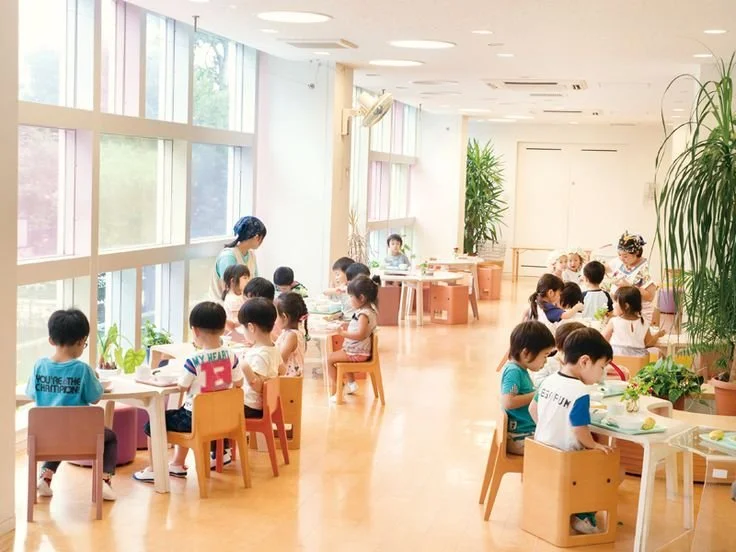
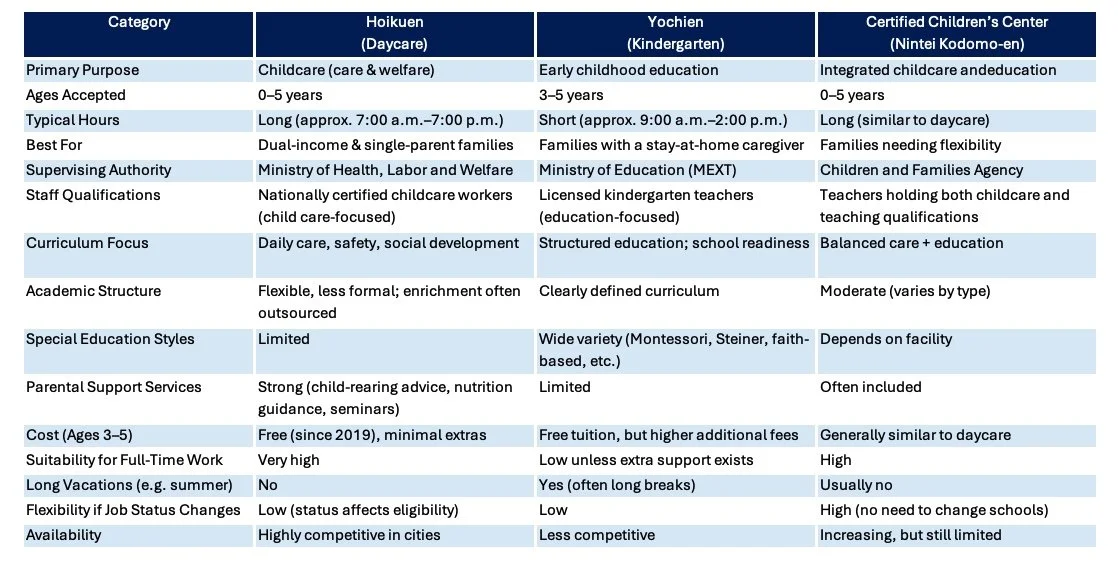
In Japan, early childhood care is provided through three separate systems: daycare (hoikuen), kindergarten (yochien), and certified children’s centers (nintei kodomo-en).
Although they may appear similar, each is designed around different assumptions about parental employment, daily schedules, and the balance between care and education.
What to Look for When Choosing a Facility
Outdoor play space: On-site playgrounds are ideal
Security measures
Communication systems: Apps or digital platforms for daily updates and emergencies
Staff engagement
Facility condition: Clean, bright, and well-maintained spaces matter
Considerations for Foreign Families
Many schools today are accustomed to children with international backgrounds
A good facility will:
Respect differences in language, culture, religion, and daily habits
Listen carefully to parental explanations and preferences
Language barriers are manageable:
Translation apps
Help from friends or community volunteers
During orientation, confirm:
Required daily items
Daily schedule
Principal and homeroom teacher names
Contact information
Procedures for lateness or absence
Meal structure
Facility rules and usage
Major events (field trips, parent meetings, weekend sports days, holidays)
👉Related blog->
Raising Kids in Japan: Costs, Subsidies, School Choices & Real Challenges for Foreign Parents
Japanese Education System 101: A Practical Guide for Families and Students

4.Securing Daycare (Hoikuen): The Biggest Challenge
For many working parents in Japan, securing daycare is the single most stressful hurdle. The so-called “daycare waitlist hell” remains a reality, especially in large cities.
Licensed daycare centers—(ninka hoikuen /認可保育園)—are the most sought after. They offer long operating hours (often 7:00 a.m. to 7:00 p.m.), government-regulated fees, and consistent quality, making them ideal for dual-income households. However, demand far exceeds supply.
The Point-Based Allocation System
Most municipalities allocate daycare slots using a point-based “need for childcare” system. Families are ranked based on objective criteria, and placements are offered to those with the highest scores.
Points are typically awarded based on factors such as:
Both parents working full-time (usually the highest score)
Working conditions, including:
Number of working hours
Contract type (full-time, part-time, fixed-term, etc.)
Single-parent households
Lack of nearby family support (often a plus for expatriate families)
Care responsibilities for elderly family members
Disability or medical needs of a parent or child
Siblings already enrolled in the same daycare or nursery
⚠️ Note:
Point criteria, weighting, and documentation requirements vary by municipality, and even small differences can significantly affect outcomes. Even when both parents work full-time, admission is not guaranteed—placement is competitive and based on relative need, not application order.
Visa and Residency Status: How They Affect Scoring
Immigration status can directly influence daycare eligibility and point allocation.
Parents on a dependent (spouse) visa are often scored as “not working”, even if they intend to job-hunt after childbirth. This can substantially lower household points.
Parents on a working visa with confirmed employment generally receive full points.
In highly competitive areas such as central Tokyo, families may need 200–240 points to secure a spot.
This gap between intention and documented employment is a major challenge for foreign families.
Documentation and Timelines
Daycare applications are paperwork-intensive and time-sensitive.
Required documents typically include:
Certificate of Employment (就労証明書 / 勤務証明書)
Tax records
Residence cards
Main application window: October–November for entry the following April (start of Japan’s fiscal and school year)
Results announced: February–March
Mid-year admission: Rare, unless families relocate or a vacancy unexpectedly opens
Planning must begin months in advance, often before childbirth.
Regional Differences and Alternative Options
Urban areas (Tokyo, Osaka): Long waitlists and intense competition
Suburban or rural areas: Higher acceptance rates but longer commuting times
If a licensed daycare is unavailable, some families turn to unlicensed daycare centers (認可外保育園). These offer greater flexibility but come with important trade-offs:
Higher fees
Less standardized quality
Greater variation in safety and staffing
Local reputation and word-of-mouth matter significantly when considering these options.
Practical Tips from Expat Parents
Apply broadly: Multiple daycare centers to improve your chances
Prepare documents early: Start gathering paperwork months ahead
Never falsify information: This carries serious legal and practical risks
Think about location: Proximity to home or work greatly affects daily stress
Choosing a Good Nursery: What to Look For
When visiting or evaluating a daycare, experienced parents suggest checking:
Outdoor space or playground access
(Indoor-only facilities can feel limiting for active children)Use of nearby parks: Distance to parks, park size and number of staff accompanying children
Strong security measures
Clear communication systems
(Apps or platforms that make it easy to contact staff)Engaged, energetic teachers
Clean, bright, and well-maintained facilities
Real Story 1: Timing Mismatches and Forced Extensions
Daycare enrollment follows Japan’s April fiscal-year cycle, with applications often finalized by October of the previous year. This frequently does not align with a child turning one or the planned end of parental leave.
If daycare cannot be secured:
Childcare leave may be extended (up to age 2)
Since April 2025, extensions generally require official proof of daycare rejection and a copy of the application.
Because this situation is common, consult HR early, as employers may allow extensions while documentation is pending.
Parents may be forced to remain on leave longer than planned
Mid-year daycare entry offers very limited flexibility, a source of ongoing frustration for many families.

5.Returning to Work: Logistics and Emergencies
As childcare leave ends, parents often feel mixed emotions. Some are ready to return to work; others find separation from their young children difficult. Either way, daily life as a working parent changes immediately and significantly.
The early years can be exhausting and intense. Many parents later realize they remember little of that period—not because it lacked meaning, but because it passed so quickly. Only in hindsight does its value become clear.
The Sick Child Dilemma
Kids get sick frequently in group settings. Regular day care/kindergarten can't accept ill children.
Sick-child care (病児保育): Limited spots, requires pre-registration; availability varies by ward.
Home-visit services or babysitters: Useful backups, but expensive and rare.
Paid time off and childcare-related days off are there to support working parents—use them when needed.
Emergencies
Immediate pickup expected for illness, disasters, or delays.
Extended hours or occasional sitters help, but plan networks early.
Many expat families also rely on housekeeping services, on-demand apps, or employer-provided benefits. Building a support network early can make a critical difference.

6.Q&A
Q1. Can we apply for daycare before our baby is born?
A1. In many municipalities, yes.
Pre-birth daycare applications are often necessary for parents expecting a baby in autumn or winter who hope to enroll their child in the 0-year-old class starting the following April.
Because rules and timing vary by municipality, it is strongly recommended to visit your local city or ward office early and consult directly. Speaking with them can help clarify eligibility, required documents, and realistic chances of placement.
Q2. Does being a foreign family reduce our chances?
A2. Not necessarily. In some cases, foreign families receive additional points due to the lack of nearby family support, which municipalities recognize as increased childcare need.
Q3. If one parent is on a dependent visa, does that affect daycare eligibility?
A3. Yes. Parents on dependent visas are often scored as not working, even if they plan to seek employment. This can significantly lower household points.
Q4. Is kindergarten an option for dual-income families?
A4. Usually not, unless one parent (or another caregiver) can handle early afternoon pickup. Kindergarten hours are short and not designed for full-time working parents.
Q5. Are certified children’s centers easier to access than daycare?
A5. Sometimes. Certified children’s centers offer more flexibility and continuity, especially if parental employment status may change. However, they are also popular and can be competitive.
Q6. What if we don’t get a spot at daycare by April?
A6. Options include:
Extending childcare leave (if eligible)
Using unlicensed daycare temporarily
Reapplying mid-year (rare but possible)
Adjusting work arrangements
Many families face this gap period.
Q7. Can we “hold” a daycare spot in advance?
A7. No. Japan’s system does not allow advance reservations. Timing mismatches between childcare leave and daycare availability are a common frustration.
7.Wrap up: Raising Children Across Borders
When I was a working mother, there was a time when we had to hire a home helper. My salary came in and went right back out to cover those costs. It wasn’t easy, and it wasn’t forever—but at the time, it felt intense.
There were days when neither of us could take time off, and we rushed home as fast as we could, doing our best to keep everything moving. Looking back now, those days were exhausting—but somehow, I also miss them. That is why I genuinely support working parents. The balance is never perfect, but the effort matters—and it passes faster than you think.
I hope the blog helped you understand maternity benefits, daycare realities, or any part of raising young children in Japan as a foreign family.
Please share your own experiences in the comments below—What surprised you most about Japan's childcare system?
And if you found this post helpful, please consider sharing it with friends, colleagues, or expat groups preparing for life in Japan.
Referrals:
Overview of Childcare Leave and Related Benefits (MHLW)
Maternity, Childcare Leave, and Employment Insurance Benefits (MHLW)
Paternity leave (MHLW)
Childcare Leave Benefits Guide (MHLW/PDF)
Children and Families Agency Child Allowance System Free Early Childhood Education & Childcare
See also
Raising Rich Kids in Japan: Teaching Financial Literacy from Age 6 (2025 Expat Parent Edition)
